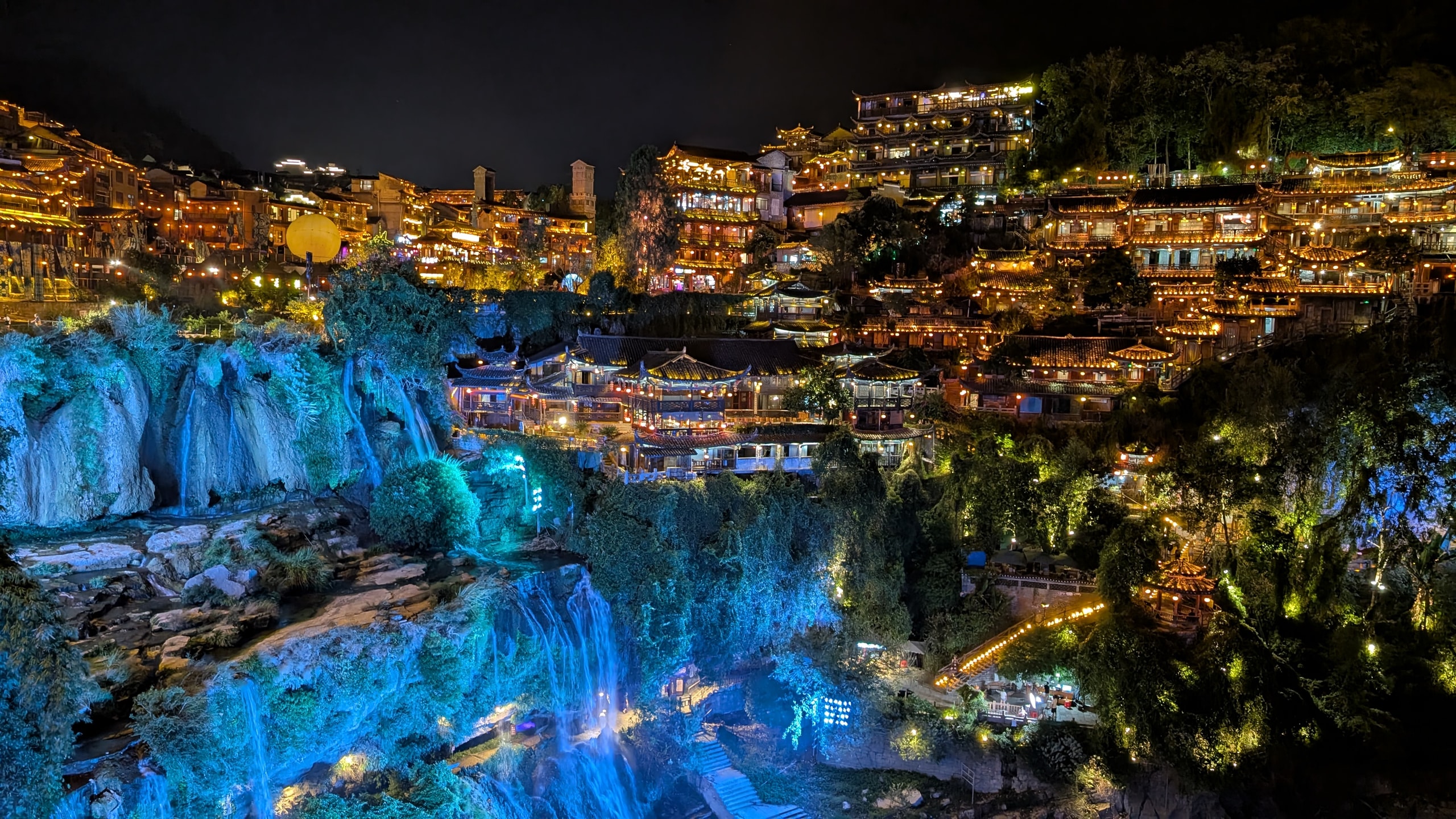
After dark the waterfall turns electric blue. The stilt houses above it go gold. Mist climbs out of the pool, the stone steps get slick, and the whole cliff face lights up like a stage set. That is Furong Ancient Town - and it is why a day trip from Zhangjiajie usually feels like half a visit.
Furong (芙蓉镇) sits on the Youshui River in Yongshun County, in the Tujia and Miao hill country of western Hunan known as Xiangxi. The nickname everyone uses is accurate enough: a town hanging on a waterfall. A roughly 60-metre cascade drops through the middle of the old settlement, with wooden diaojiaolou (吊脚楼) clinging to the rock on either side. The place is genuinely old - a river port with more than two thousand years of traffic - but the modern name comes from film. It was Wangcun (王村) until 2007, when it was renamed after Xie Jin's 1986 movie Hibiscus Town (芙蓉镇), shot here. For a visitor the useful shape is simpler: compact, ticketed, best after dusk, and twenty-three minutes by high-speed train from Zhangjiajie West.
If you are building a China itinerary around pillars and cable cars, this is the lantern night that sits between them - not a capital circuit, and not a free stroll through an open old town.
The three-day ticket is the whole plan
Furong is a gated scenic area. You cannot wander in like Chongqing's Ciqikou. Adult entry is about ¥108 ($15) at the gate; online platforms often list ¥60-90 ($8-13). The ticket is valid for three consecutive days with multiple entries after the first scan. That detail decides the trip.
Come in the afternoon, walk the stone street while it is still daylight, eat rice tofu, watch the lights come on, sleep nearby, and walk the quiet streets again before the next trainload arrives. A same-day dash from Zhangjiajie gets you the waterfall and a crowd. An overnight gets you the reason people remember the place.
What the ticket usually covers: the waterfall and water-curtain walkway, the cliff-top Tusi Palace (土王行宫), Baishou Hall (摆手堂) with the evening folk show, the Xizhou Bronze Pillar, the covered Tuwang Bridge, and the old town streets down to the Wangcun dock. Buy at the visitor centre with your passport, or book ahead on an English-language OTA if you want to skip the queue in peak season. Country-level payment and booking habits live in things to know before visiting China.
After dark is the point
Lights typically come on around 18:30 (a little earlier in summer, later in winter). The half hour of blue hour that follows - warm lantern light on wood while the sky is still deep - is the frame everyone comes for. Then full night takes over: gold eaves, red cloth on the bridges, and that odd blue wash on the falling water.
Stand at the waterfall viewing platform (观瀑台) or on Tuwang Bridge and let the scale settle. The town is not huge. From the right ledge it looks stacked and lit on purpose - which is fine, as long as you came for a show with a real cliff under it. Closer in, the mist hits your face and the blue light makes the pool look colder than the air.
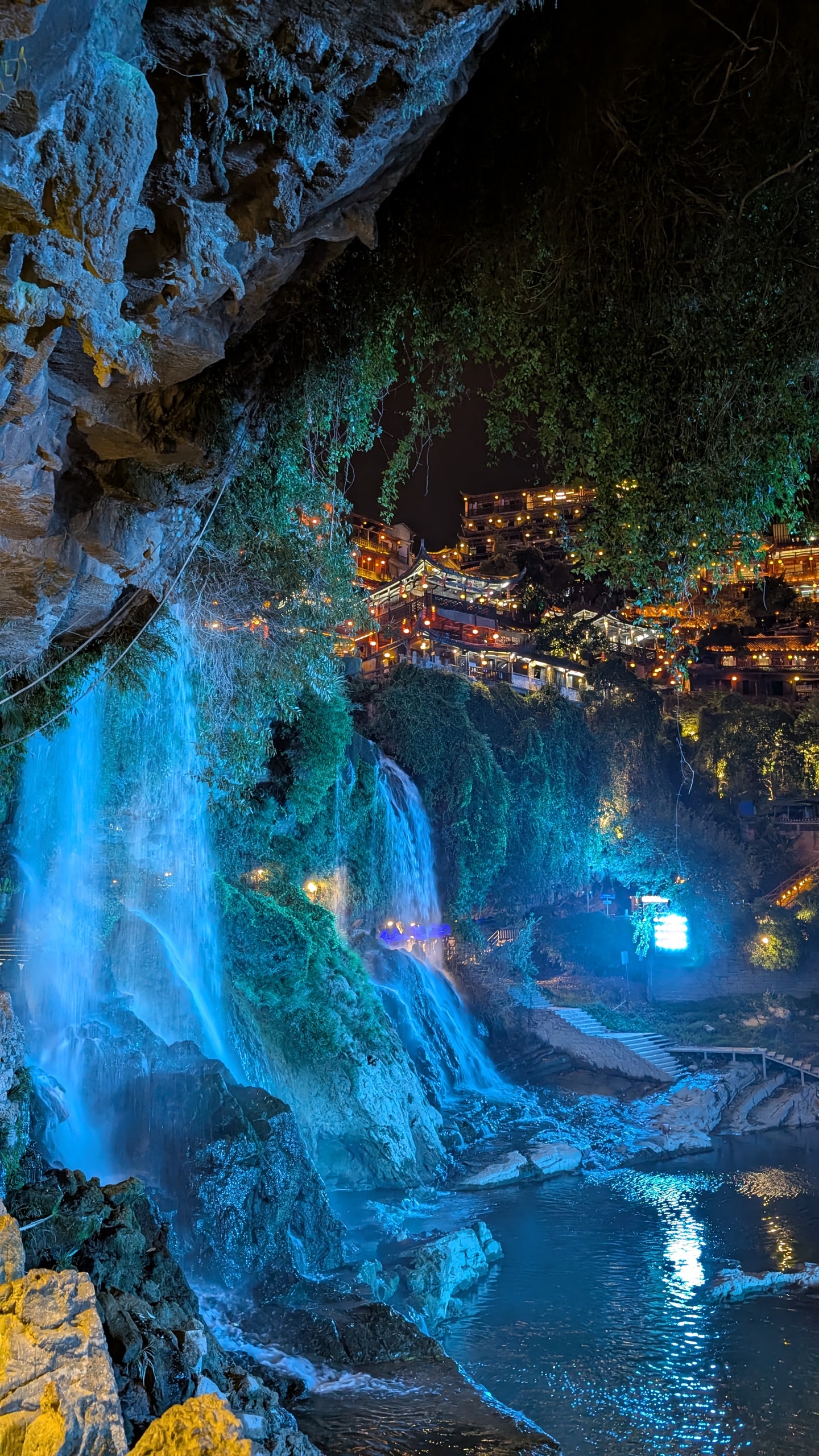
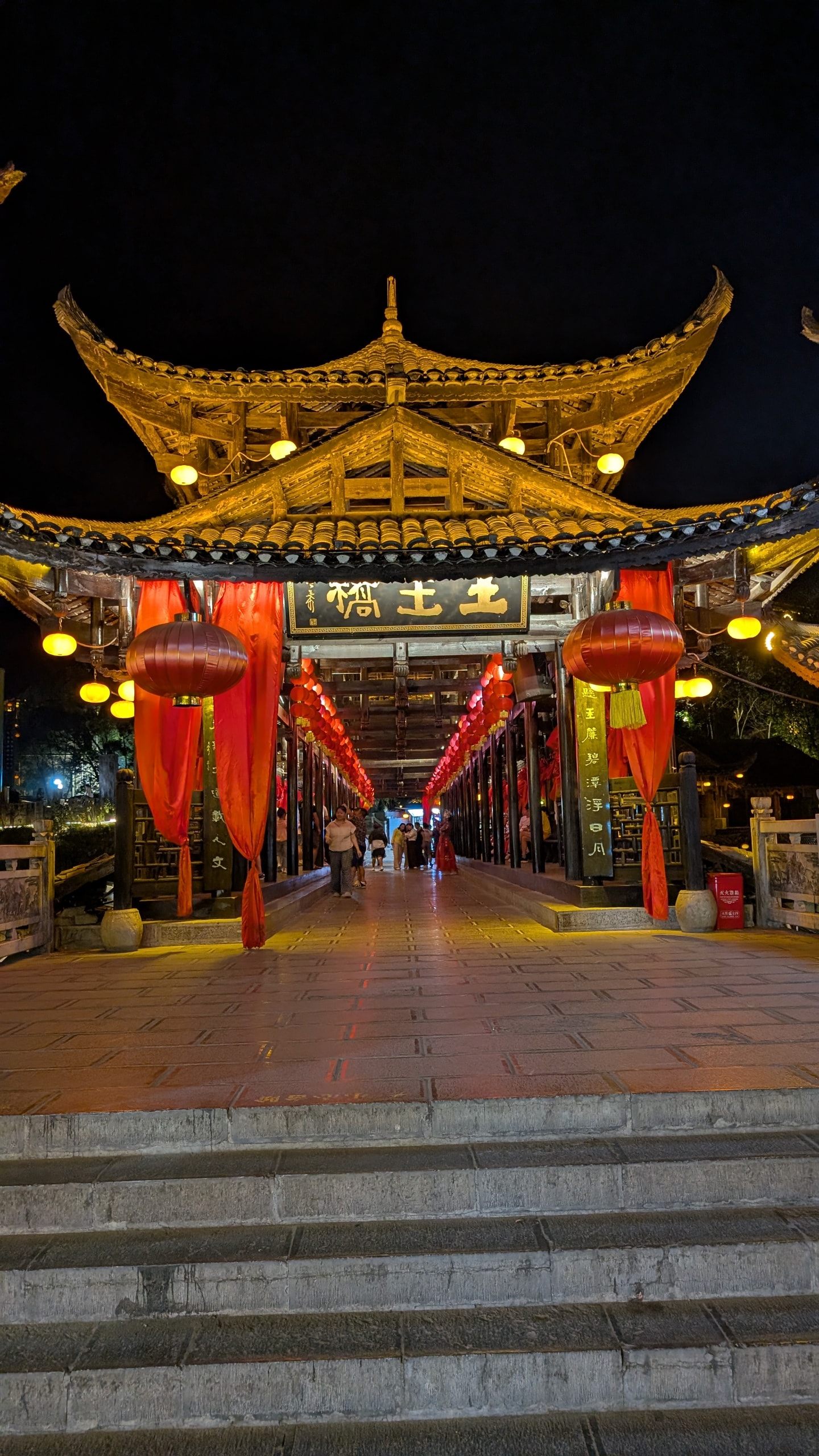
The covered bridge complex is where the red and gold get loudest. Stone arches, multi-tier wooden roofs, lanterns in rows, fabric hanging like a festival that never quite packed up. People walk through in a slow queue. You do not need a costume rental to enjoy it - though you will see plenty of those.
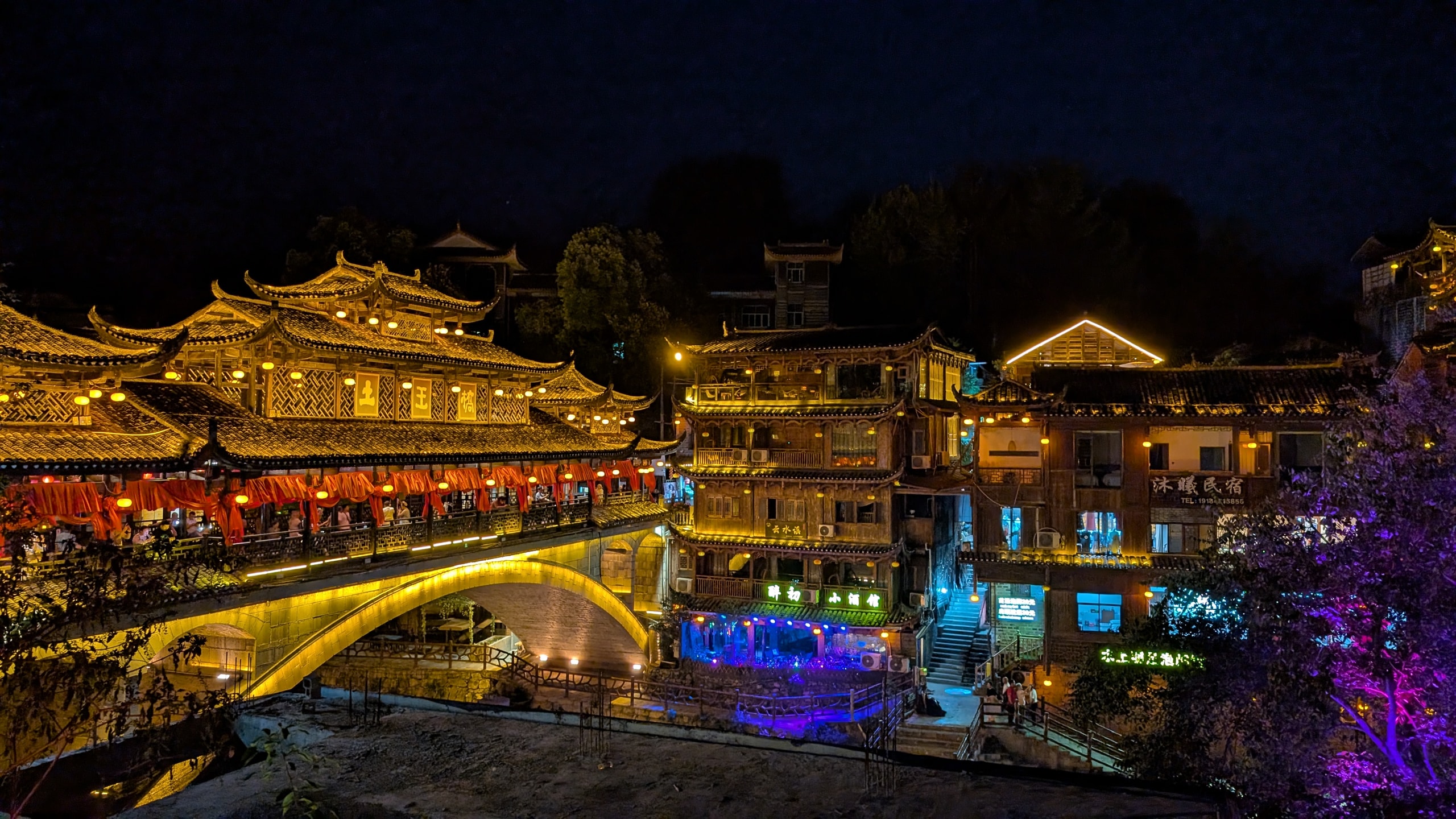
Down at water level the same bridge reads differently: warm light under the arch, a tall wooden building stacked beside it, and the river holding a messy reflection. Stepping stones cross the quieter water. Signs warn you not to climb or swim - fair, given how many phones point at the edge.
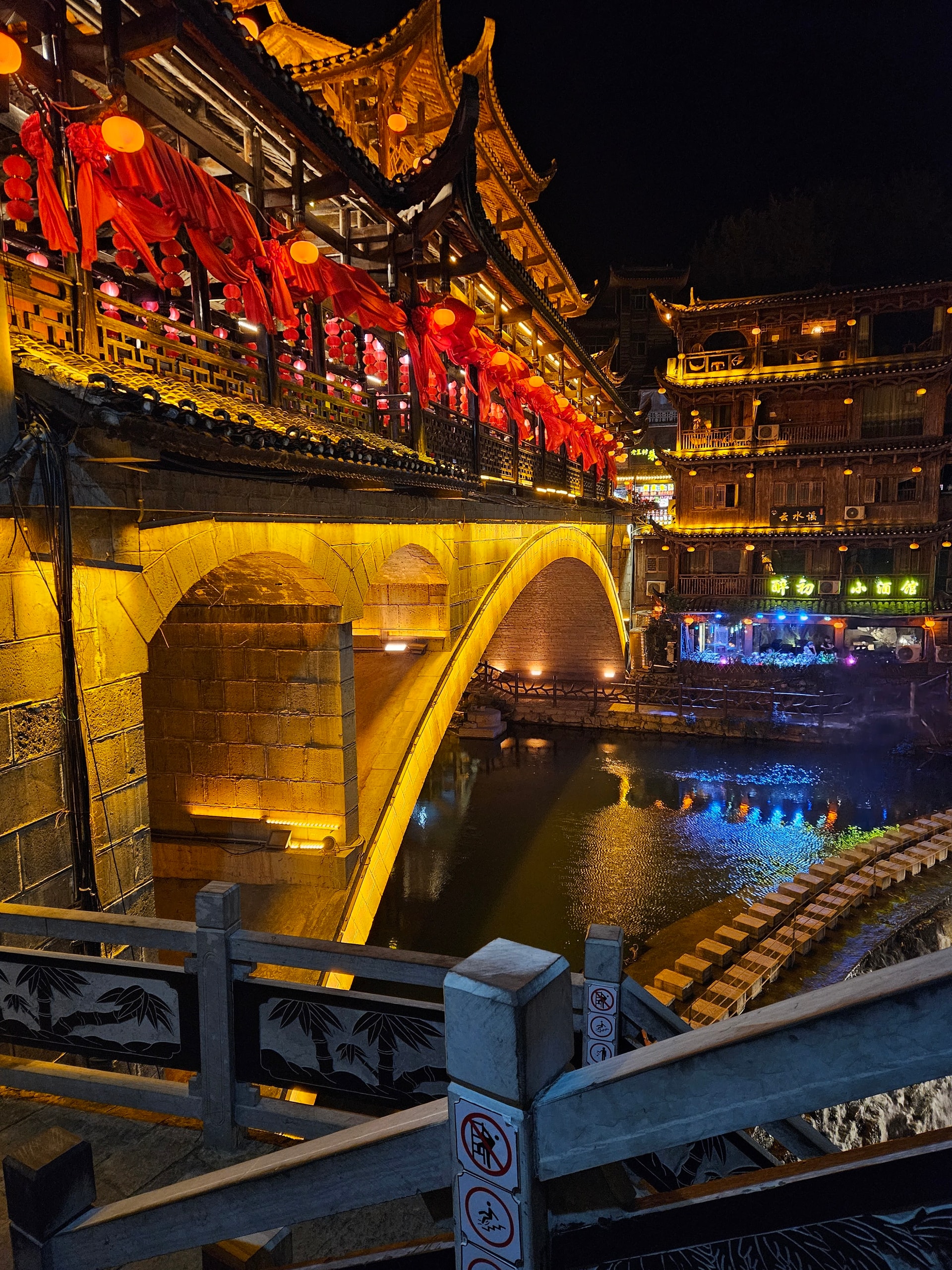
Tuwang Bridge (土王桥) itself is the close-up: stone steps up, a black plaque with gold characters, red lanterns, and a tunnel of smaller lanterns running into the covered walk. Built in the wind-and-rain bridge tradition - heavy timber, no casual nails holding the show together for the camera. Walk it once for the photo, once more without the phone if the crowd thins.
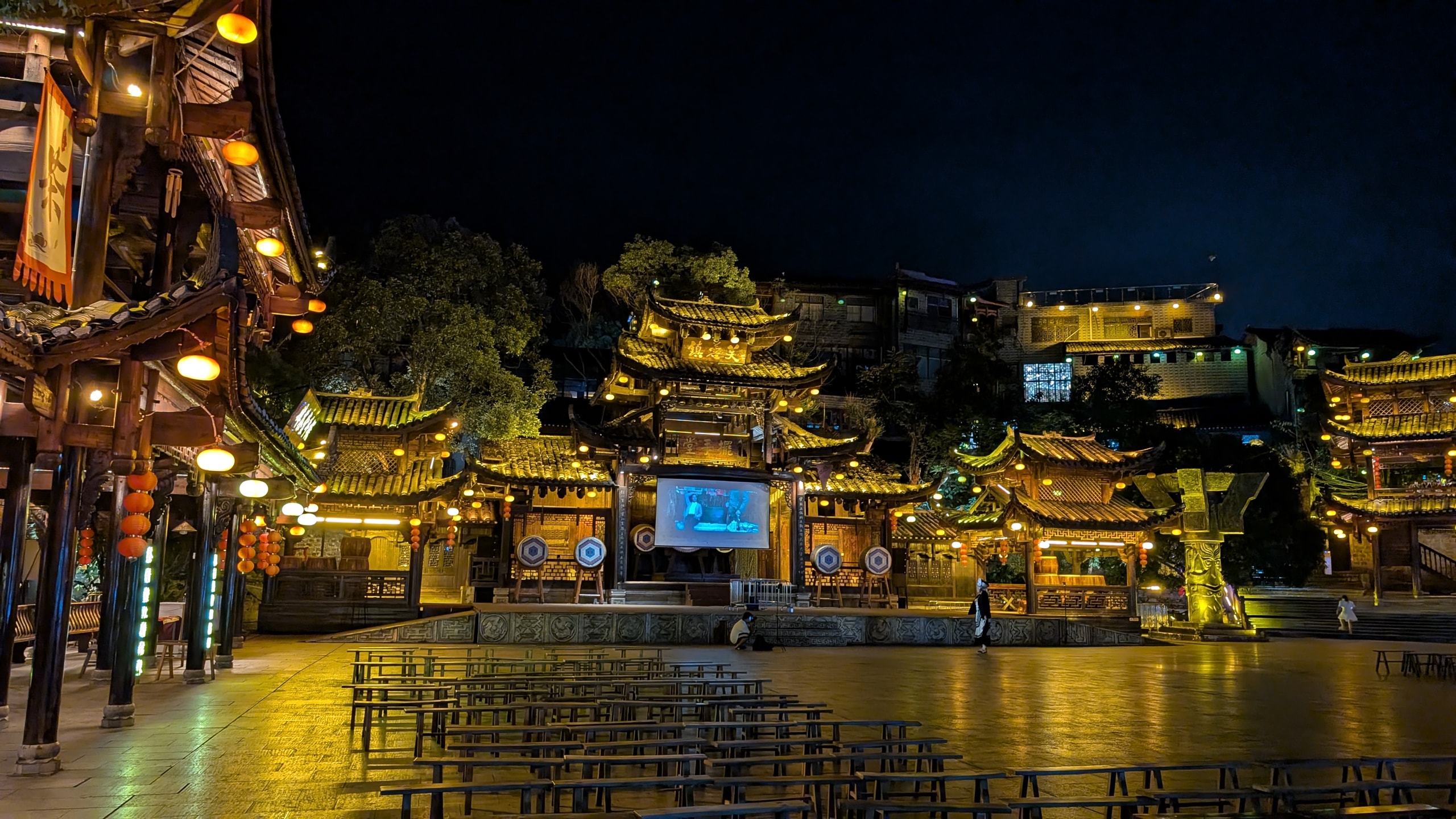
Further up, the main square fills with benches and a stage. Large drums, a screen, folk dance when the schedule says so - usually around 21:00, included with the ticket. It is tourist theatre. It is also one of the few times the town stops moving and faces the same direction. Stay for a set if you like drums and colour; skip it if you would rather keep walking the quieter lanes.
The daytime walk: gate to dock
Furong is mostly one downhill line. Enter near the visitor centre at the east end, climb briefly to the Tusi Palace for the gorge view, then drop through the town: bronze pillar, Tuwang Bridge, the five-li stone-slab street (五里石板街 - roughly 1.2 km of worn flagstones), the waterfall, the stepping stones, and out toward the Wangcun dock on the Youshui. You do not need a complicated loop. Half a day at a sightseeing pace covers the sights; the overnight is for the light change, not for more temples.
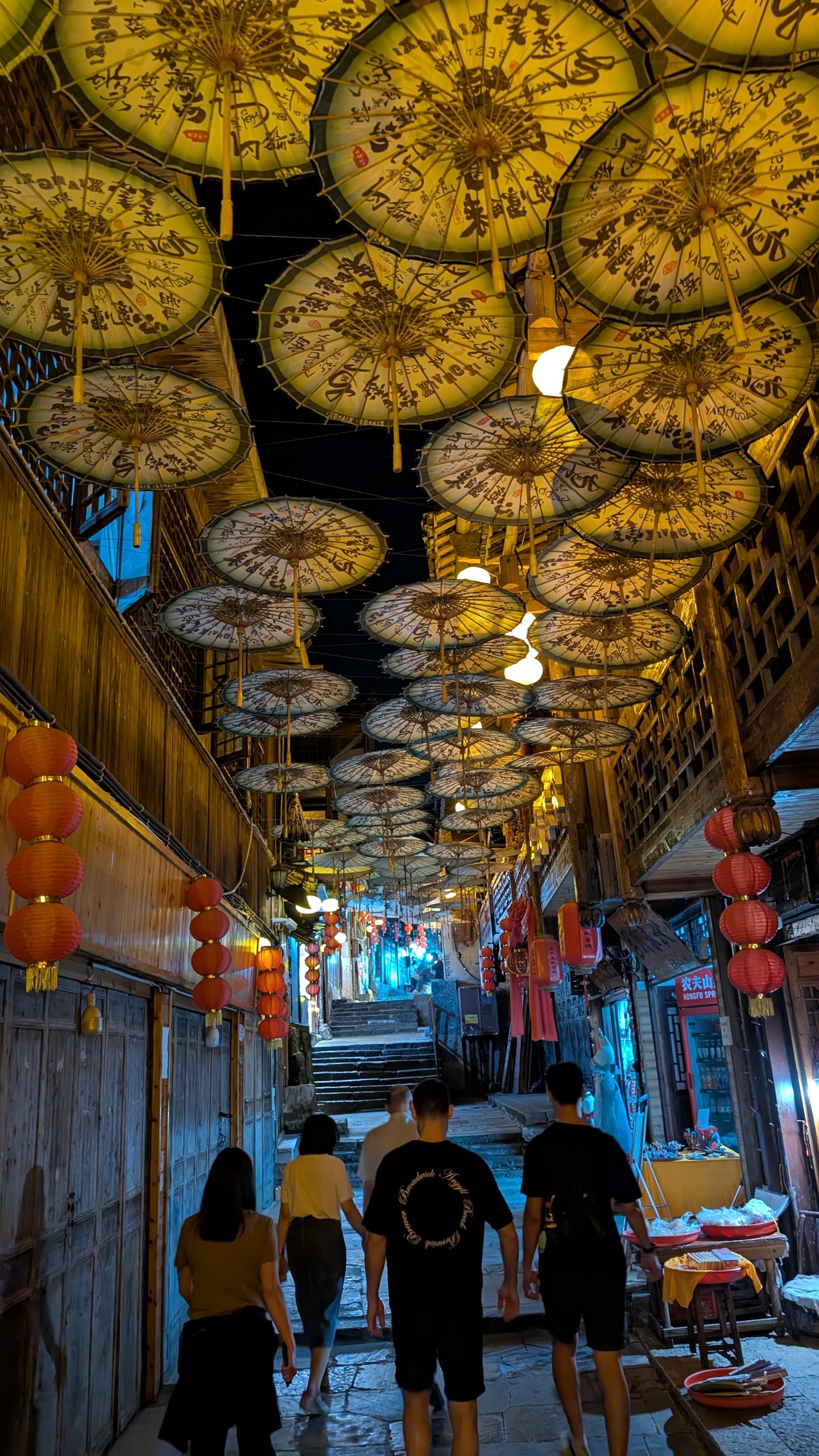
The stone street is where the place feels lived-in between photo stops - shops under wooden eaves, snack stalls, laundry on a balcony, fruit crates at the bottom of a stair. Side alleys climb under oil-paper umbrellas hung as a glowing ceiling. Some of it is decoration for cameras. Some of it is still a town selling water and noodles to people with sore knees.
The waterfall walk (水帘洞栈道) is the wet-season prize: a walkway cut into the cliff behind the cascade. Loud, cool, slick. Bring grippy shoes and something waterproof for the phone. In a dry winter the same falls can shrink to a thin curtain, and that is where most "not worth ¥108" reviews come from. Season decides more than the marketing photos do.
Tusi Palace on the cliff is a Tujia stilt-house complex with the wide view - and a filming footprint from the 1986 movie. Worth the short climb early, before legs complain. The Xizhou Bronze Pillar (溪州铜柱), cast in 940 AD to record a treaty between the Chu court and the local chieftain, is the quiet history stop for anyone who cares about more than lanterns.
Optional boats leave from the dock on the river when the schedule allows - a short ride, not a day on the water. Fine if you have time; skip if you came mainly for the night view.
Rice tofu and what to skip at dinner
The snack the town sells hardest is rice tofu (米豆腐) - soft rice jelly in a sour-spicy sauce, made famous by the film's stall-keeper character. A bowl runs about ¥5-10 ($1-1.50). Look for the well-known shop at No. 113 on the stone street; copycats borrow the celebrity name, so the house number helps. Beyond that, expect Xiangxi mountain food: smoke-cured pork, wild mushrooms when in season, pounded glutinous-rice cakes (蒿草粑粑, a few yuan), sweet rice wine, blood-rice duck if you are curious.
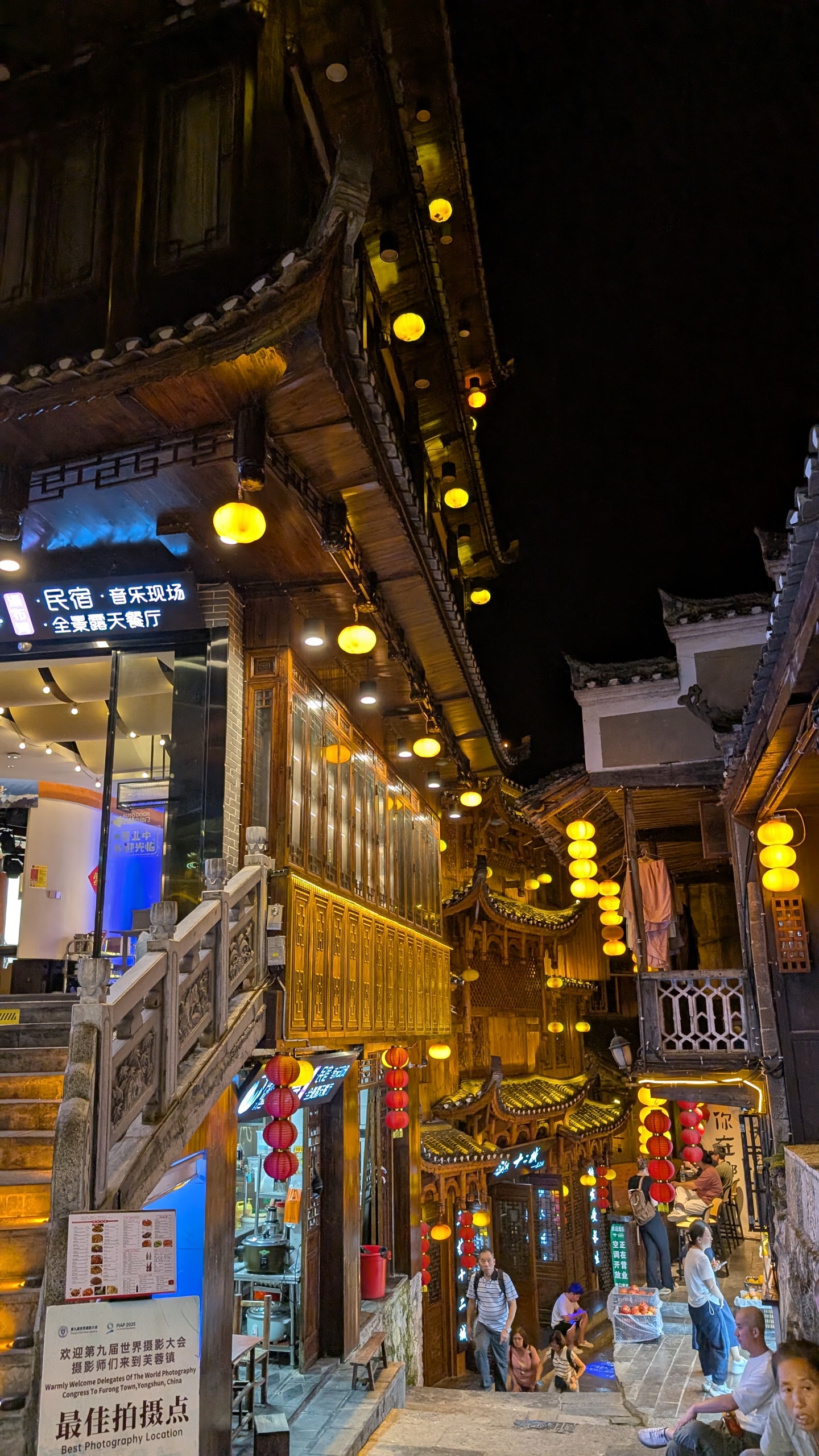
Eat where people are already queuing a little off the cliff edge. The restaurants with the loudest door staff and the best "waterfall view" signs tend to charge for the chair. A simple dinner in town or just outside the gate runs roughly ¥40-80 ($6-11) if you stay off the postcard tables.
Getting there, when to go, what it costs
From Zhangjiajie West (张家界西), the high-speed train to Furong Town station (芙蓉镇站) takes about 23 minutes on the Zhangjiajie-Jishou-Huaihua line. Fare is often around ¥35 ($5). The station sits a few kilometres from the old town - scenic shuttle for a few yuan, or a short taxi (¥10-20 / $1.50-3). From Changsha South, direct or easy connecting HSR runs roughly 2.5-4 hours depending on the train. Buses from Zhangjiajie or Fenghuang still exist if times do not match; the train is simpler for most foreign visitors. English-language train tickets with passport details are easy on Trip.com - same ID rules as elsewhere in China.
How long: one night is the sweet spot. Arrive mid-afternoon, leave the next morning after a quiet walk. Two full days only if you are slow, photographing everything, or pairing with a soft Xiangxi bus day. Do not treat Furong as a base for Wulingyuan - sleep near the park gates for the pillars, then use Furong as the lantern stop on the way in or out.
Season:
- June-September - fullest waterfall, heat, summer crowds. Best if the falls are the reason you came.
- April-May and late September-November - greener, milder, moderate flow. Strong all-round pick; avoid the Oct 1-7 Golden Week crush.
- December-February - quiet and cold; lights still work, water often does not. Come for the town, not the cascade.
Money: mid-range overnight - ticket, simple guesthouse, meals, train from Zhangjiajie - often lands around ¥400-700 ($55-100) depending on whether you sleep inside the scenic area or cheaper outside the gate. Waterfall-view rooms inside cost more and earn it if the window is real. Outside-the-gate inns are the budget move; the three-day ticket lets you come and go.
Pair Furong with Zhangjiajie's pillars and Tianmen if knees and weather cooperate; link it toward Fenghuang on the same rail corridor if you want a second old town with a different river mood. More of this cluster lives in the destinations archive.
Who should come - and who should keep moving
Come if you want a compact Xiangxi night: real cliff, real water (in season), stilt houses, and a ticket that does not punish an overnight. Stay away if you expect an ungated living village, English menus on every corner, or a waterfall that ignores the calendar. Furong is a managed scenic town that puts on a show. The show works when the water is up and you are still there after 18:30.
Skip the same-day sprint that treats the lights as a checkbox between two park tickets. Protect the evening, the early morning, and one honest bowl of rice tofu on the stone street. The blue waterfall is the reason you stayed.