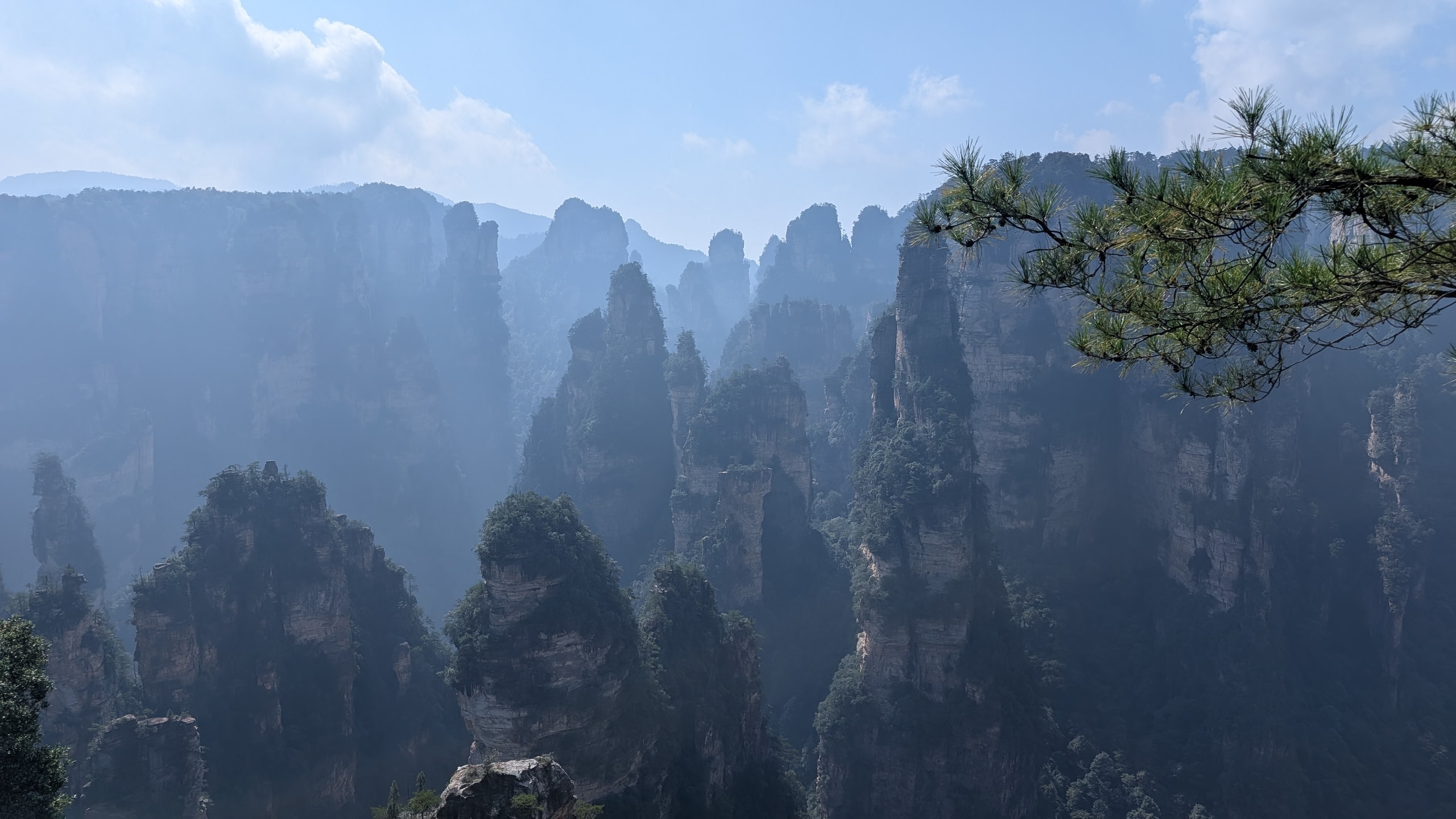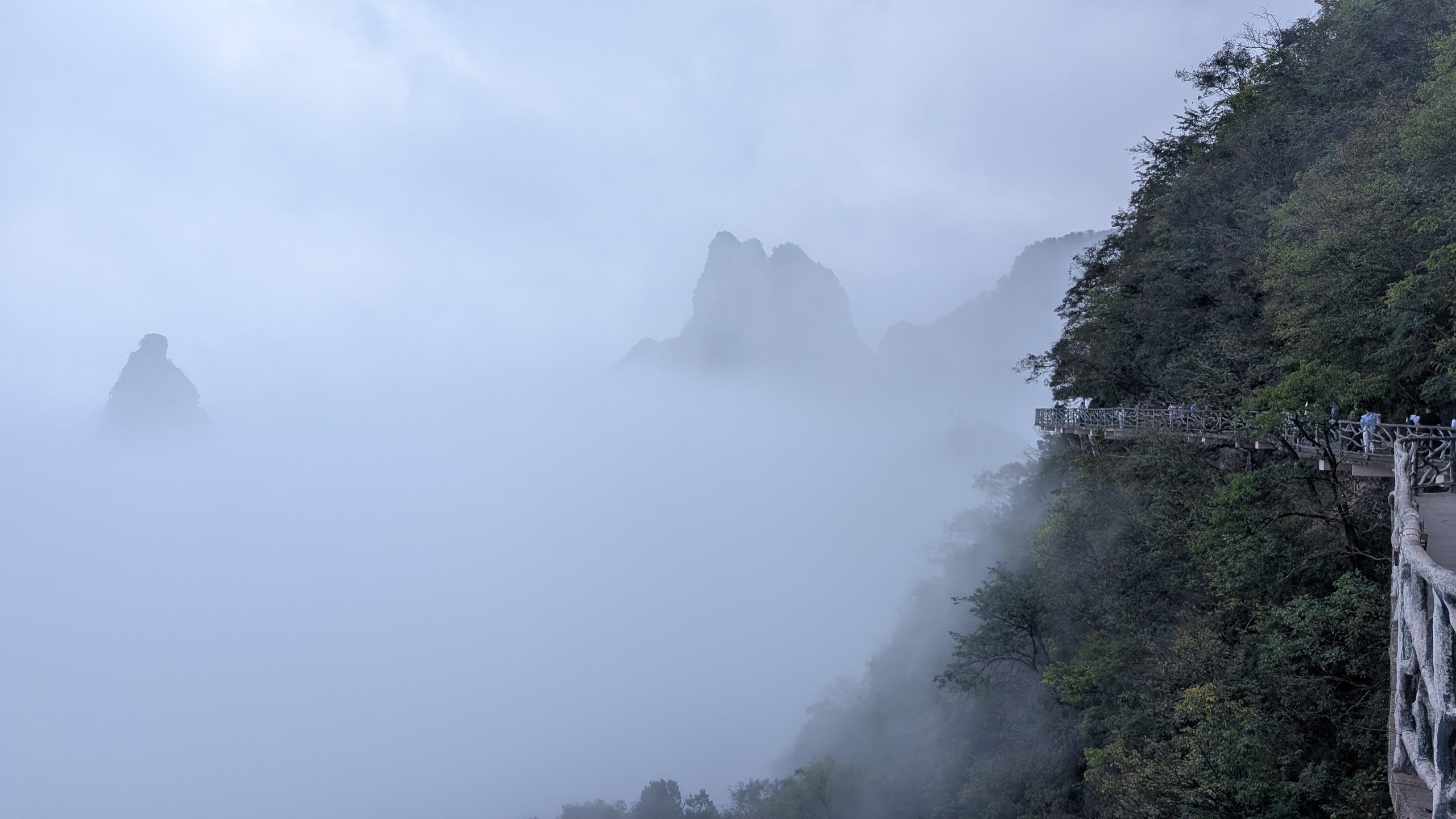
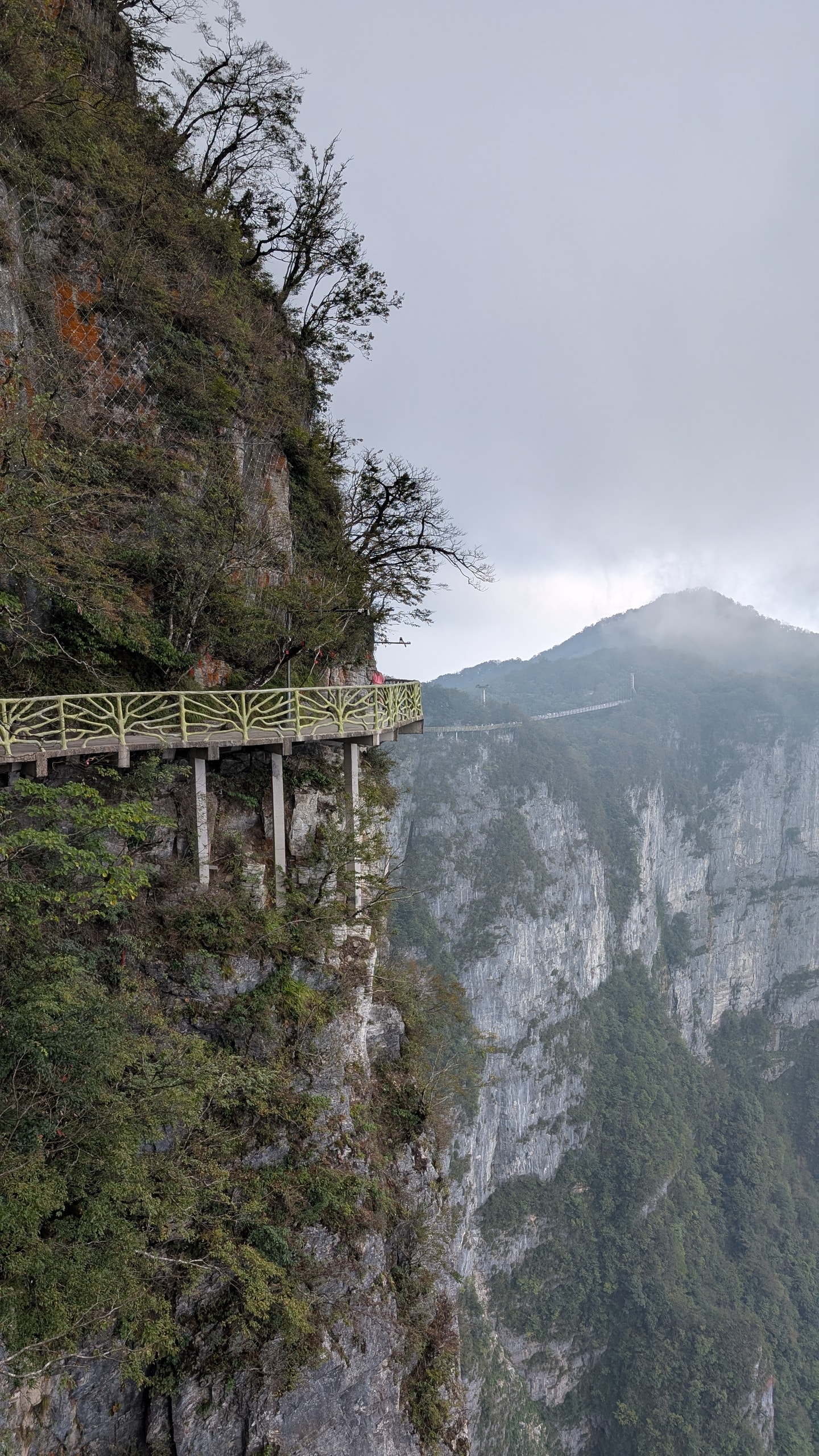
Most photos of Tianmen Mountain show a stone arch with clean blue sky behind it. On an ordinary day you stand in the same spot and see grey. The fog here works in minutes: a white wall, then a cliff face, then a ridge with a walkway stuck to it, then nothing again.
That is not a reason to skip the place. Tianmen is a limestone wall above a provincial city with paths bolted along the side of it, and the walking holds up even when the weather takes half the view away.
The mountain above the city, not the Avatar park
Clear this up before you book anything. Tianmen Mountain (天门山) rises directly over Zhangjiajie city in northwest Hunan, close enough that the cable car station sits next to the railway station. It is not the park with the sandstone pillars people know from Avatar. Those are 40 km northwest in Wulingyuan, where the pillars and the four-day ticket are, behind a different gate on a different day. Mixing the two up is a common and expensive mistake.
The peak tops out around 1,518 m. The arch everyone comes for, Tianmen Cave (天门洞), is a hole punched clean through the ridge at roughly 1,300 m: about 131 m tall and 57 m wide, with daylight on both sides. Local records put the rockfall that opened it in 263 AD, which is where the name Heaven's Gate comes from.
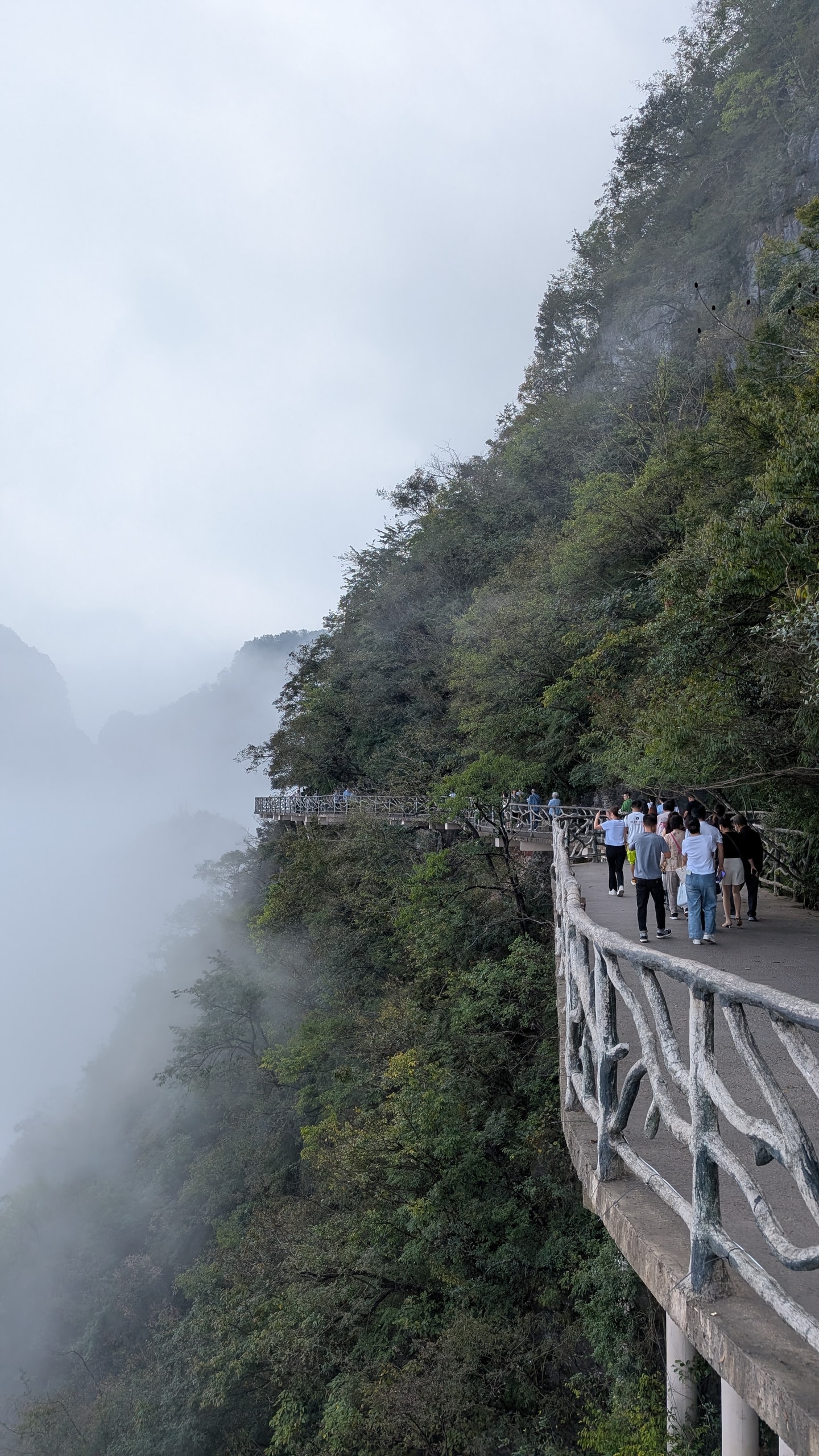
Everything here is engineered: railings cast in concrete to look like tree branches, tunnels, escalators running inside the rock, a road that took most of a decade to build. If you want wilderness, this is the wrong hill. If you want a day of steep views with a coffee stand at the bottom of the stairs, it delivers.
Getting up: the cable car is half shut until the work is done
The ropeway from town is 7,455 m long, one of the longest passenger cableways anywhere, and the full ride used to take close to half an hour over the rooftops and up the cliff.
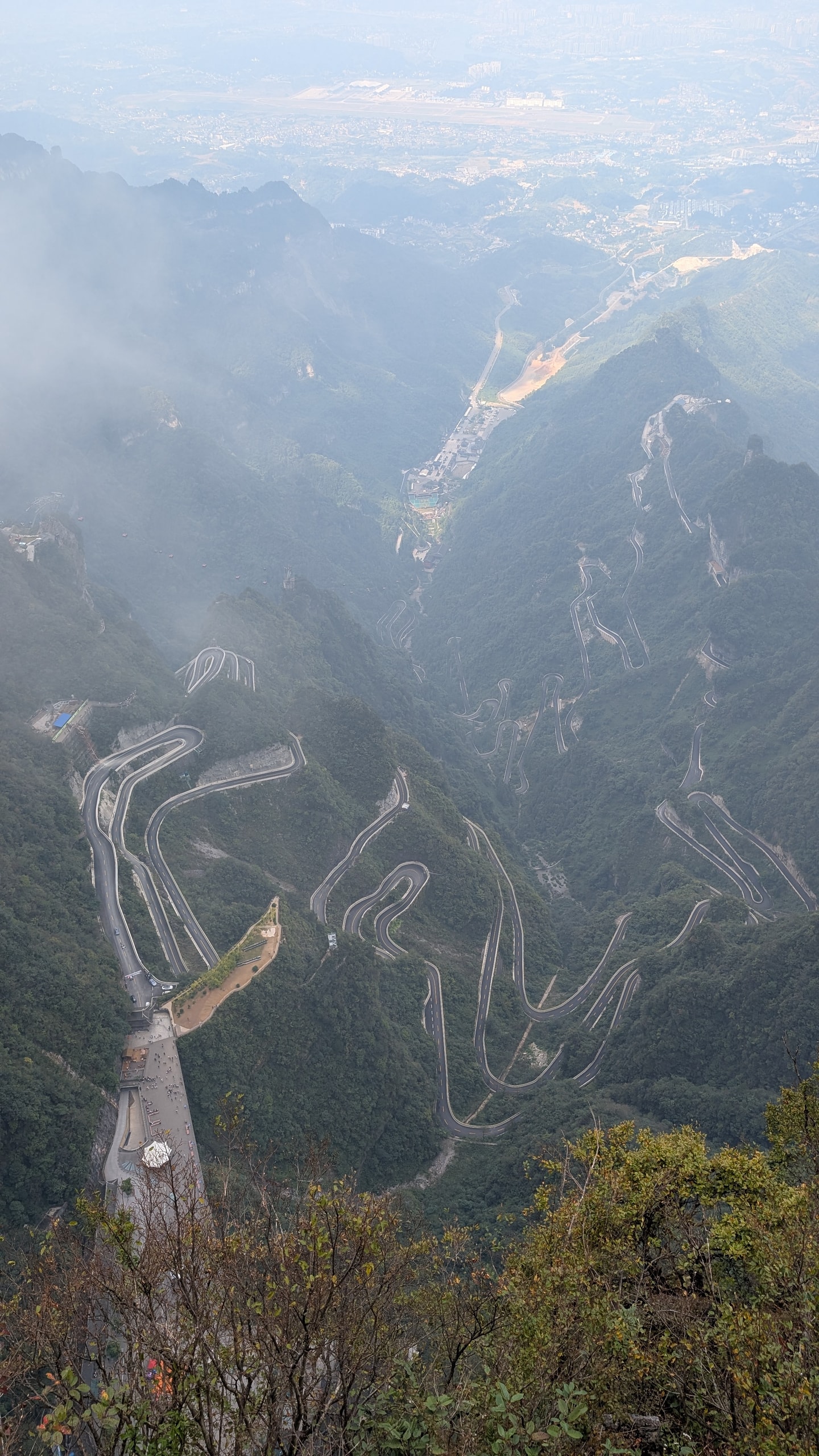
Right now it does not do that. The upper section, from the middle station to the summit, closed on 6 November 2025 for a rebuild expected to run into 2027. The lower half still runs, roughly ten minutes to the middle station, and from there shuttle buses take you the rest of the way up Tongtian Avenue: 11 km of road with 99 hairpin bends stacked into a single valley.
Treat that as a swap rather than a downgrade: the bends are one of the better parts of the mountain.
The main ticket runs ¥275-288 ($39-41) depending on the route and the season, and it covers the ropeway and the shuttle buses. Two extras get charged separately: the escalators inside the mountain at ¥32 ($4.50) one way, and shoe covers for the glass sections at ¥5 ($0.70) each. Entry runs on time slots. Gates open at 7:00 and last admission is around 16:00, though the timetable moves with the season. Book a day or two ahead in high season with your passport number, and expect the ticketing habits described in things to know before visiting China.
You will see routes called A, B and C at the ticket window. They are the same pieces in a different order: ropeway, bus up the bends, escalator through the inside of the mountain, and the stairs. The only choice that changes your day is whether you climb the 999 steps or ride the escalators past them.
The 999 steps are the part worth doing
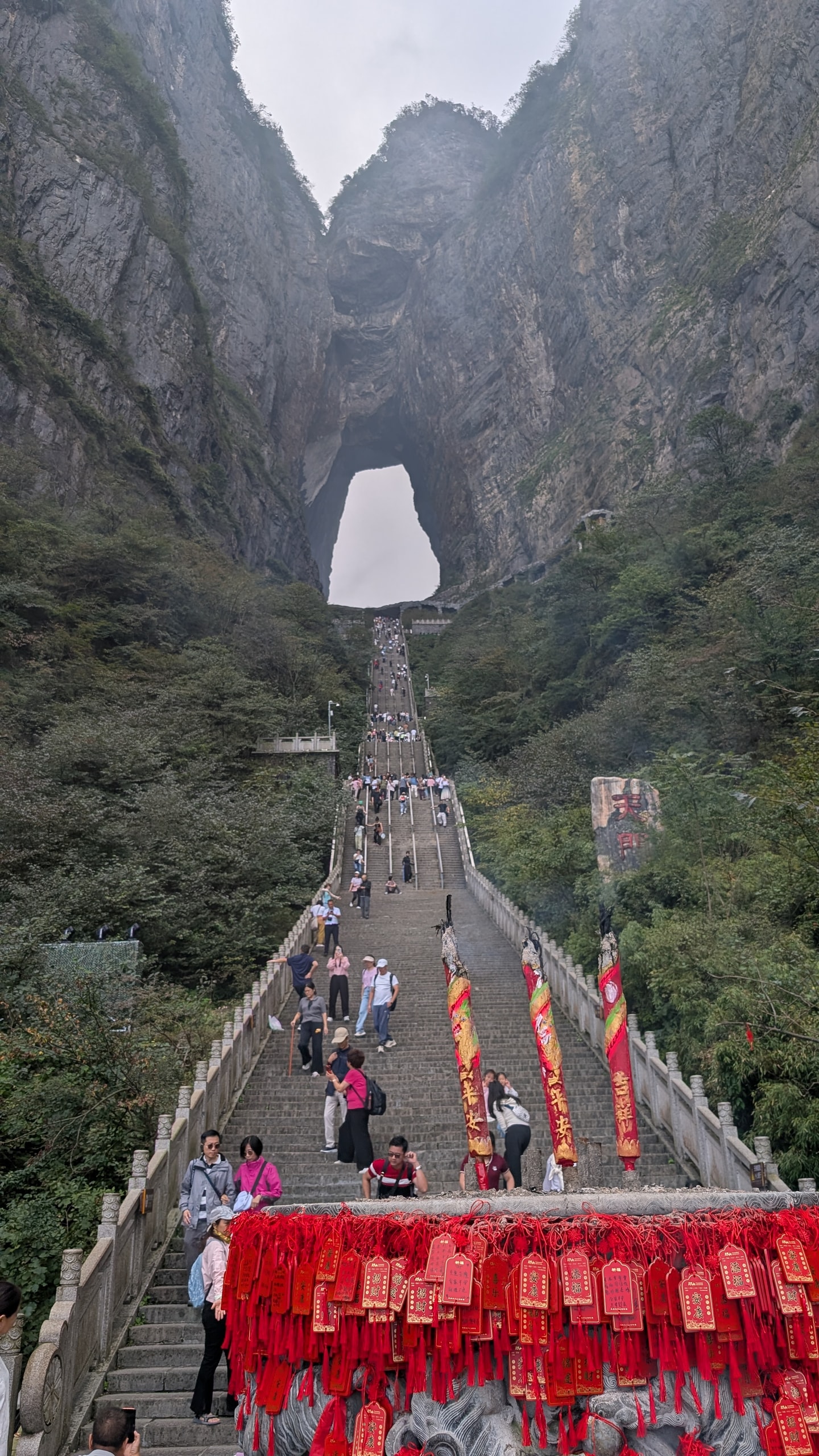
The bus drops you in a plaza at the foot of the cliff, with a coffee counter, a noodle window, banners for whatever festival is running, and a wall of rock in front of you with a hole in it. A stone gate at the foot of the staircase reads 上天梯, the stairway to heaven. Above it the steps run up in one straight line and vanish into the arch.
There are 999 of them, a number picked for luck rather than engineering, and they climb about 150 m. The climb takes most people 25 to 45 minutes. There are handrails the whole way, but the last third is steep enough that the queue thins into small groups standing and breathing. Anyone with bad knees or a stroller should take the escalator and spend the money without guilt.
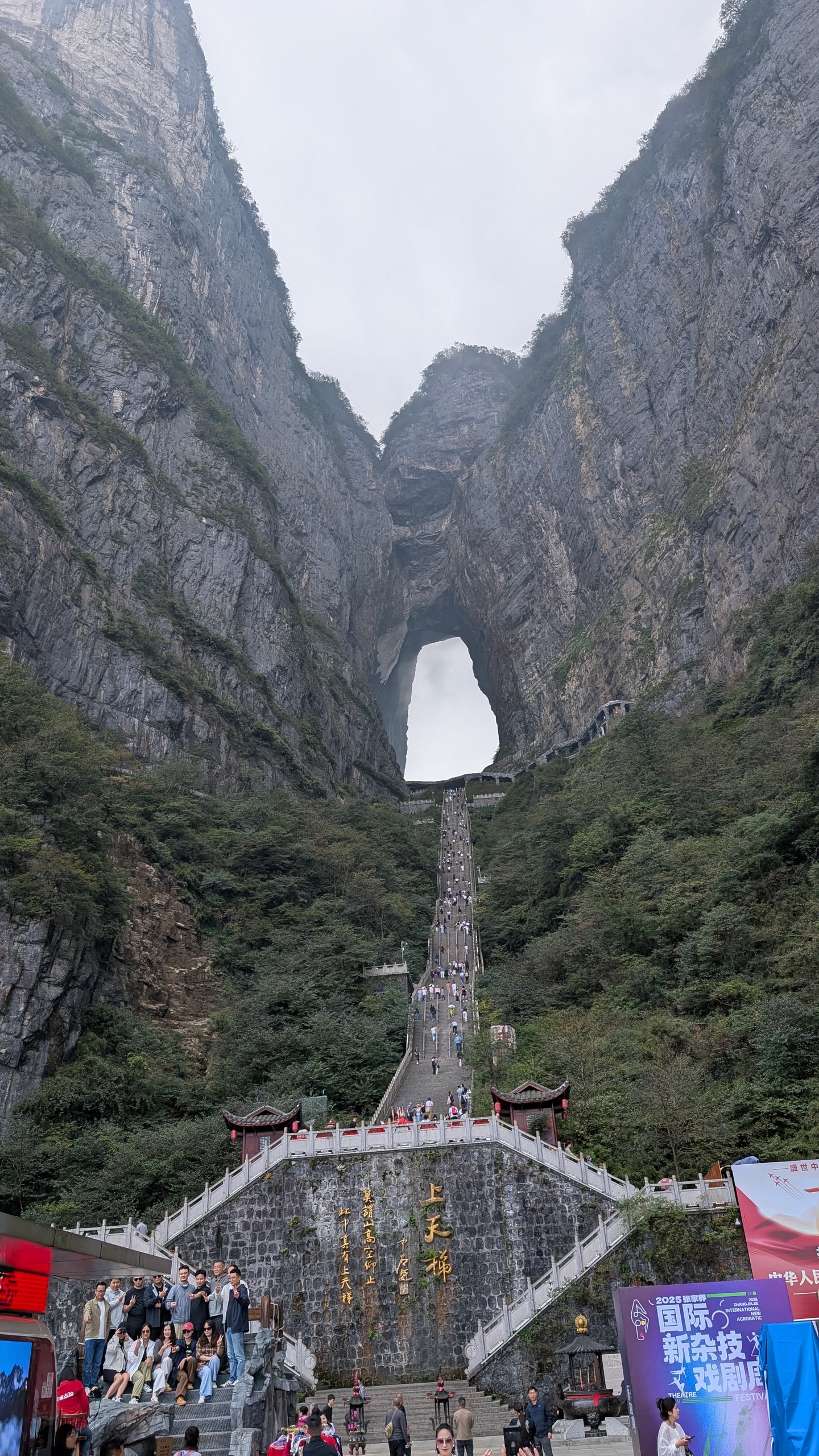
Nobody climbs 999 steps gracefully. Everyone stops, and everyone turns around to see how far down the plaza already is.
Partway up, the stone balustrades are hung with thousands of small red tablets, wishes written in gold and tied on with cord until the rail looks upholstered. People buy them at the bottom, carry them up, and knot them wherever there is a gap. A few yuan each, and it is the one souvenir on the mountain that leaves nothing in your bag.
Under the arch
At the top the staircase runs into the cave and the scale finally lands. The walls close in, the light goes flat, and the opening turns into a tall wedge of sky with a lot of rock leaning over it. On a damp day cloud pours down through the gap like smoke off a pan, which is what the brochure photos promise and what stops you seeing anything else.
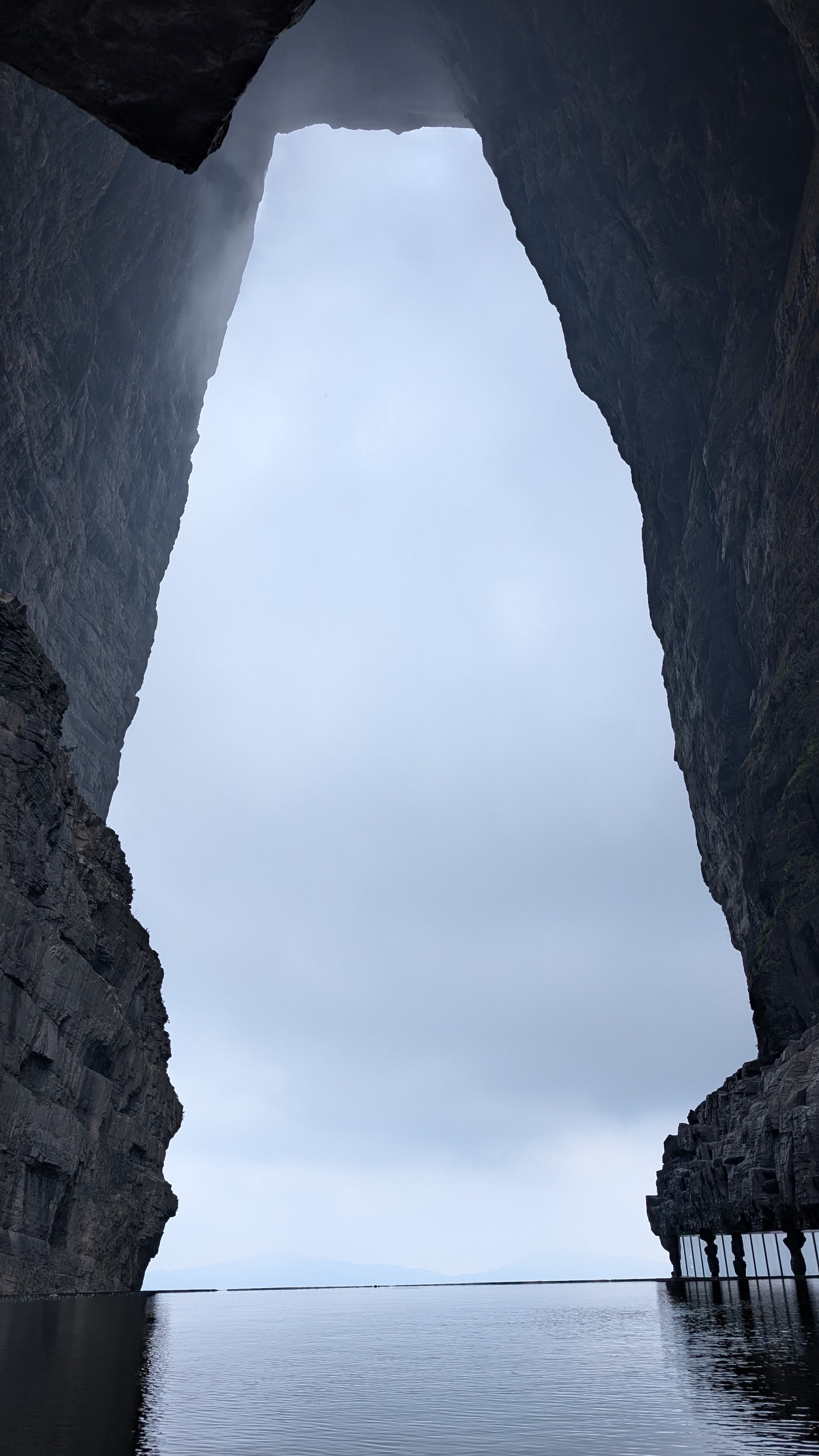
The hole is big enough that people have flown through it. Stunt pilots flew a plane through the gap in 1999, and Jeb Corliss took a wingsuit through it in 2011. In 2018 a Range Rover Sport became the first vehicle to climb the 999 steps, filmed for an advert. Standing under it, none of that feels clever. It is a lot of rock with a gap in the middle.
Walk out the far side and up the short stair beyond, and you get the view back down over Tongtian Avenue: the road folded on itself a dozen times, buses crawling, the airport and the city blocks flat in the haze. Ten minutes there beats another photo of the arch.
The walkways on top, and whether the glass is worth it
An escalator inside the mountain, cut into sections with landings between them, lifts you from the cave to the summit ridge at about 1,400 m. Anyone who has used the hillside escalators in Chongqing will know the feeling: a slope too steep to walk, so somebody installed machinery in it. From the top station the mountain is two loops, east and west, both built as galleries pinned to vertical cliff.
The Guigu plank road runs roughly 1,600 m along the west side at about 1,400 m, with a 60 m glass-floored stretch in the middle. Coiling Dragon Cliff, on the east loop, is the famous one: a 100 m glass walkway, 1.6 m wide, opened in August 2016, hanging over a drop that goes further down than you can usefully see. Both want ¥5 for the cloth covers you pull over your shoes.
The honest version: the glass is a five-minute novelty with a queue, and half that queue is people taking sitting-down photos while everybody else waits. The plain concrete and timber galleries around the next corner have the same drop, the same view, no shoe covers and no line. Do one glass stretch for the picture, then go back to walking.
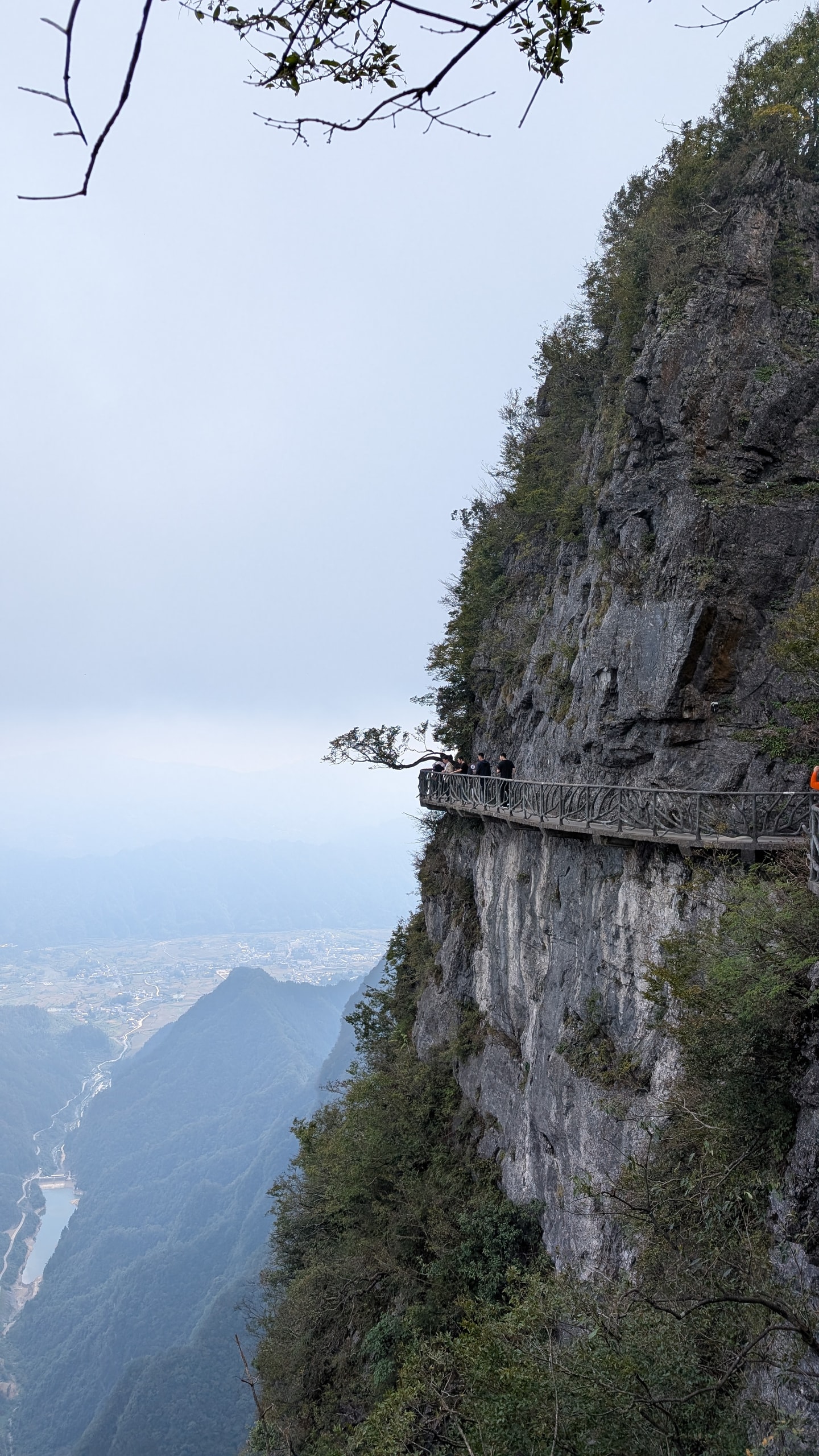
The paths link up through tunnels, short stair sections and a couple of suspension bridges, and the crowd thins once you are past the first two viewpoints. There is a small forest cable car up top (¥25 / $3.50 one way) if the loop starts to feel long. Most people walk it.
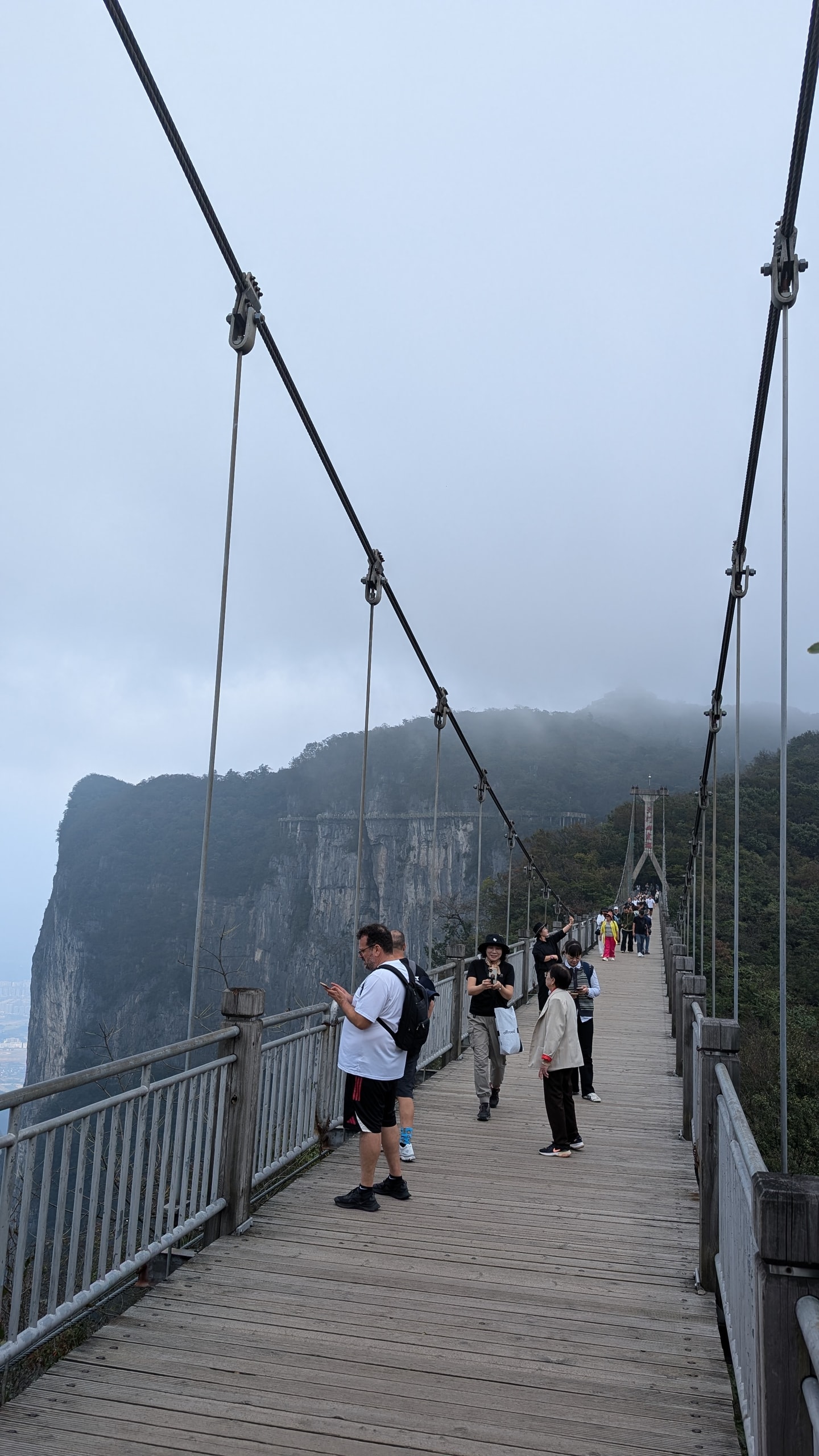
Cloud sits on this ridge most of the year
This is wet mountain country. A bright morning down in the city tells you very little about what is happening 1,300 m up, and two hours can take you from a white-out to a clear valley and back again. Spring is the thickest, but any month can hand you a grey afternoon.
Practical ways to handle it:
- Take an early slot. The first entries go around 7:00, and the more hours you have up there, the more chances the weather gets to change.
- Do not chase the view in one lap. Walk the loop, eat something, come back to the same railing an hour later.
- Autumn is the strongest window. October and early November bring the driest air and some colour in the trees. Avoid the national holiday, 1 to 7 October, when the stairs turn into a slow queue.
- Summer is hot and thundery, and storms close the glass sections without warning.
- Winter is sharp and clear on its good days, genuinely icy on its bad ones. Snow and ice close the cave road and the stairs outright.
Bring one layer more than the city weather suggests. The plaza was mild and the summit ridge was cold and wet on the same October afternoon.
What the day costs and how long it takes
- Ticket: ¥275-288 ($39-41), including the ropeway and buses
- Escalators: ¥32 ($4.50) one way, worth it if you are skipping the stairs
- Glass sections: ¥5 ($0.70) per section for shoe covers
- Lunch on the mountain: noodles or rice for about ¥30-45 ($4-6), priced for people who cannot leave
- Realistic total: ¥350-400 ($50-55) per person for a full day
Give it five to six hours inside the gate, more if you climb the steps and walk both loops. Half a day only works if the cave is all you want. There is nowhere to sleep on the mountain, so you stay in Zhangjiajie city, which is functional rather than pretty, with cheap and decent hotels near the cable car.
Who should come, and who should not bother
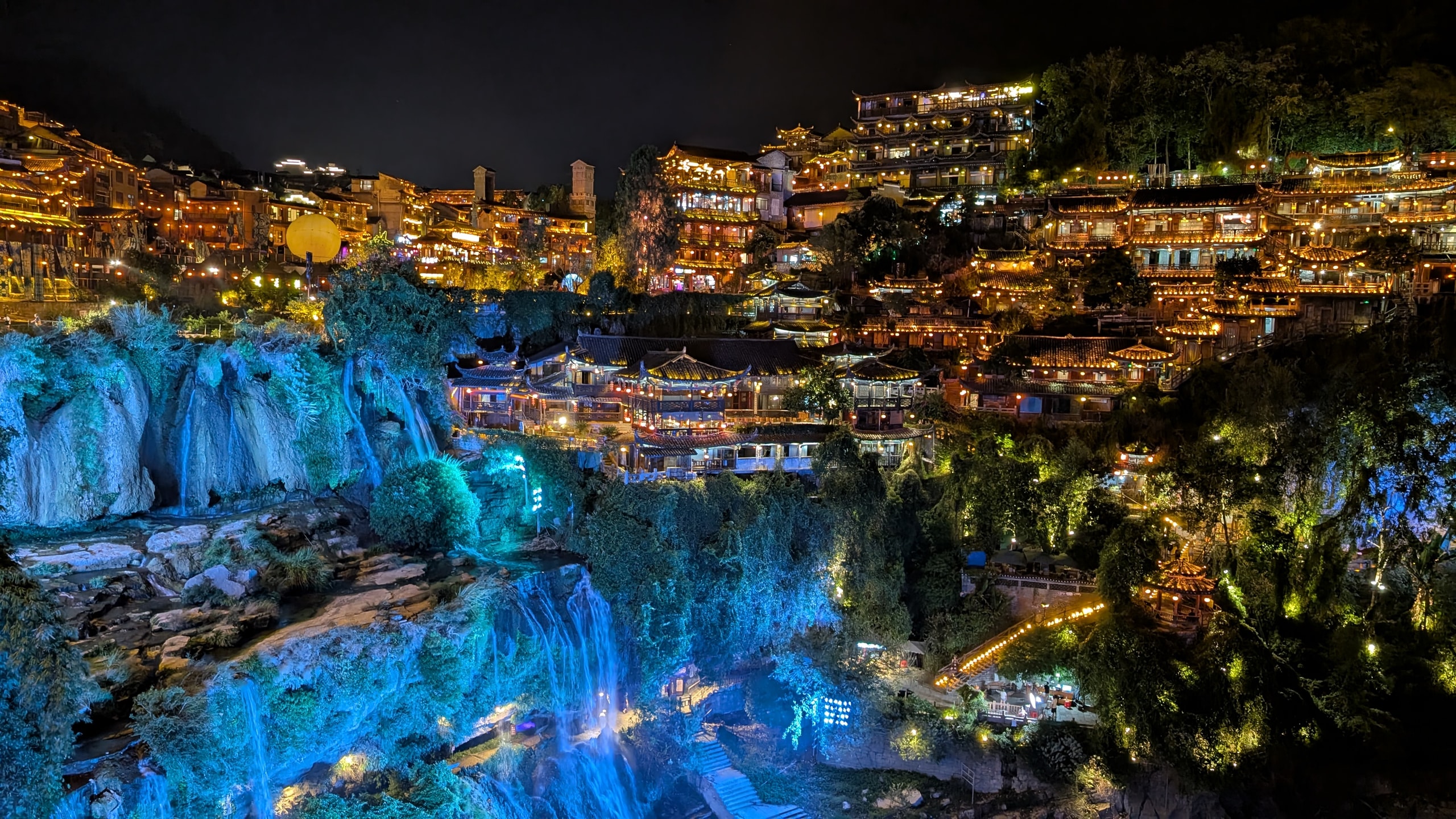
Come if you like built mountains: engineered paths, big drops, a road that should not exist, and a natural arch you can climb into. Come if you are already in Zhangjiajie for Wulingyuan and want a day that starts in town rather than on a 7 am bus. It also sits well next to a night at Furong Ancient Town, 23 minutes away on the high-speed line, if you want water and lanterns after all that rock.
Skip it if crowds spoil things for you, if you need a summit you earned on foot, or if the trip is short enough that only one mountain fits. Check hours, current routes and winter closures on the Tianmen Mountain ticket page before you fix the date.
And take the fog as part of the ticket. The gate was there long before the cable car, and it spends most of its days out of sight.