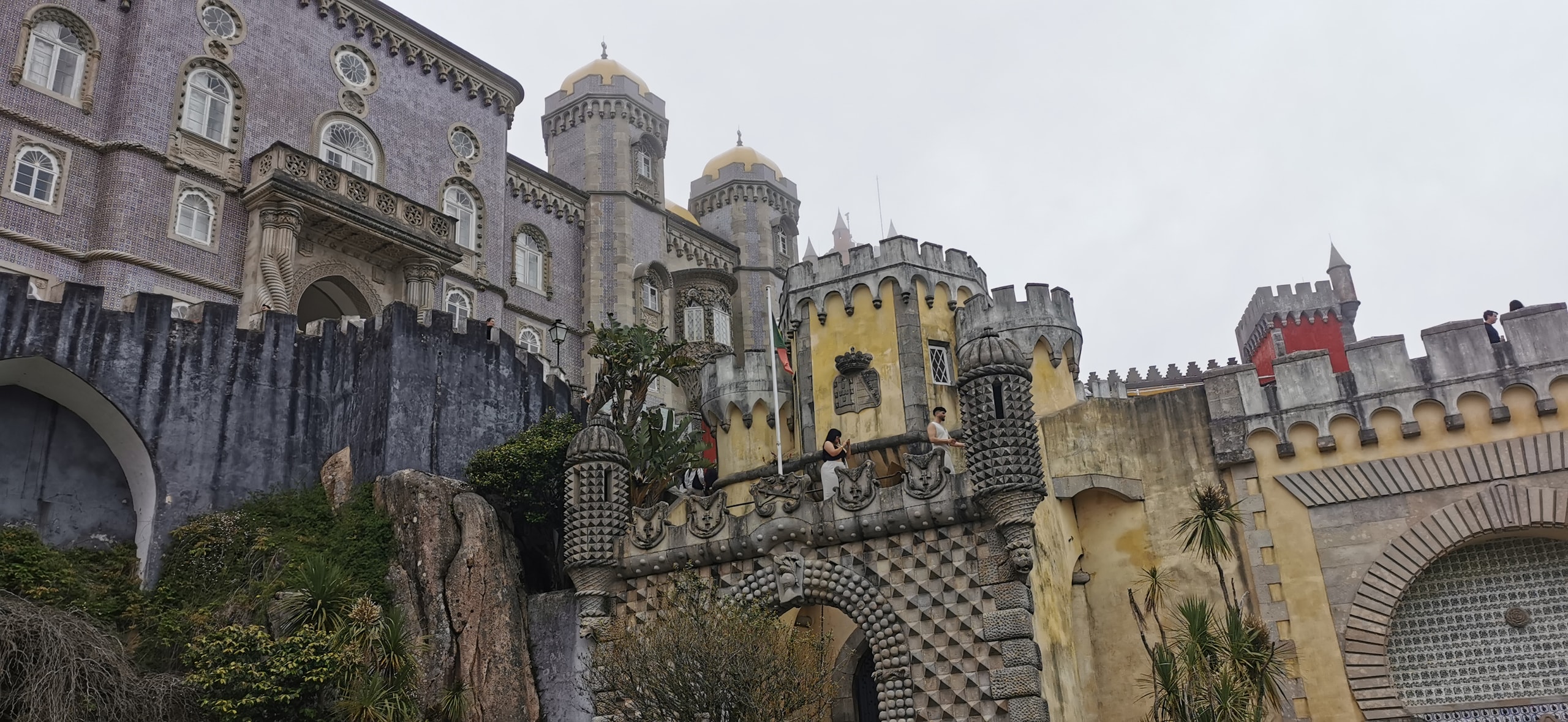
From the Moorish Castle you look two ways. Down in the valley, the National Palace’s two white chimneys stick up out of terracotta roofs. Across the next ridge, Pena Palace sits in cloud - a red tower, yellow walls, the toy-fort shape people already know from photographs. The forest between them is steep, mossy, and slow. That is the whole trip, and it does not fit in an afternoon.
Lisbon to Sintra is a 40-minute suburban train. That fact has ruined more visits than the fog. The palaces sell timed tickets. The bus from the station queues around the block. Pena, the Moorish walls, and Quinta da Regaleira each want two or three unhurried hours. Stack them on a Tuesday with a return train in mind and you will remember the waiting. The rest of Portugal is a different trip; this one is the hills.
Stay two nights. One night is the minimum that works. A day trip can do Pena well and almost nothing else.
The town after the last train
Sintra’s historic centre sits in a fold of the hills, a short uphill walk from the station. White and cream houses, red tile, a Gothic church tower, and a road that switchbacks through the trees. In daylight the lanes take the palace overflow - tour groups, tuk-tuk touts, a line at the pastry shop. After the last crowded train back to Lisbon, the same streets go quiet. A few windows light up. The palaces on the ridge turn into silhouettes. That version of the town is the reason to book a room.
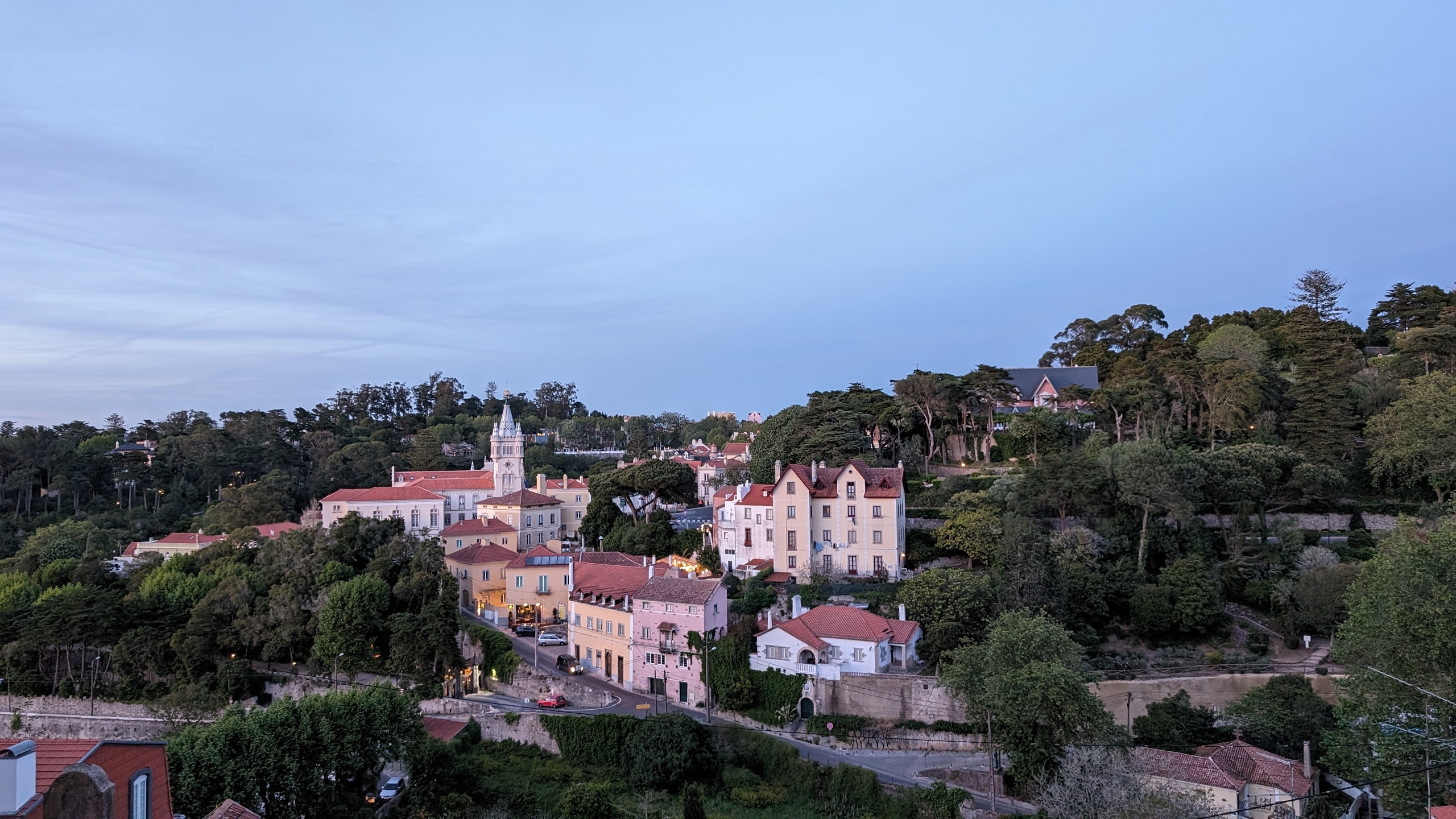
A simple guesthouse or small hotel in the old centre runs roughly $100-180 a night in late April, May, and September. August is higher and thinner on rooms. Stay within walking distance of the National Palace so dinner does not become a logistics problem. You do not need a car. The historic centre has restricted traffic, and the hill monuments are a bus, a taxi, or a steep walk.
Eat in town. Travesseiros - almond-and-egg-cream pastries in puff pastry, the shape of a small pillow - are the local habit. Casa Piriquita on Rua das Padarias is the name on every list; the line is real and the pastry is still worth it. Queijadas de Sintra, the smaller cheese tarts, travel better if you want something for the train. A plate of grilled fish or a pork stew for dinner is $18-32 if you step one street off the most obvious square.
The Cultural Landscape of Sintra is a UNESCO listing for a small set of hills that hold palaces, a Moorish wall, and a forest with its own weather. Cloud sits on the ridge while the valley is still in sun. You can see that split from the castle walls on a May morning. A timed ticket at Pena does not guarantee a view.
Pena Palace is the one to book first
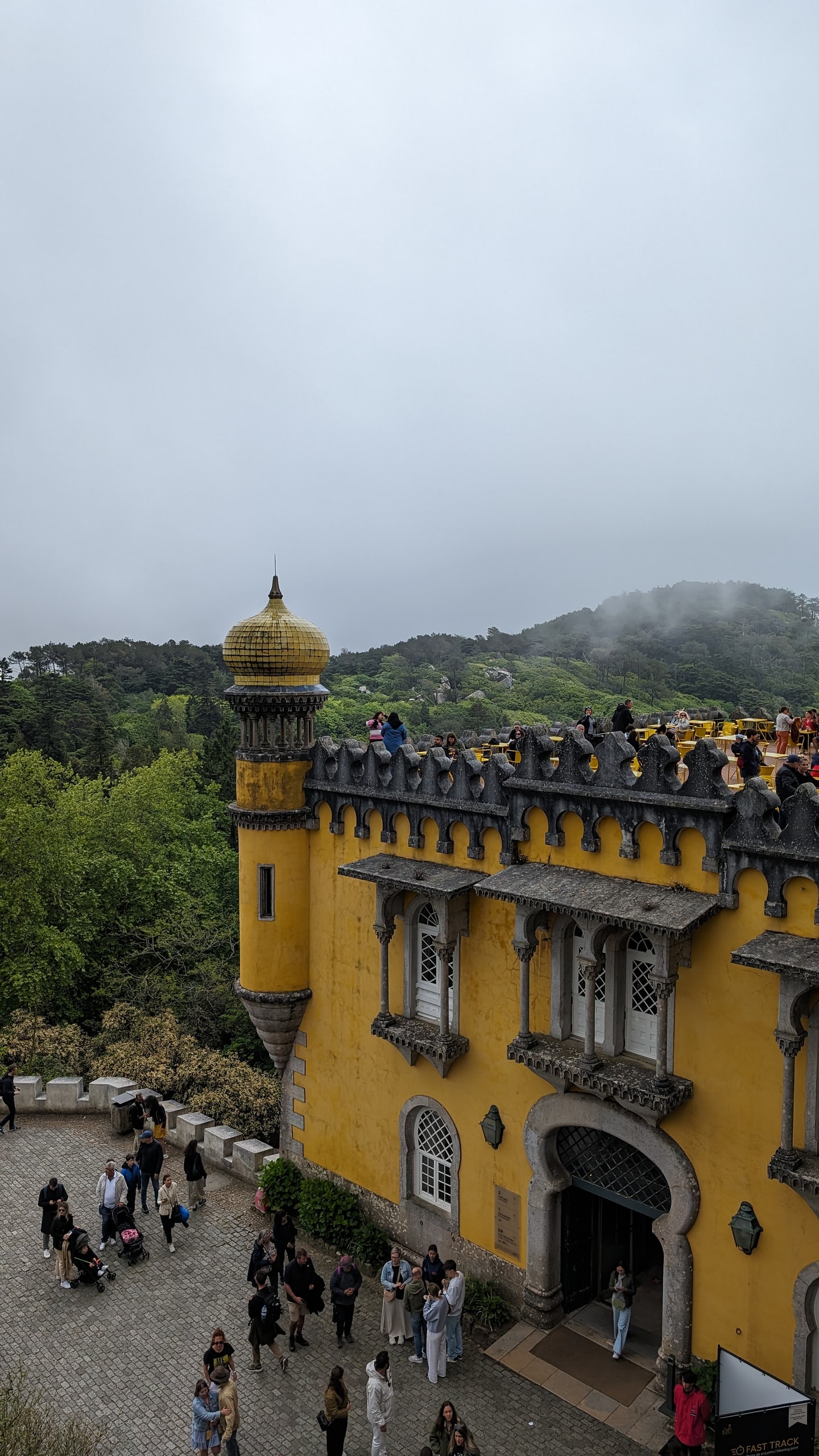
Pena is the image. Yellow walls, a terracotta-red tower, onion domes, battlements, and a stretch of pale purple tile that looks like someone changed their mind halfway through the paint order. King Ferdinand II built this 19th-century summer palace on the bones of an old monastery, high enough that the Atlantic sometimes sits under a lid of cloud. The mix of styles is the point. It is also why the terraces fill by 10:30 a.m.
Book the Essential Visit on the Parques de Sintra ticket site before you travel. Adult entry to the park and palace is €20 ($22). Youth and senior tickets are €18 ($20). The park alone is €12 ($13) if you only want the grounds, but the terraces, the courtyards, and the Triton over the gate are why most people came. Take the timed palace slot. Walk-up in July is a long conversation with a sold-out screen.
Go early. The first palace slots are the ones that still feel like a building instead of a corridor. A round-trip shuttle inside the park, from the lower entrance up to the palace, is an extra €4.50 ($5) and worth it if you would rather not climb the hill twice. The park covers about 85 hectares. You will not see all of it. That is fine.
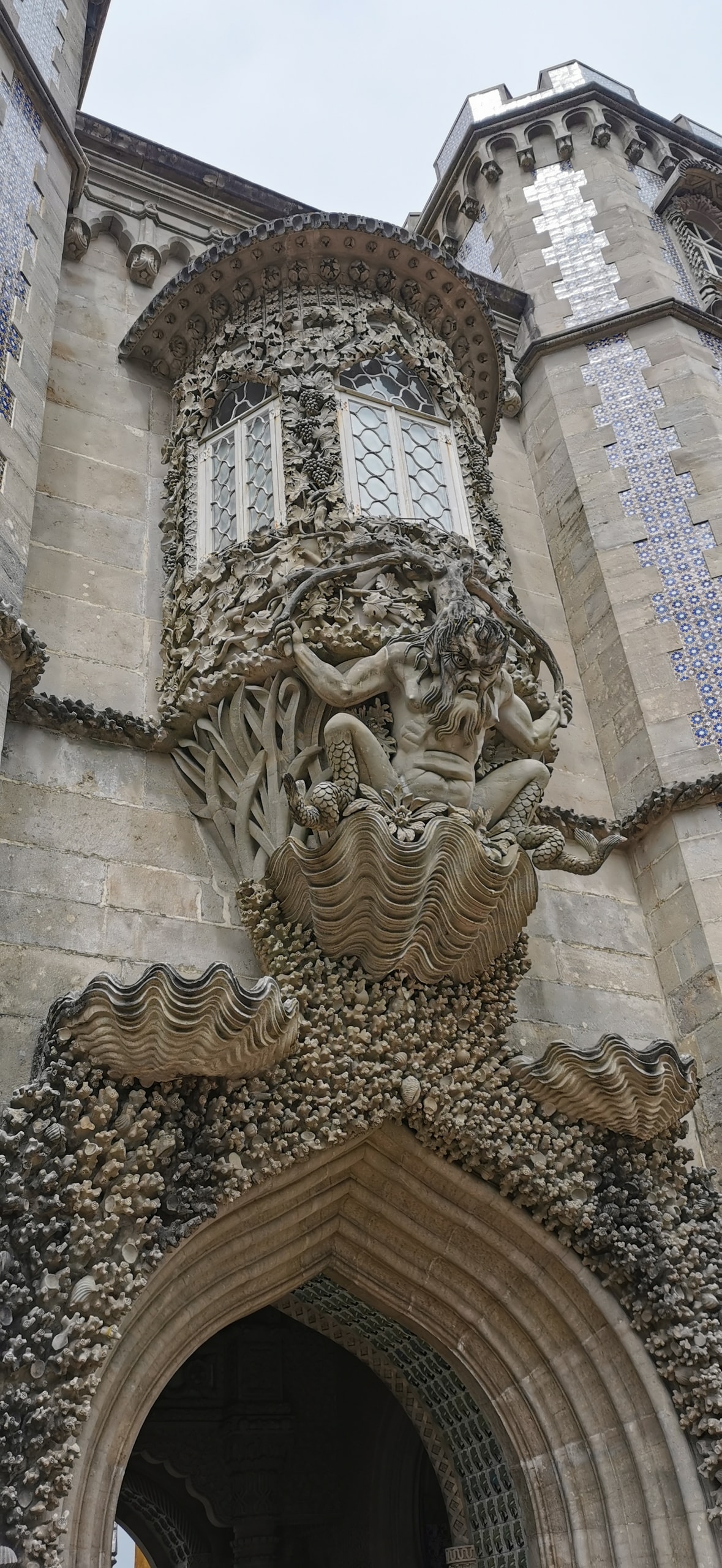
The Triton Portal is the detail that stops people. A bearded sea figure heaves out of a clamshell, holding up a bay window wrapped in stone vines. The wall around him is carved to look like coral. Blue-and-white tiles run off to the side. It is on the outside of the palace, which means you should not skip the approach even if the interior rooms start to blur.
Inside, you get a 19th-century royal summer house: tiled walls, a long dining table, stained glass. Walk through once. Do not give it a second hour. The terraces are the better half of the ticket - yellow and red walls, a clock tower, and on a cloudy day the forest dropping away into white.
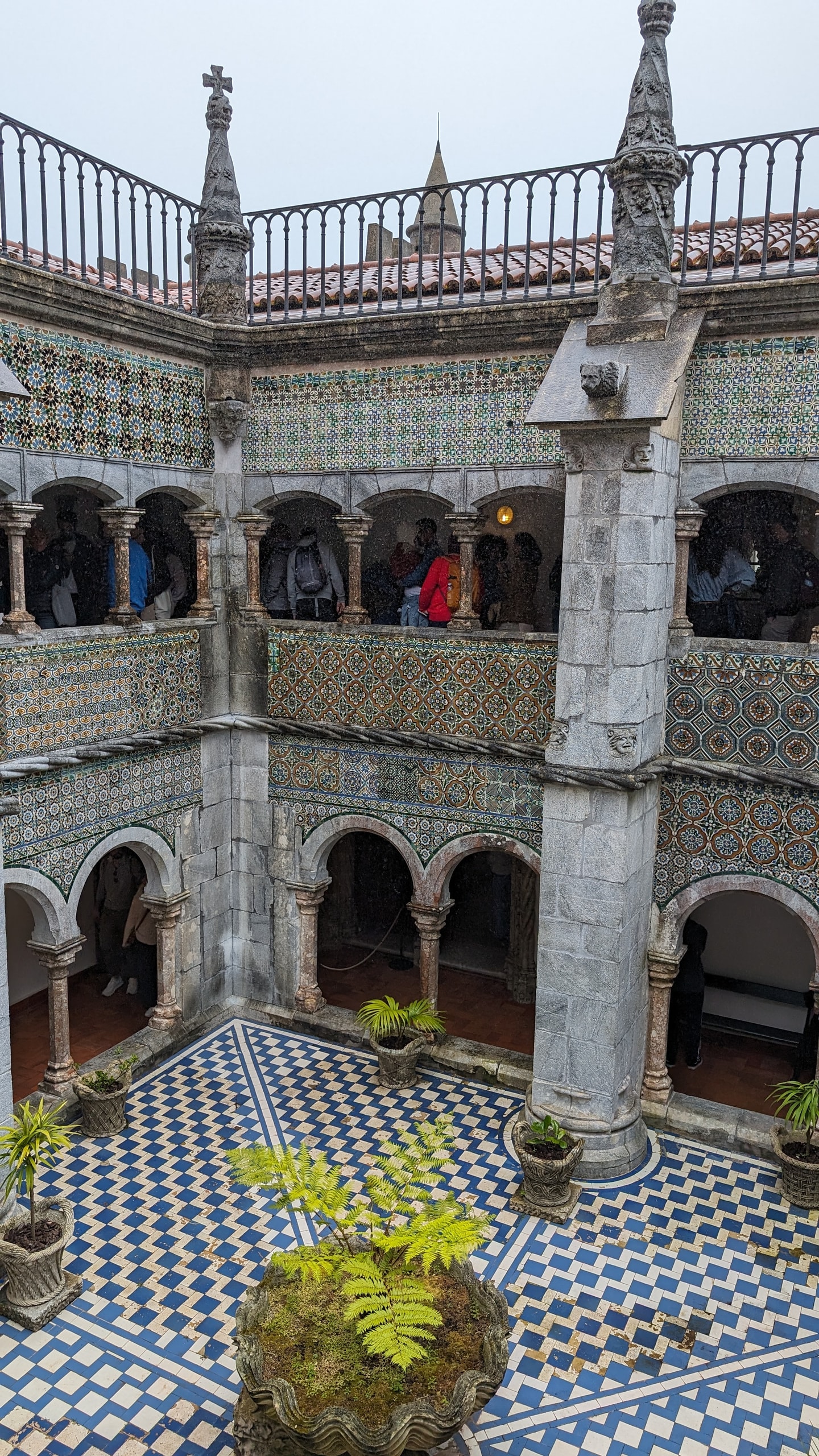
The Manueline cloister is the interior that earns a pause: green and blue tiles, a zigzag pavement, ferns in stone pots. Then go back outside.
Pena in fog is still worth it. The colours stand out against a grey sky. You just lose the wide view. If the ridge is socked in, spend your time on the stonework and save the panorama for the Moorish Castle, which often sits just far enough out of the cloud to see the town.
The Moorish Castle is the better lookout
A short walk downhill through the forest from Pena, the Castelo dos Mouros is older, rougher, and less interested in entertaining you. The walls were raised in the 8th and 9th centuries, rebuilt after the Christian conquest, and restored in the Romantic period so they would look like a ruin on purpose. Granite boulders the size of rooms sit in the masonry. The builders used the rock that was already there.
Adult entry is €12 ($13). Buy it in the same Parques de Sintra purchase as Pena and the site knocks a small multi-monument discount off the total - 5% for two places, not a magic pass. The castle is the right second stop because the path between the two is downhill and the views face the other way.
From the ramparts the historic centre looks like a map: the twin chimneys, the square, the terracotta roofs, then fields and a haze that might be the sea. This is the view Pena’s interiors cannot give you. Allow ninety minutes. Wear shoes with grip. The wall-walk is a real staircase along a ridge, not a courtyard loop, and the drop on the outer side is not decorative.
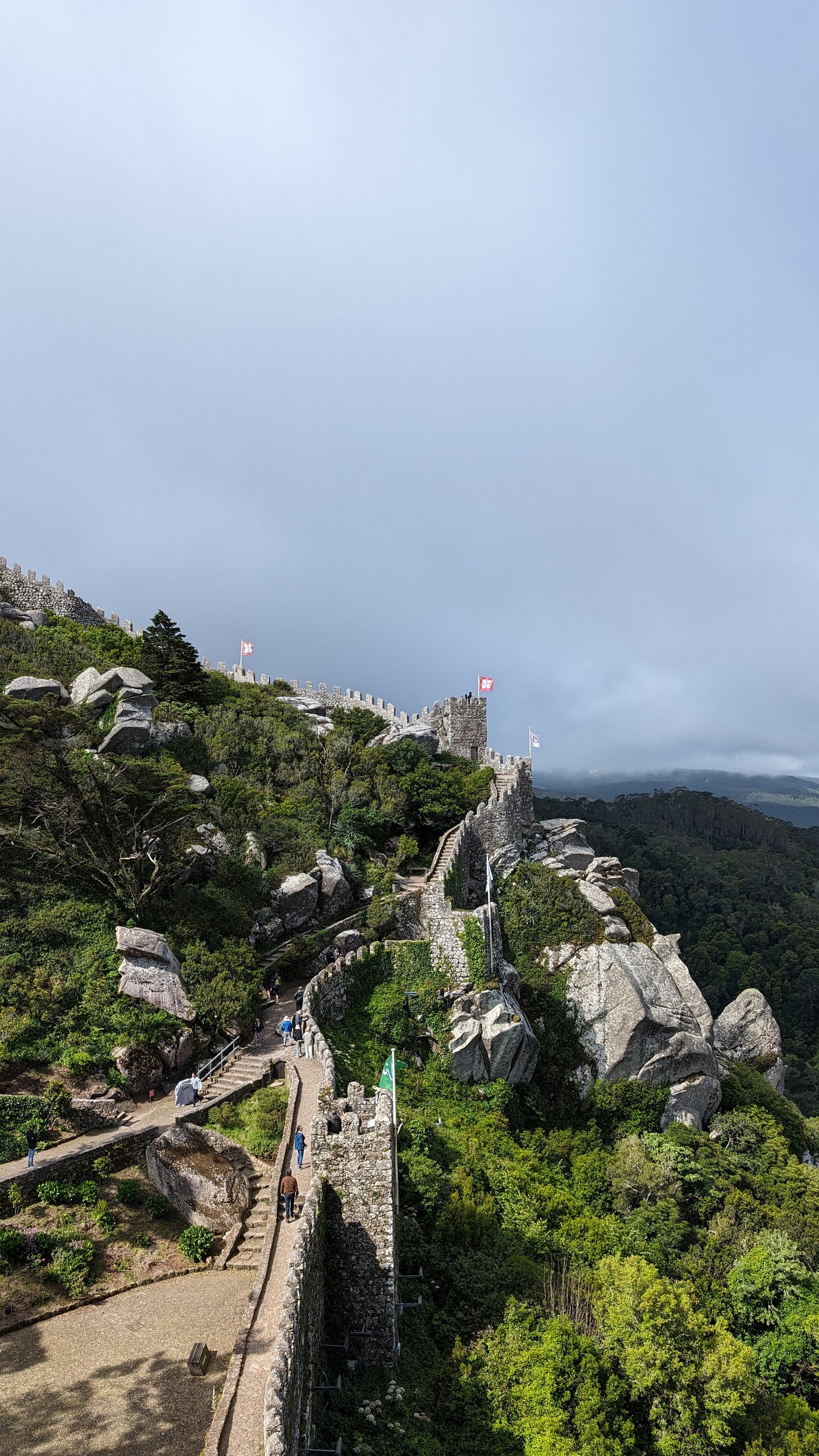
Flags snap on the towers. On an overcast morning the stone and the moss do more work than the sky. Bring a layer. The ridge is cooler than the town.
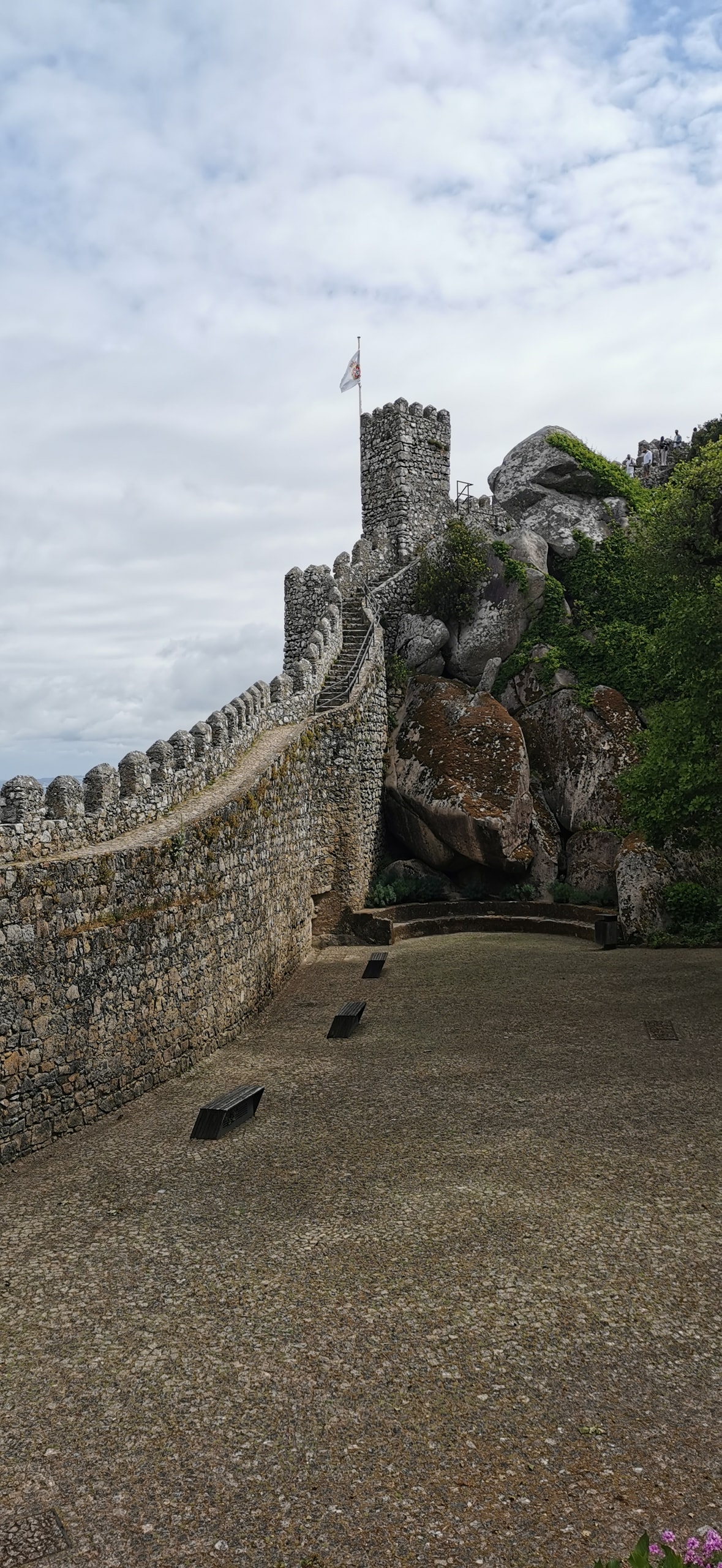
Walk down to town when you are done. The 434 bus will be a scrum at the Pena car park by late morning.
Regaleira is why the second day exists
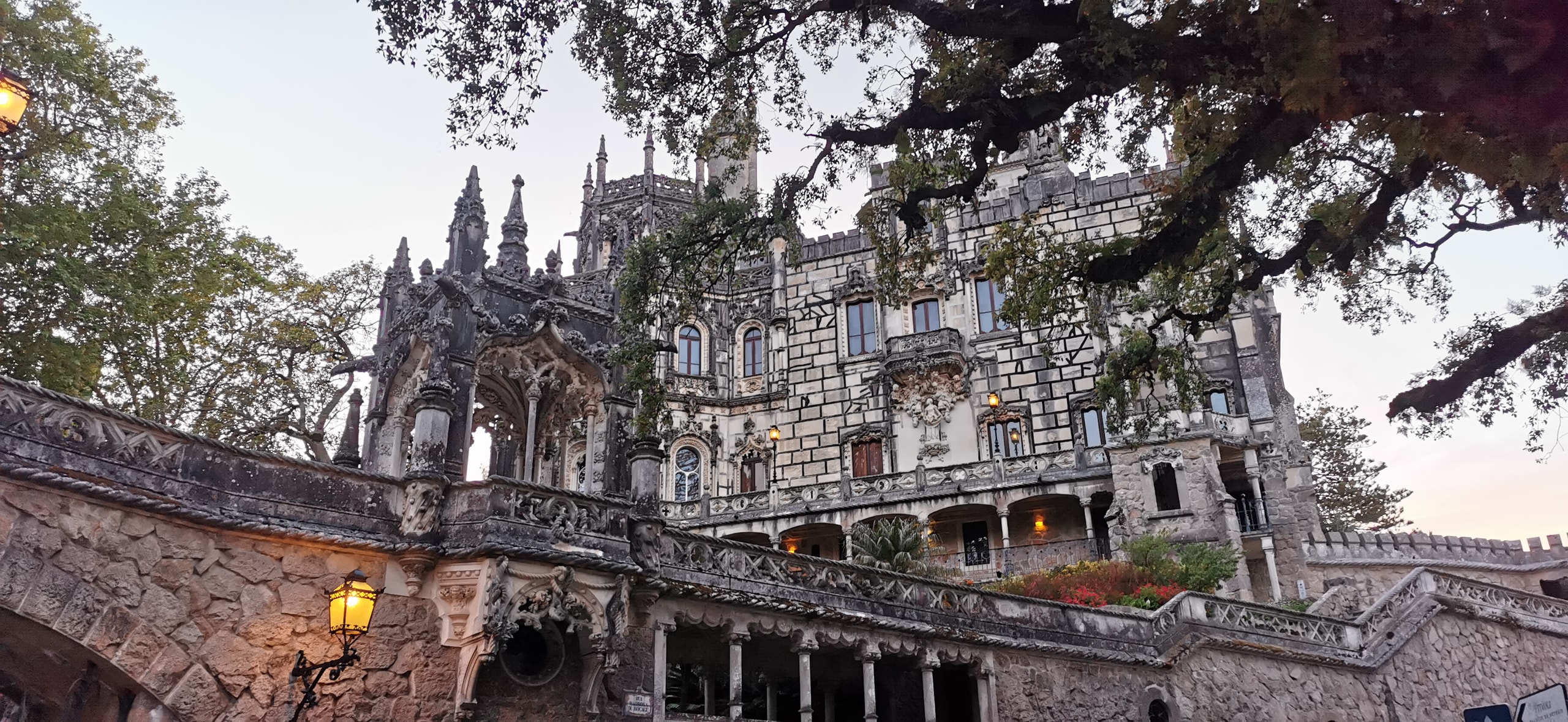
Quinta da Regaleira sits on the edge of the historic centre, which is the practical gift of staying overnight. You can walk there after breakfast without a bus. The palace is Neo-Manueline theatre: spires, pinnacles, a stone staircase up from the road, iron lamps. Carvalho Monteiro, who made a fortune in Brazil, built the estate around 1900 with the Italian architect Luigi Manini. The brochure talks about Knights Templar, Freemasonry, and hidden meaning. Some of that is in the stone. Most of what you will actually do is walk through a damp garden full of tunnels.
Adult entry is €20 ($22) in 2026, with youth and senior tickets at €15 ($16.50). Book a timed slot on the official Regaleira site. This ticket is separate from Parques de Sintra. No combo covers both. From April to September the gardens stay open until 7:30 p.m., last entry 5:30 p.m.; the palace, chapel, and exhibitions close half an hour before the grounds. Two to three hours is the honest visit. Four is possible if you like getting lost.
The palace interior is a few rooms. Nice, not the reason you paid. The gardens are the estate: terraces, a chapel, grottos, a lake with stepping stones, and a network of tunnels that spit you out at the foot of a waterfall or beside a pond you did not expect.
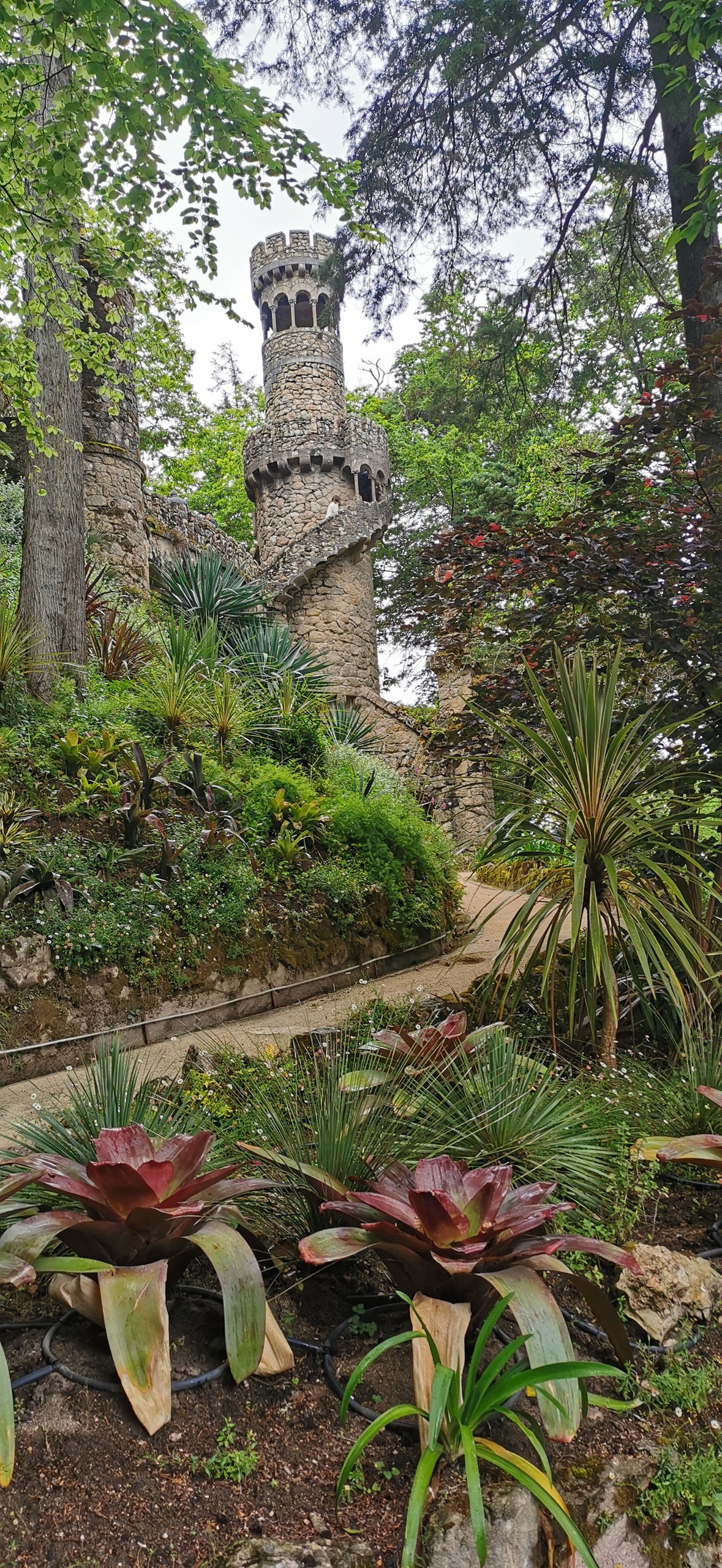
The paths duck and climb. Follow one downhill and you hit water.
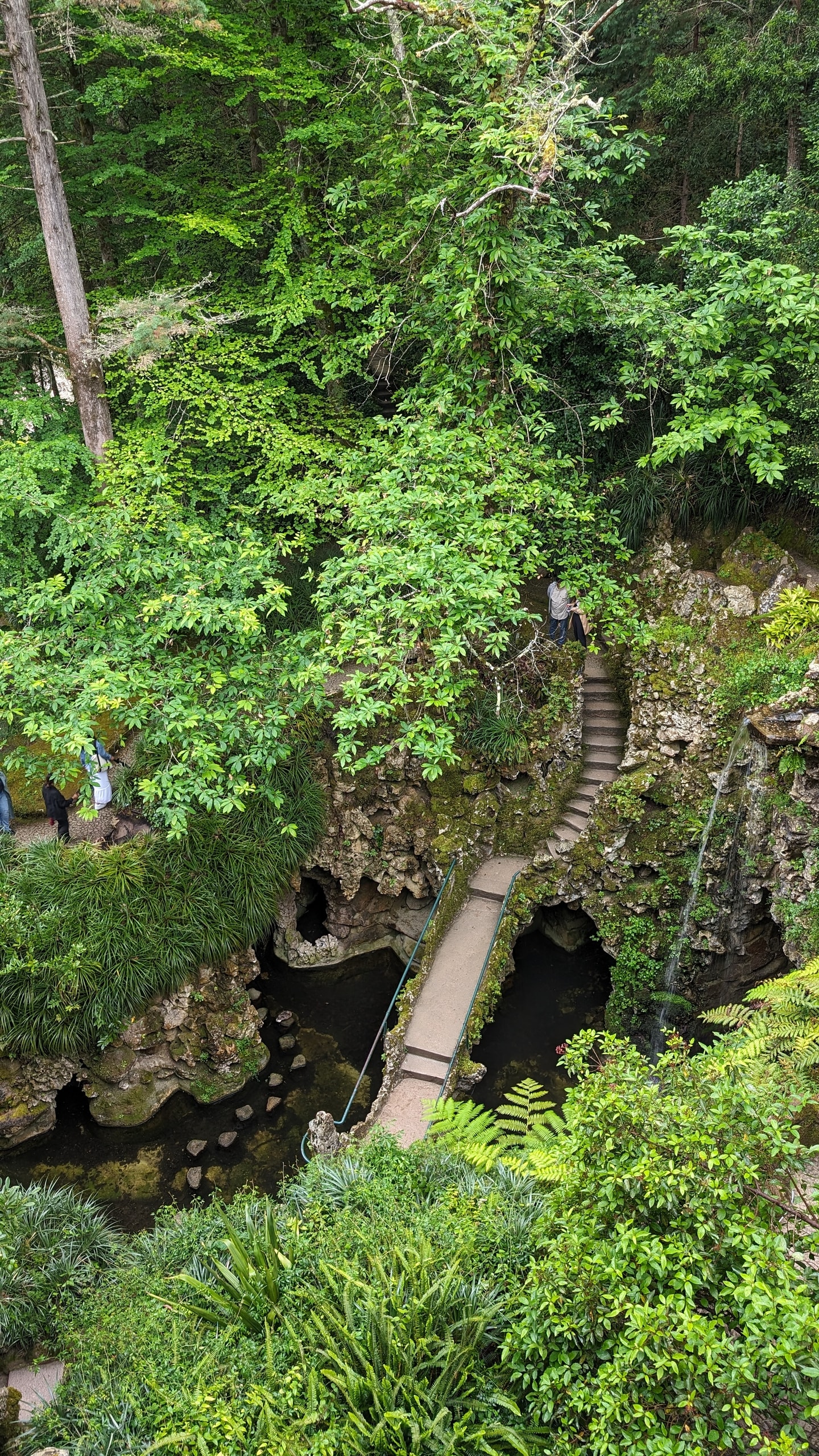
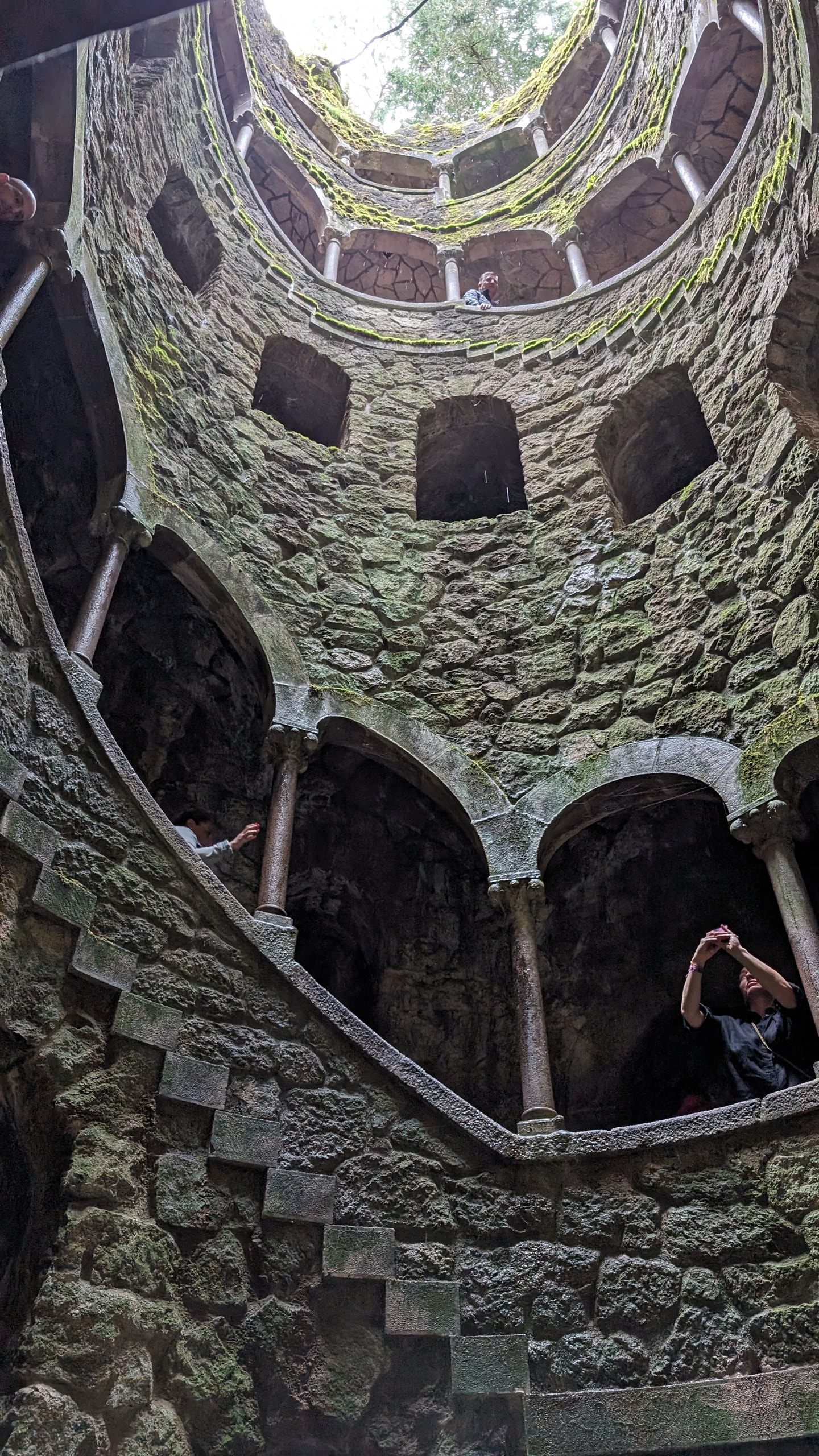
The Initiation Well is the thing people come to stand in. It is not a well. It is an inverted tower: a spiral staircase of nine levels dropping about 27 metres to a mosaic compass rose on the floor. You look down from the rim and the stairs wind in on themselves. You walk down, through a tunnel, and come out in the garden. There is usually a queue at the mouth. Join it once.
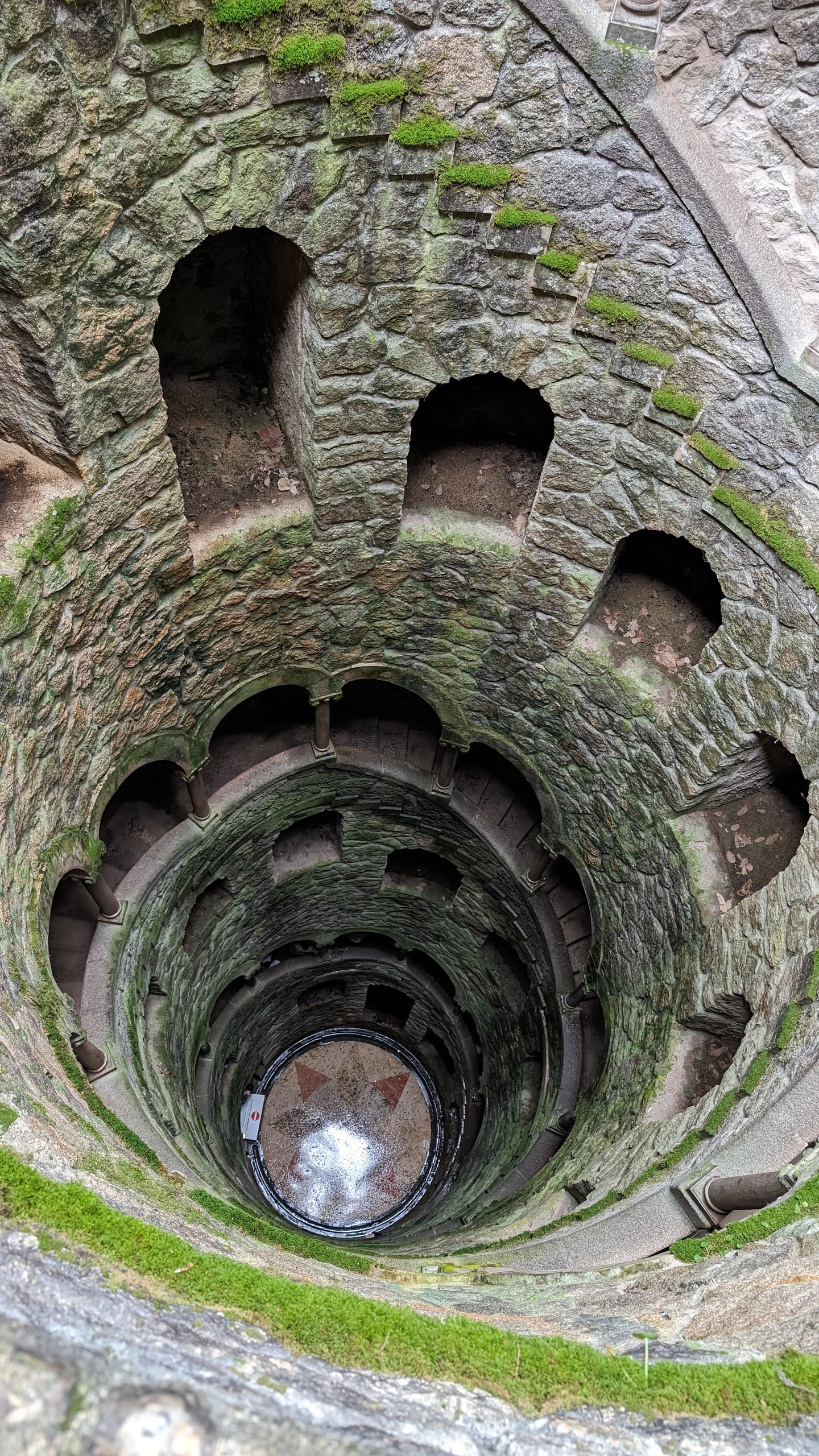
From the bottom the sky is a bright circle. The galleries stack. People on the stairs look down with phones. Walk the spiral; the tunnel is only the other door.
Go late if you can. Midday is the well at its most crowded and the grottos at their most impatient. A 3 p.m. slot in shoulder season still leaves you time to do the spiral without someone on your heels. The tunnels are dark, low in places, and slick. A phone torch is enough. Do not wear the shoes you would wear to a Lisbon tile museum.
Book Pena for the palace. Save time for the well - that is the part people talk about later.
Two chimneys and a morning with no bus
The National Palace of Sintra is the white building in the valley with the two conical chimneys. Those chimneys belong to a kitchen that once roasted for a court. The palace is in town, which makes it the easy morning after a hill day, or the thing you do if the ridge is in cloud. The Essential Visit is €13 ($14) for adults. Tiled rooms, a Swan Room, a Magpie Room, and more azulejos than you can usefully remember. An hour and a half is plenty. The gardens are free.
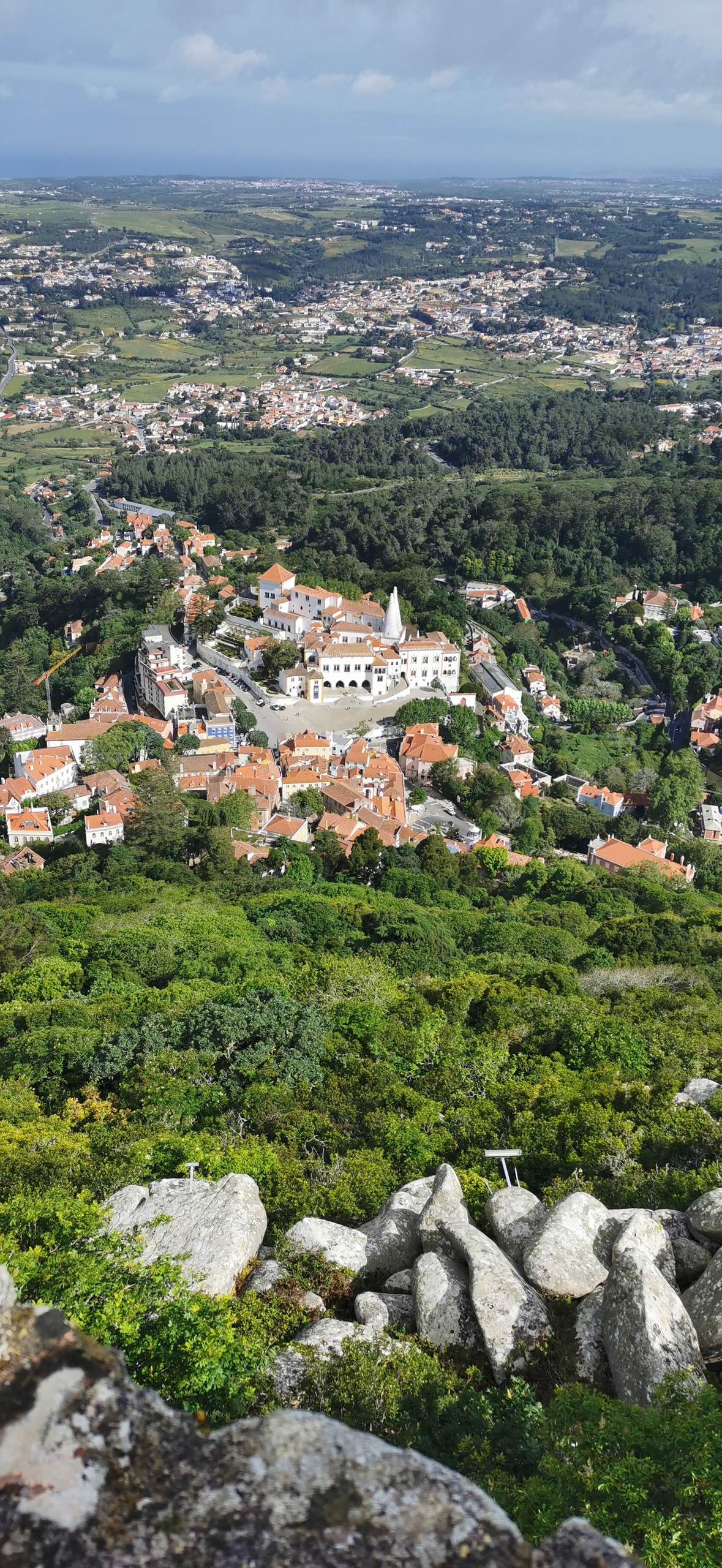
You do not have to go in. Walking the lanes around it, buying a queijada, and looking up at the chimneys from the square already tells you what kind of town this was: a royal summer seat, then a Romantic playground, now a very busy station stop.
The train is easy. The hill is not.
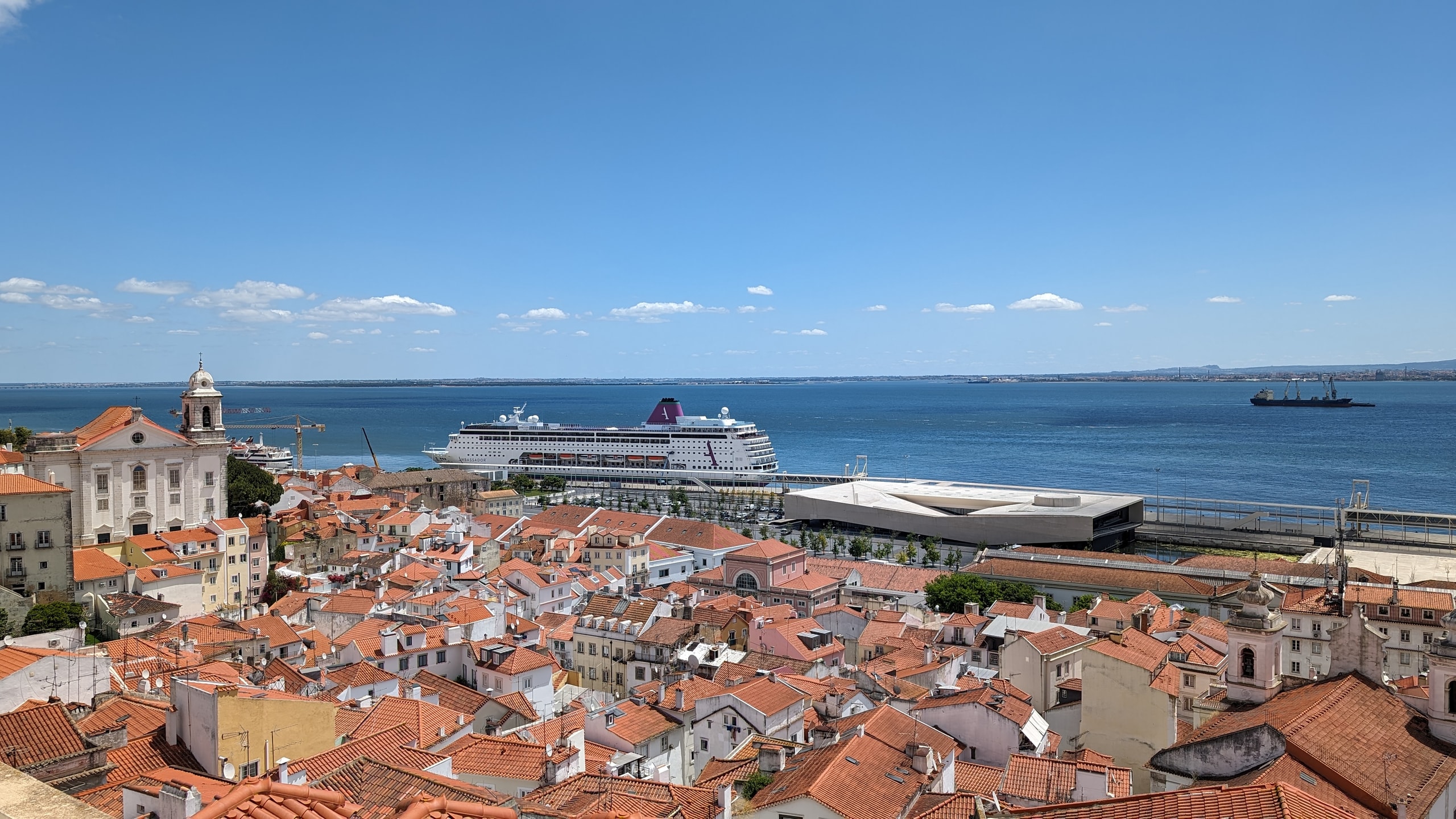
From Lisbon, take the CP urban train from Rossio (or Oriente if you are on the airport side). The ride is about 40 minutes from Rossio, closer to 50 from Oriente, and trains run roughly every 20 minutes. A single is about $2.50-3 on a Navegante card; the card itself is $0.50 the first time. There is no special tourist train. Check Comboios de Portugal for the current timetable. Validate the card. Sit down. This part is not the problem. For the city the train leaves from, start with Lisbon without Tram 28 - four nights on foot and a cheap ferry to the other bank.
The problem starts at Sintra station. Scotturb 434 is the bus that loops the station, the historic centre, Pena, and the Moorish Castle. In high season the queue can eat 45 minutes of a timed ticket. Tuk-tuks at the forecourt will offer to solve this for $15-30.
The practical pattern for a first hill day:
- Book Pena’s earliest palace slot you can live with.
- Take a taxi or Bolt from town or the station to the Pena park entrance ($8-15). Skip the 434 that morning.
- Do Pena, then walk downhill to the Moorish Castle.
- Walk down to town for lunch. Do not go back up.
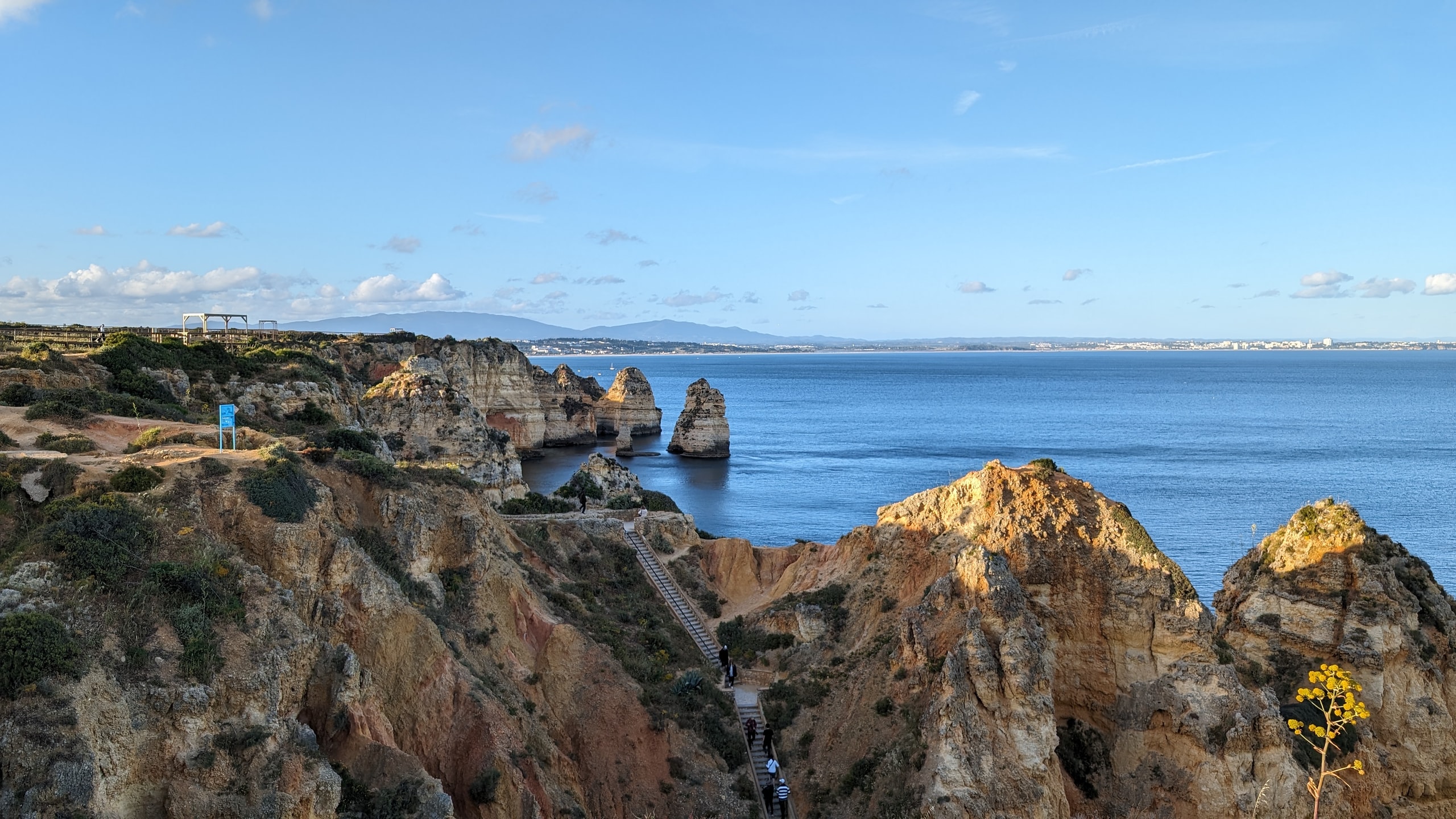
Regaleira is a town-edge walk. Save it for the next morning or a late afternoon. Monserrate, the Capuchos convent, and Cabo da Roca are extra days or a different trip. Cabo da Roca is a windy cape with a stone marker and a gift shop, about half an hour west. Adding it to a Sintra palace day is how you see a parking lot at the edge of Europe and nothing else well. If you want Portugal as cliffs and Atlantic wind instead of palaces and fog, the western Algarve is the other end of the country.
What a couple of nights actually costs
For two people sharing a room, a realistic two-night stay in May or September looks like this:
- Room in the historic centre: $100-180 a night
- Train Lisbon-Sintra return: about $5-6 per person
- Taxis on the hill day: $8-15 each way if you use them
- Pena Essential Visit: $22
- Moorish Castle: $13
- Regaleira: $22
- National Palace (optional): $14
- Lunch: $12-20 per person
- Dinner: $25-40 per person with wine, off the main square
- Pastries: a few dollars, and you will buy more than one
That is roughly $350-550 for two nights of lodging plus the three hill tickets, before Lisbon hotels on either side. It is not a cheap add-on to a city break. It is also not a $200 van tour that promises every palace before dinner and turns the well into a ten-minute photo stop.
May is the month that matches these hills at their greenest: cloud on Pena, town still in sun from the walls. June holds. July and August work if 8:30 a.m. is the start of the day and everything after 2 p.m. is a town afternoon. September opens the ticket slots again. Winter is quieter and wetter. Some garden paths go slick. The palaces do not get less interesting.
Who should skip the one-day version
Skip the plan that starts at Rossio at 9, does Pena at noon, the castle at 2, Regaleira at 4, and a 6 p.m. train. You will do it. You will not like the memory.
Skip buying tickets from a man with a lanyard on the station forecourt. Official sites only: Parques de Sintra for Pena, the Moorish Castle, and the National Palace; Cultursintra for Regaleira.
Skip Monserrate on a first two-night stay unless gardens are the whole reason you came. It is another ticket and another bus.
Skip Cabo da Roca as a “while we’re here” extra. The cape will still be there if you rent a car for the coast.
Sintra is for people who will book a timed ticket, walk a wet staircase, and stay for the evening when the coaches have gone. The palaces are crowded because they are good. Timing and a room in town are what separate a good two days from a long, expensive commute.