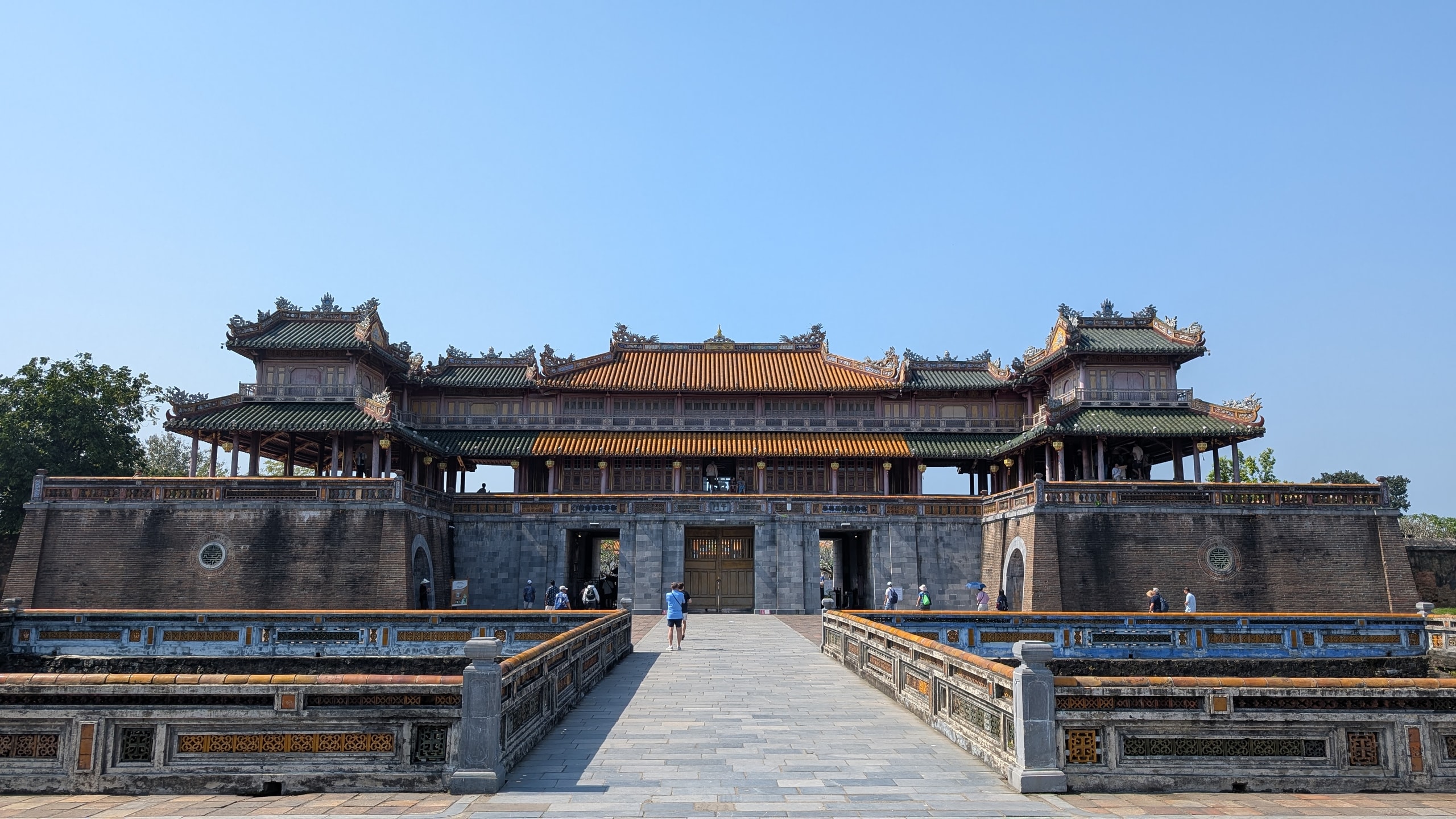
Walk through the Noon Gate into Hue's Imperial City and the first thing you notice is the grass. Wide, mown lawns run between the halls, crossed by stone paths that lead to foundations with nothing standing on them. You expect something like Beijing's Forbidden City, packed with palaces. What you get is a handful of restored buildings spread across a park, a few gardeners watering flower beds, and very little shade.
The emptiness has a history. Hue was the capital of Vietnam's last royal family, the Nguyen dynasty, from 1802 until the last emperor, Bao Dai, gave up the throne at the Noon Gate in August 1945. The citadel was then fought over twice: in 1947, during the war against the French, and in 1968, when North Vietnamese and Viet Cong troops held the city for almost a month during the Tet Offensive and American and South Vietnamese forces took it back street by street. Most of the palace buildings did not survive. UNESCO listed the Complex of Hue Monuments in 1993, and the rebuilding is still going on.
Hue sits on the Perfume River, about 100 km north of Da Nang. Most visitors see it on a day tour from Hoi An: four hours of road, the citadel, one tomb, back after dark. It can be done, but the city is worth a night, the same case the Vietnam things-to-know guide makes for the whole central coast.
The road from Hoi An: take the Hai Van Pass
Hoi An to Hue is about 140 km. The quick way is the highway through the Hai Van tunnel, roughly three hours by car. The better way is over the Hai Van Pass, the old coast road that climbs to about 500 metres between Da Nang and Lang Co, with the sea below you. It adds maybe forty minutes and it is the best part of the drive.
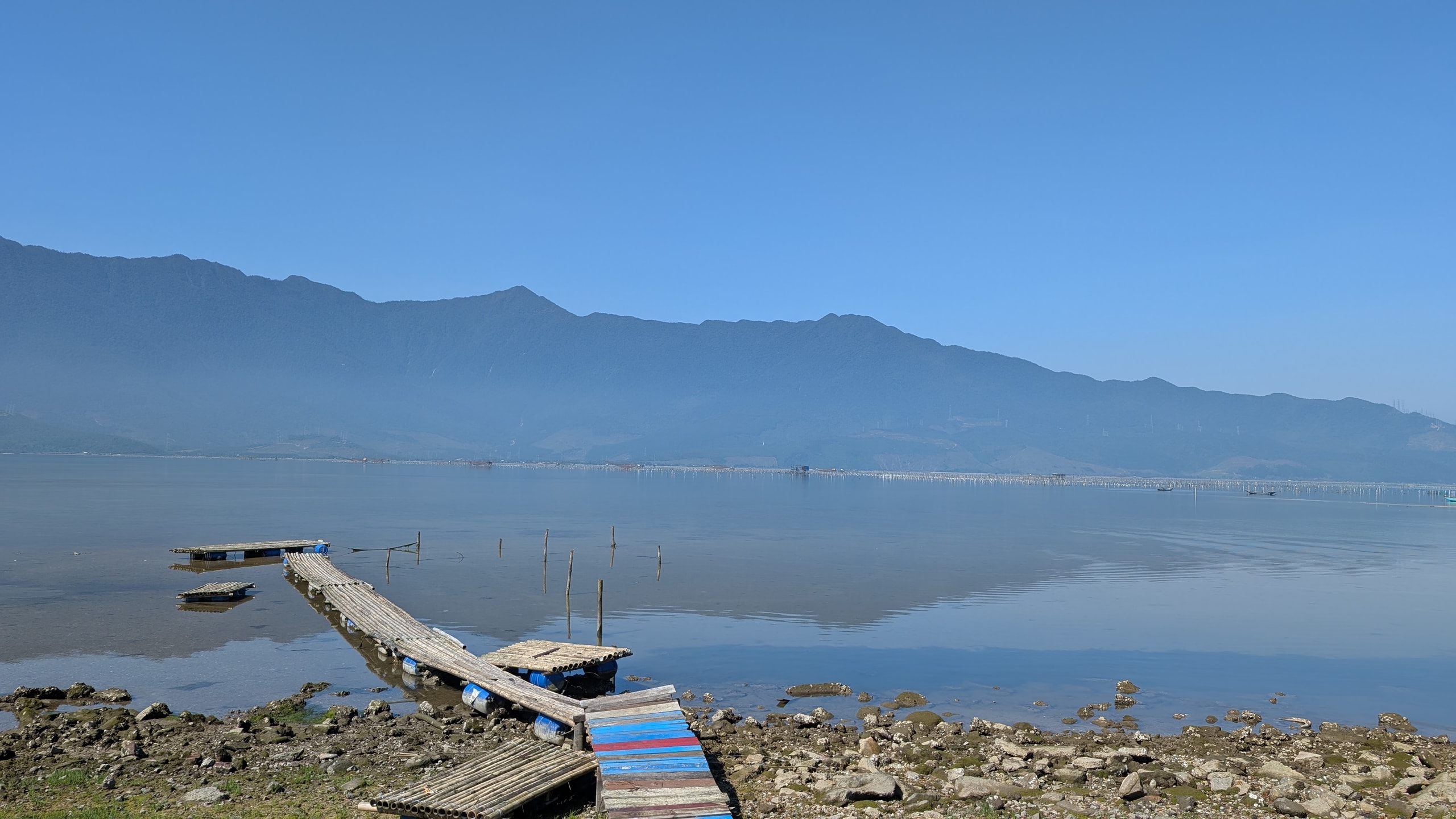
On the north side of the pass, the road runs beside Lap An lagoon at Lang Co. In the morning the water is still enough to hold a reflection of the mountains, and long rows of poles mark out the oyster farms. Restaurants on stilts along the shore grill a plate of oysters for around 100,000 VND ($4). Stop for twenty minutes.
A private car with a driver who will stop on the pass costs roughly $60-80 one way, and most will collect you from your hotel, including a family guesthouse near Hoi An's old town. Motorbike tours with your bag strapped on the back run about $50-70. The cheapest option is the coastal train from Da Nang, two and a half to three hours, with tickets on Vietnam Railways from around 100,000 VND ($4). It skips the lagoon.
The Imperial City: gates, cannons and a lot of lawn
The citadel's walls and moat make a square more than 2 km on each side, with a whole neighbourhood of houses, cafes and schools inside. The Imperial City, where the court lived, is a smaller walled square in the middle, and that is the part you pay for.
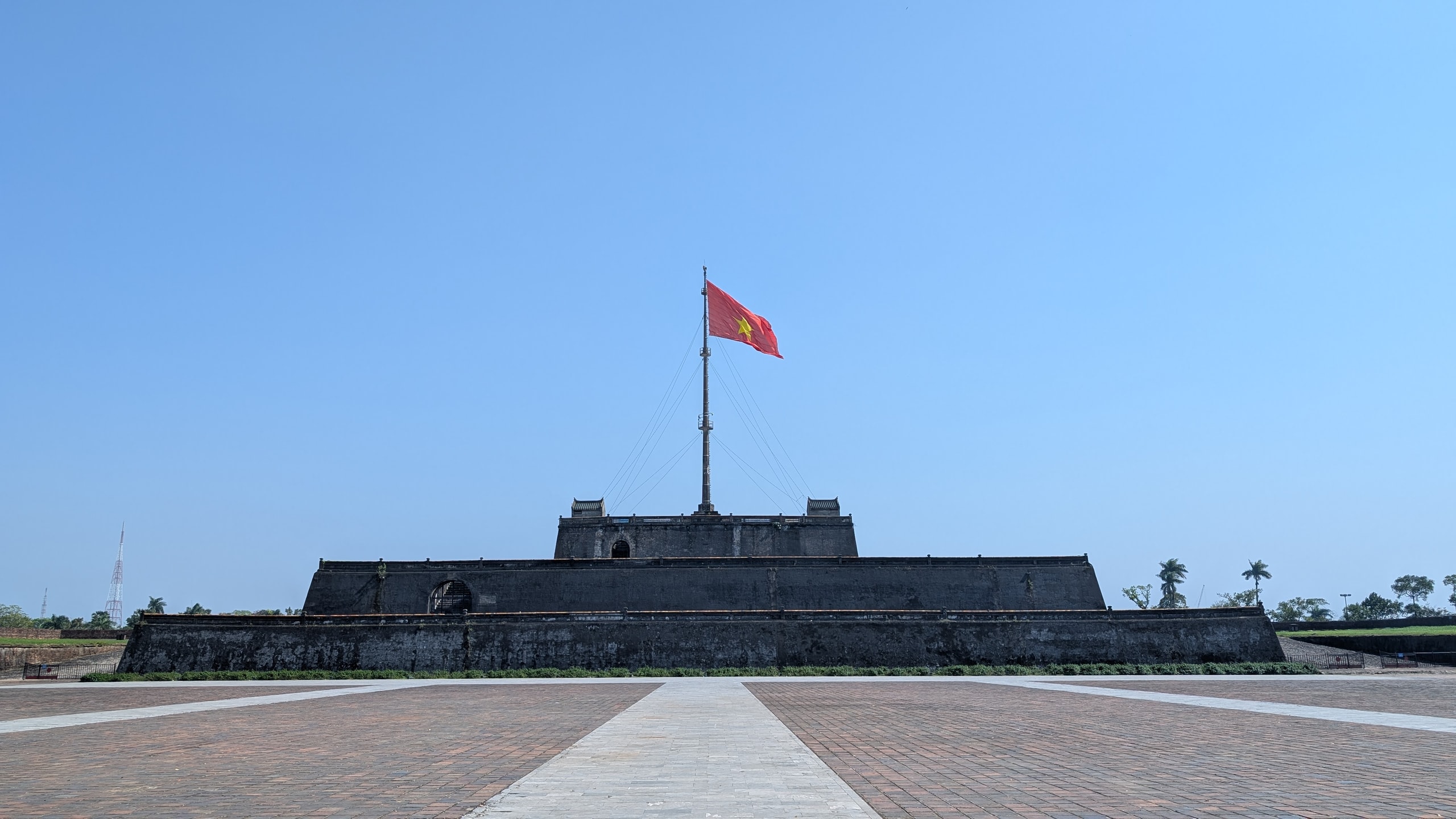
Coming from the river, you pass the Flag Tower first: a three-level brick platform under a very large Vietnamese flag. The paved square in front has no trees at all, and at two in the afternoon in March the bricks throw the heat straight back at you. Take the photo and keep moving.
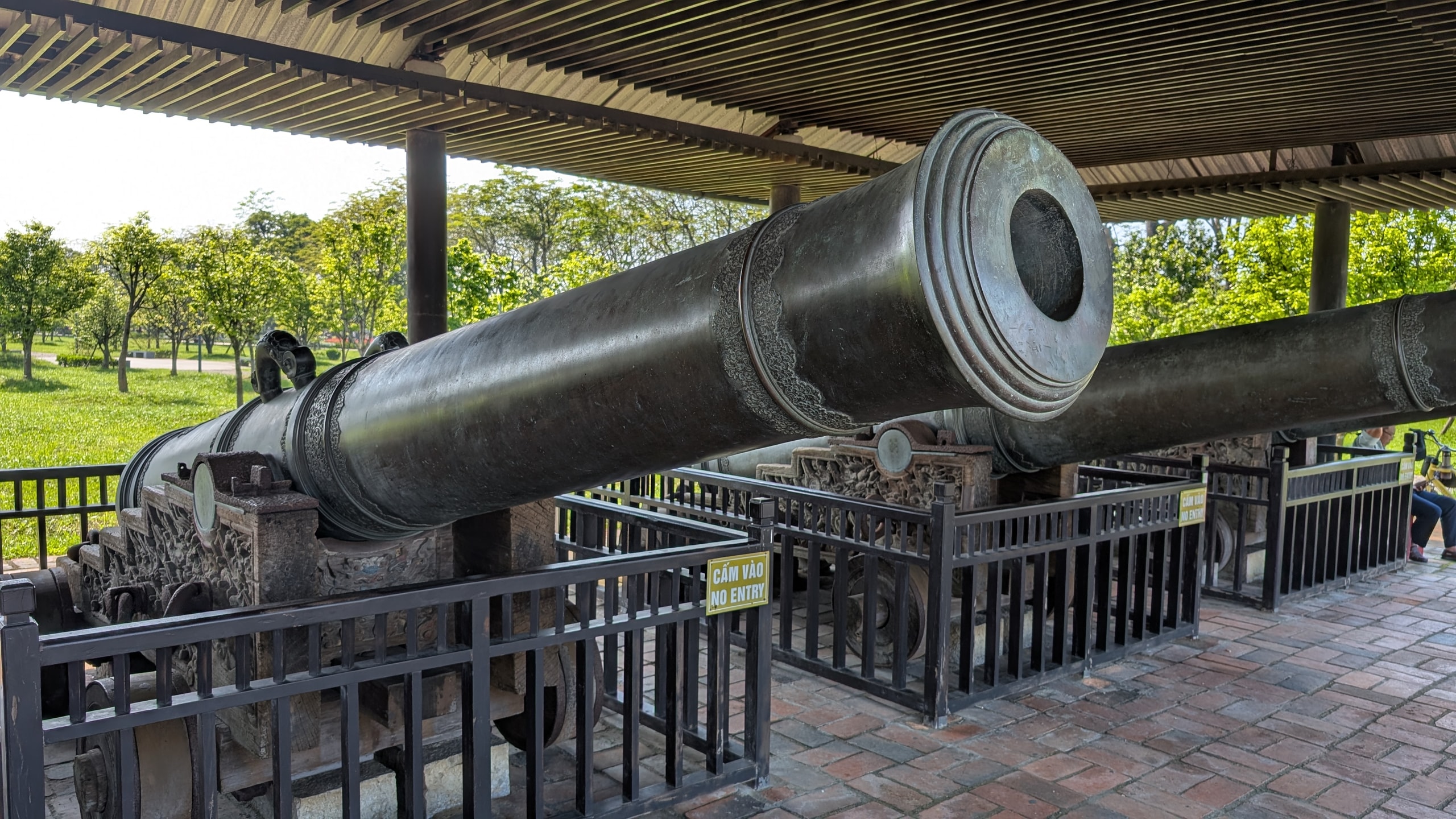
Nearby, under long tiled roofs, sit the Nine Holy Cannons. Emperor Gia Long had them cast in 1803 from bronze taken from the Tay Son rulers he had just defeated. Each is about five metres long and weighs around ten tonnes, and none was ever fired. They are fenced off now, but the pavilions are some of the only shade in this part of the citadel.
Then comes the Noon Gate, Ngo Mon, built in 1833: a stone base with five doorways and a two-storey wooden pavilion on top. The centre door was for the emperor alone. You can climb up into the pavilion for a view back towards the Flag Tower.
Inside, Thai Hoa Palace, the throne hall, reopened in 2024 after years of restoration. Past it, most of the Forbidden Purple City, the emperor's private quarter, is lawn and the outlines of old walls, with signs showing photos of what stood there before 1968. For the war itself, told from the government's side, the War Remnants Museum in Saigon goes much further.
Give the Imperial City two to three hours. An adult ticket is 200,000 VND ($8). Hours change, so check the Hue Monuments Conservation Centre before you go.
Kien Trung Palace is the building to find
The best building in the Imperial City sits at the far north end, and plenty of tour groups run out of time before they reach it. Kien Trung Palace was built between 1921 and 1923 for Emperor Khai Dinh and later became Bao Dai's home. It was destroyed in the late 1940s, and for about seventy years only the foundations were left. Rebuilt from old photographs and drawings for around 123 billion VND ($5 million), it opened to visitors at Lunar New Year in 2024.
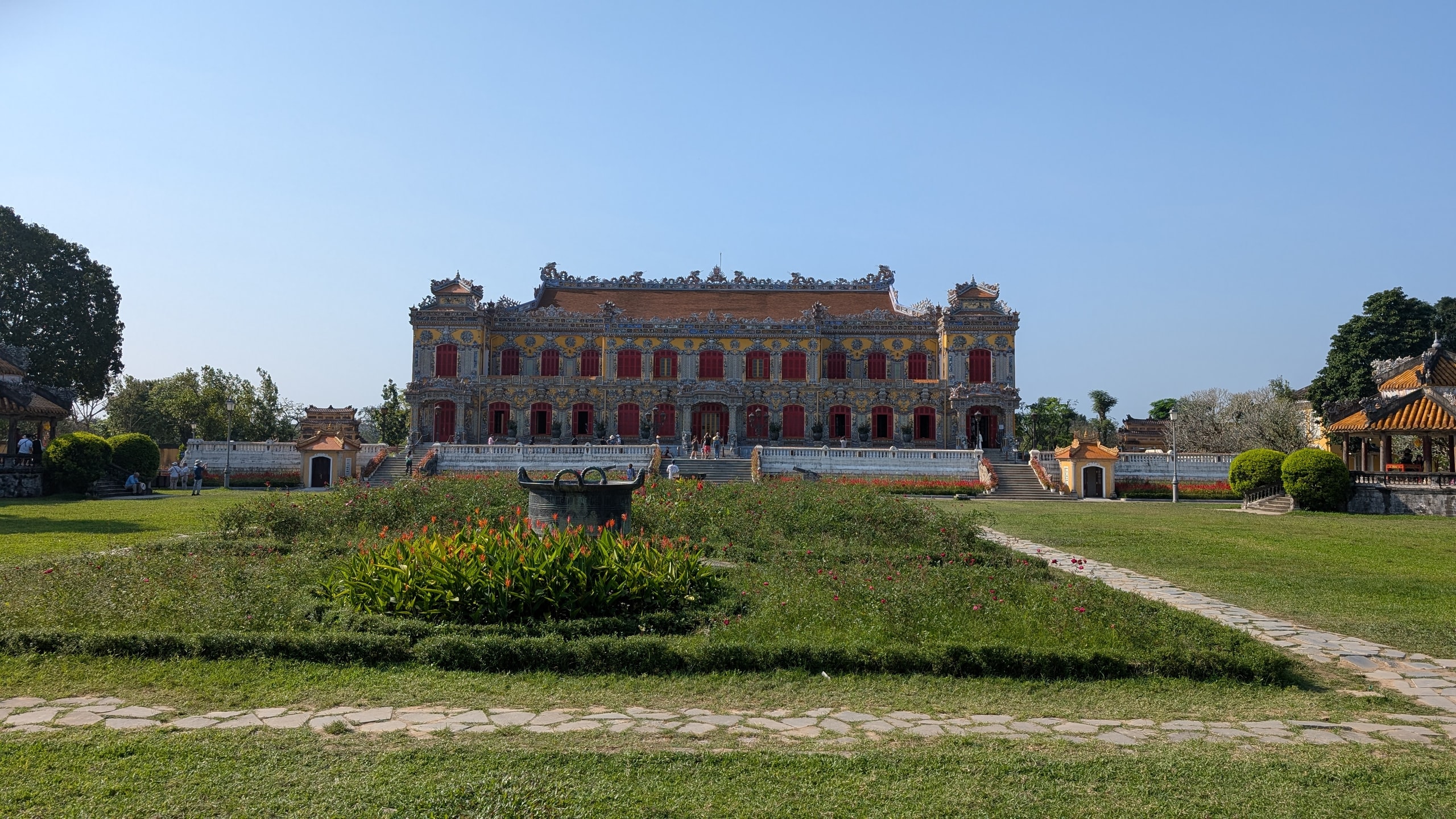
It looks like nothing else in Hue. The shape is a French villa, with balustrades and tall windows, but the surface is covered in Vietnamese decoration: dragons along the roofline, and trim made from broken porcelain and coloured glass pressed into the plaster. The walls are deep yellow and the shutters red. Inside are a few rooms with period furniture and photos of the royal family. Thirty minutes covers it, and it is included in the Imperial City ticket.
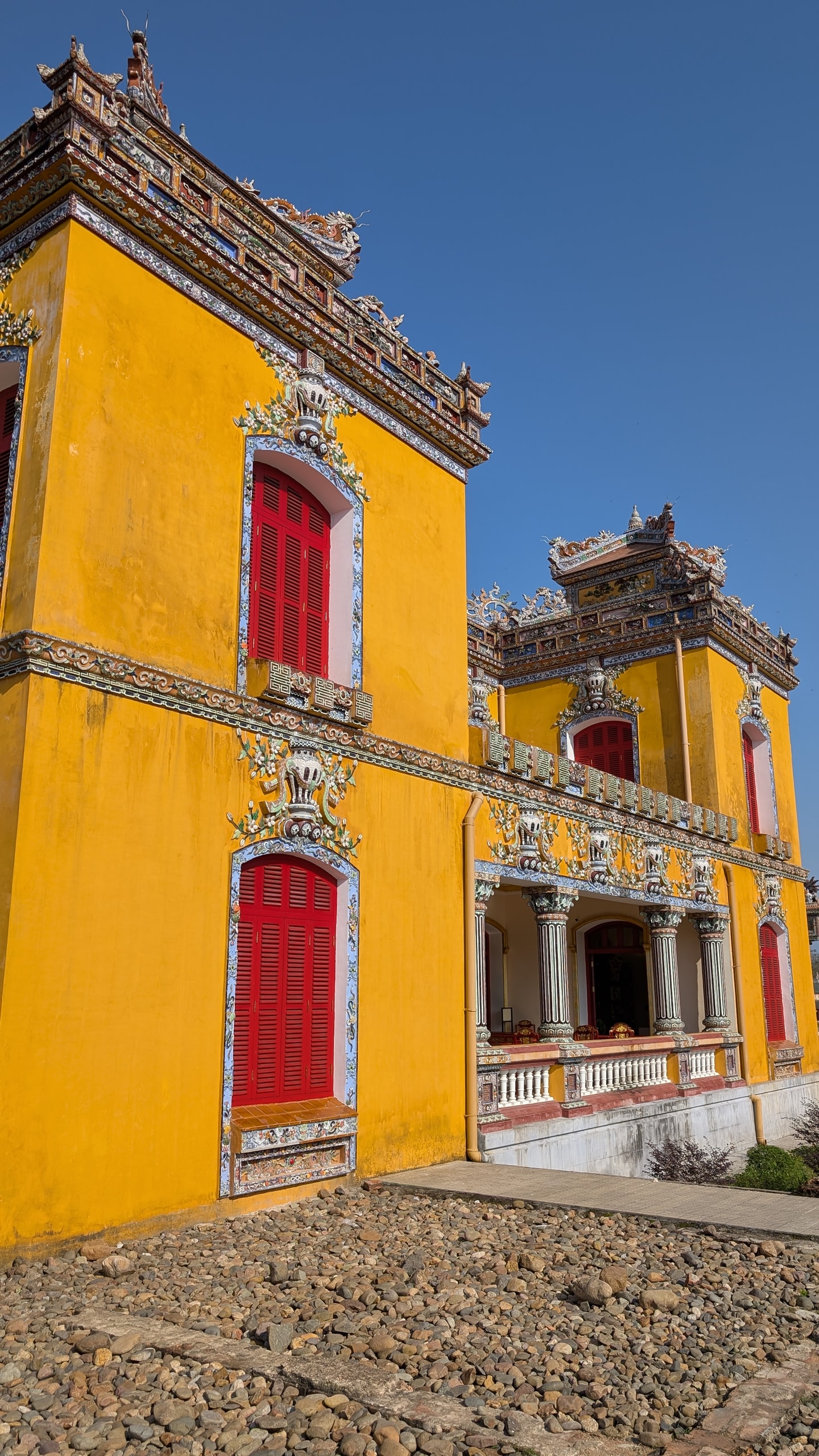
Go late in the afternoon, when the lower sun lights up the yellow front.
Khai Dinh's tomb: if you see one tomb, see this one
The Nguyen emperors built their tombs in the hills south of the city, and seven are open to visit. A day trip usually fits one. Pick Khai Dinh.
Khai Dinh reigned from 1916 to 1925 and was not a popular man. He was widely seen as a puppet of the French, and he raised taxes by about 30 percent to pay for his tomb. It took eleven years to build, from 1920 to 1931, and looks nothing like the older tombs: concrete, weathered to dark grey, mixing Vietnamese dragons with Gothic-looking spires and European columns. Some people find it ugly. It is still the most interesting building in Hue.
The tomb is about 10 km south of the centre, so you need a car or a Grab (120,000-150,000 VND, $5-6, each way). Entry is 150,000 VND ($6). From the gate you climb 127 steps between banisters carved as long dragons, past a courtyard of stone mandarins, elephants and horses lined up to guard the emperor.
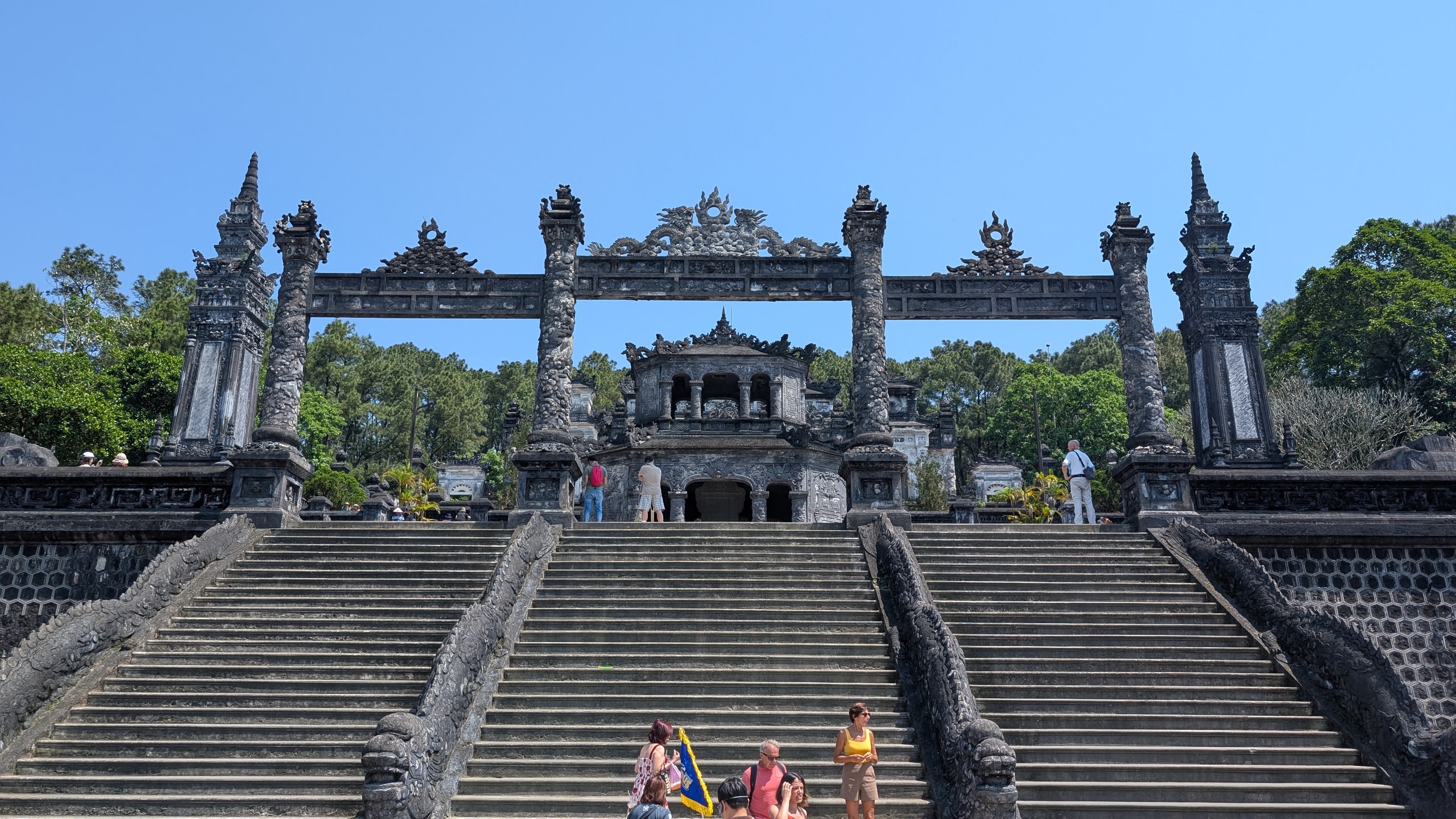
At the top is the main hall, Thien Dinh, and it is the reason to come. Nearly every surface inside is covered in mosaic made from broken porcelain and glass: walls, columns, the canopy over the throne. In the middle sits a gilded bronze statue of Khai Dinh, cast in Marseille. His remains lie 18 metres below it.
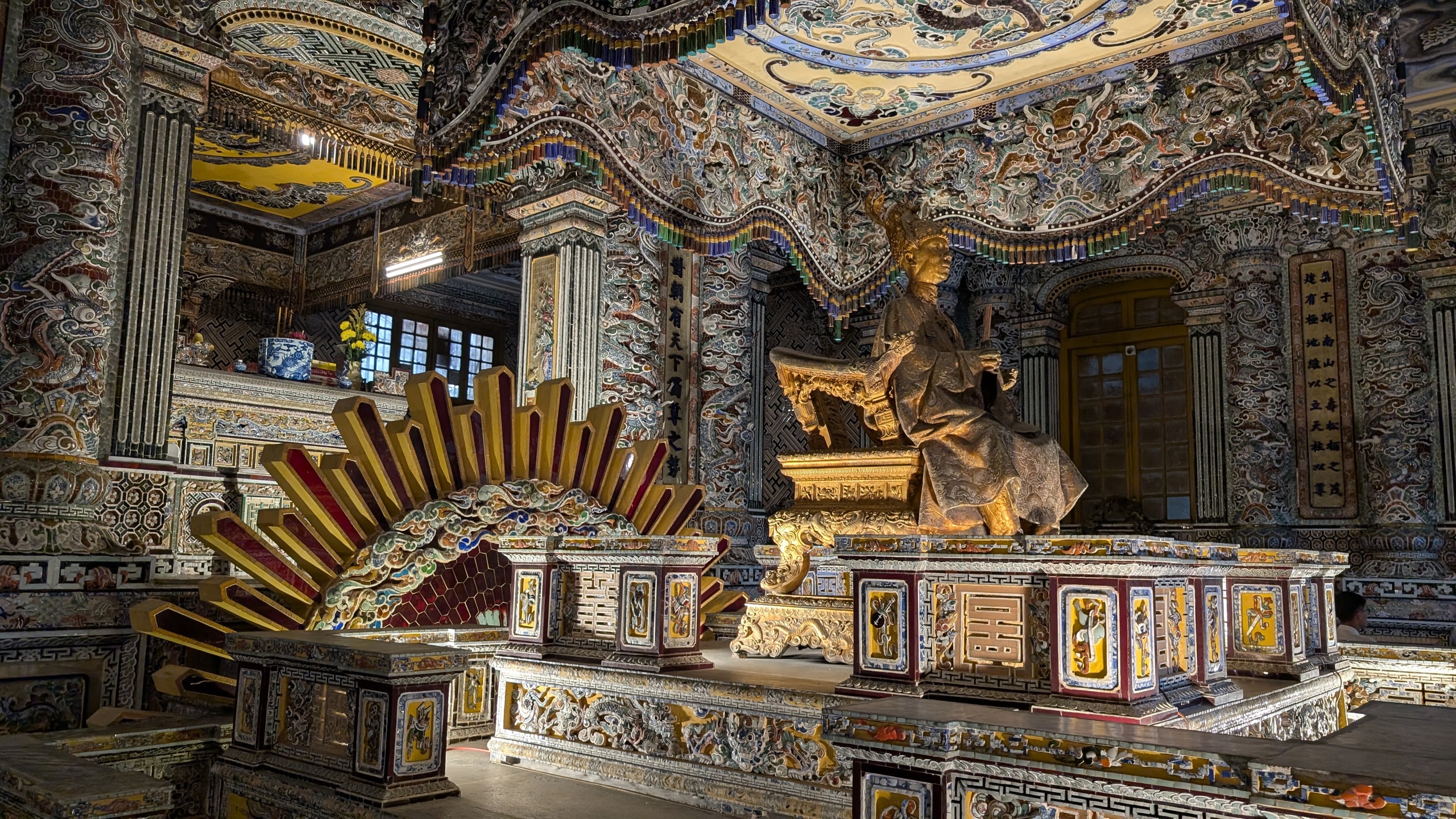
He taxed the country to build it, and a hundred years later it is the one tomb everyone wants to see.
The climb is short, but there is little shade, and by 11 a.m. the stone is hot. Go when the gates open at 7 a.m. if you can, which is one of the best reasons to sleep in Hue. With time for a second tomb, Tu Duc's is closest to town, set around a lotus lake and pine trees. Minh Mang's is the most traditional and the quietest, but further out. All three in one afternoon mostly means seeing three car parks.
What Hue costs, and what to eat
A clean guesthouse runs $15-25 a night and a mid-range hotel with a pool $40-70. The combo tickets reward staying: the Imperial City plus Khai Dinh and Minh Mang costs 420,000 VND ($17), or 530,000 VND ($21) with Tu Duc added, and both are valid for two days.
Eat bun bo Hue in the city it is named after: a beef noodle soup with lemongrass and chilli, often with a cube of pig's blood you are free to leave in the bowl. A street bowl costs 40,000-60,000 VND ($1.60-2.40), and the best stalls sell out by late morning. Com hen, rice with tiny river clams, costs about 25,000 VND ($1). Both are easy to find around Dong Ba Market.
When to go, and how long to stay
February to April is the best time: dry, warm and mostly clear, around 30°C (86°F) at midday in early March. May to August often hits 35-38°C (95-100°F), and the Imperial City lawns give you nowhere to hide. October and November bring heavy rain and floods that regularly push the river into the citadel streets.
Two nights is right. Come over the pass, reach the Imperial City by early afternoon, and walk to Kien Trung before closing. Do Khai Dinh at 7 a.m. the next day, then a second tomb or a boat up the river to Thien Mu Pagoda. One night also works.
If you really only have one day, do the pass early, reach Khai Dinh before noon, and spend the afternoon in the Imperial City, walking straight to Kien Trung first. You will see the main sights. You will also spend about seven hours in a car. More stops around the country are on the Vietnam page.