At ten past seven in January the sun drops into the Andaman Sea off Pantai Cenang and a few hundred people stop what they are doing to watch it. The toy vendors keep working. Jet skis come in and get dragged up the sand for the night. The water close to shore is a green-brown that no filter fixes, and by 7:15 it stops mattering, because the sky turns orange and everyone on the sand turns to face it.
Langkawi is an archipelago of 99 islands off Malaysia's northwest coast, in the state of Kedah, close enough to the Thai border that your phone sometimes gets confused about it. The main island is roughly 30 km across, mostly forest and limestone, with a ring road and one busy beach strip. It has been a duty-free island since 1987 and a UNESCO Global Geopark since 2007, the first in Southeast Asia.
Most people book it for the beach. The beach is the least interesting thing here. Three or four days is the right length, and at least one of those days belongs on a mountain. It pairs well with four days in George Town on Penang, thirty-five minutes away by plane, and the two islands have almost nothing in common.
The cable car earns the ticket
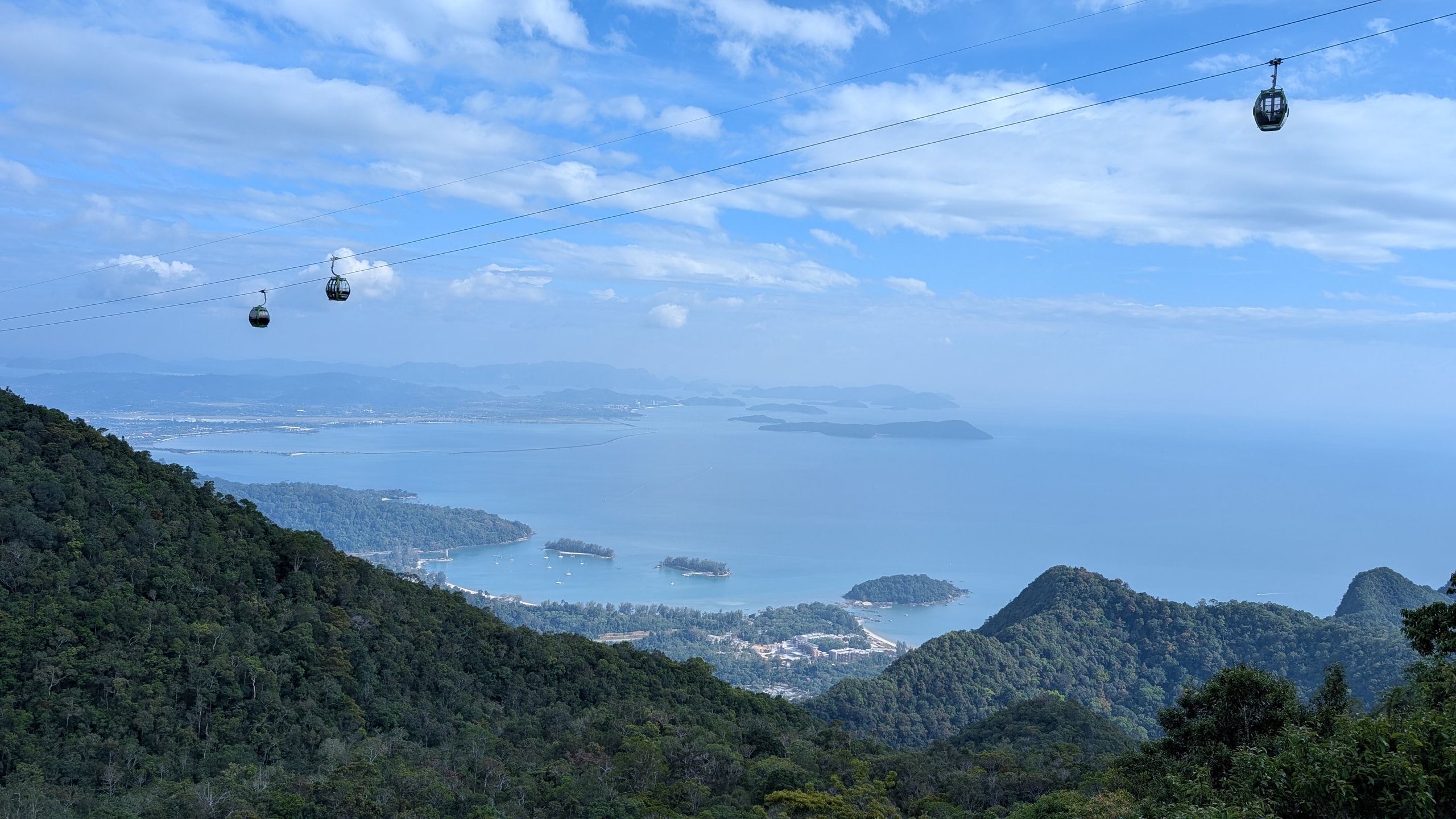
Panorama Langkawi sits at the Oriental Village near Burau Bay, on the island's northwest corner. The SkyCab climbs Gunung Machinchang in two stages to a top station at 708 metres, and the second stage is steep enough that the cabin floor feels wrong for a few seconds. The whole ride takes about fifteen minutes each way.
At the top you get the view in the photo at the head of this page: ridge after ridge of forest, the airport runway flat against the coast, the bay at Pantai Kok with boats parked in it, and small islands scattered out toward Thailand. On a clear afternoon the Thai island of Tarutao is visible. The rock underfoot is Cambrian sandstone, around 550 million years old and the oldest exposed rock in Malaysia, which is the actual reason for the geopark status.
The SkyBridge is the separate paid extra, and it is worth it. A curved 125-metre walkway hangs from a single pylon at 660 metres, with two glass floor panels in the middle if you want to look straight down. You get down to it by the SkyGlide inclined lift or a long flight of steps.
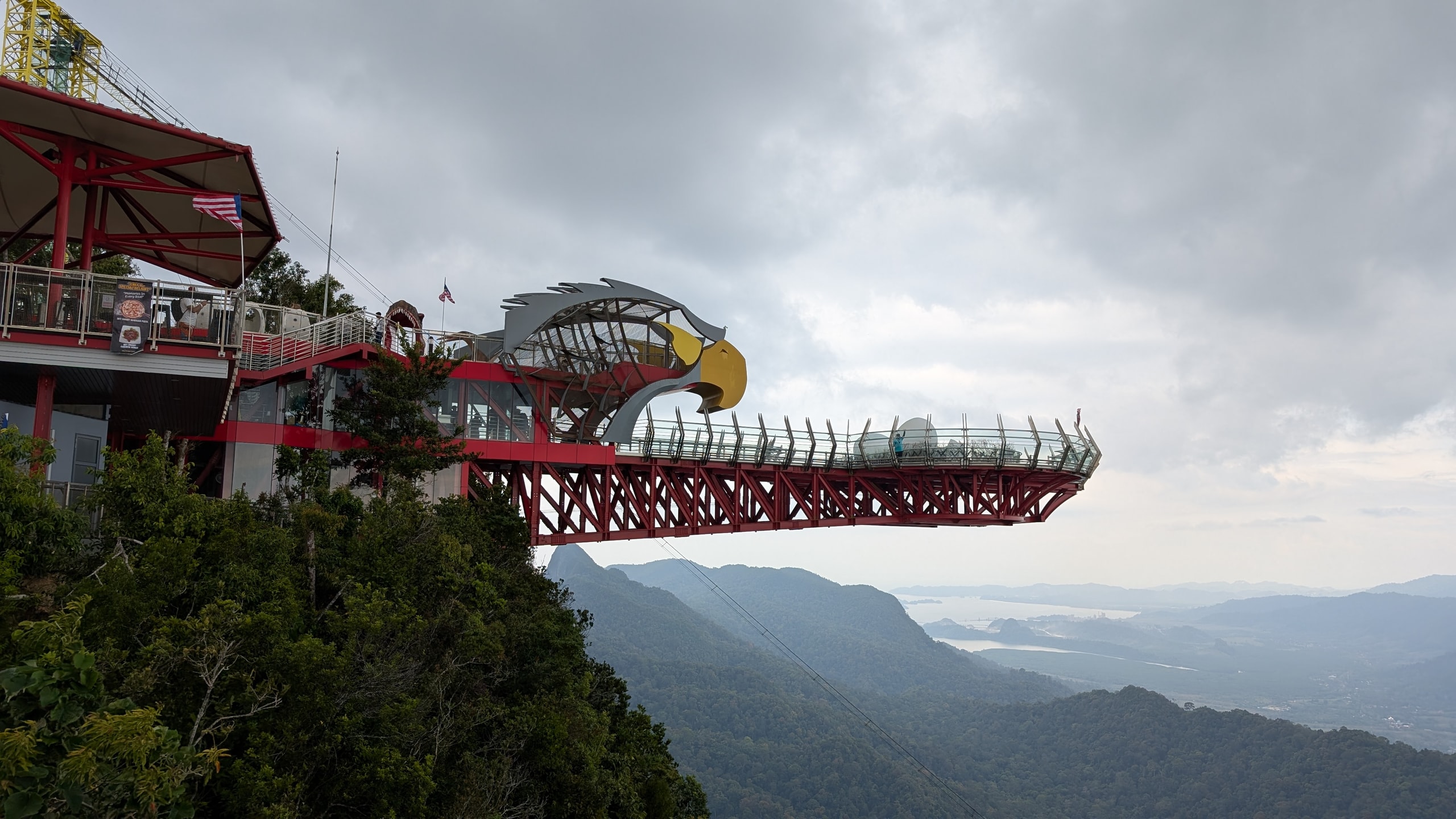
Budget around RM85 ($19) for a standard adult foreign-visitor SkyCab ticket, plus a few ringgit for the SkyBridge and roughly RM20 ($4.50) if you want the SkyGlide instead of the stairs. Book on the Panorama Langkawi site the night before and pick a morning slot. Queues stack up between 11 a.m. and 2 p.m. when the tour vans arrive, cloud usually wins by mid-afternoon, and the whole system shuts on windy days. Check the forecast the evening before.
Cenang Beach is worth one sunset
Pantai Cenang is about 2 km of sand on the west coast with the island's densest strip of bars, dive shops, convenience stores and rental counters behind it. It is where most visitors sleep and where nearly all the noise lives.
The sand is coarse and grey-tan rather than white, and the water carries sediment from the mangroves and the strait, so it stays cloudy near shore for most of the year. It is fine to swim in. It is not worth putting a snorkel mask on. If you want clear water you take a boat to the outer islands, or drive north to Tanjung Rhu, where the beach is longer, paler and much quieter. For a beach that carries a whole trip on its own, Phu Quoc has better water and better sunsets than anything on Cenang.
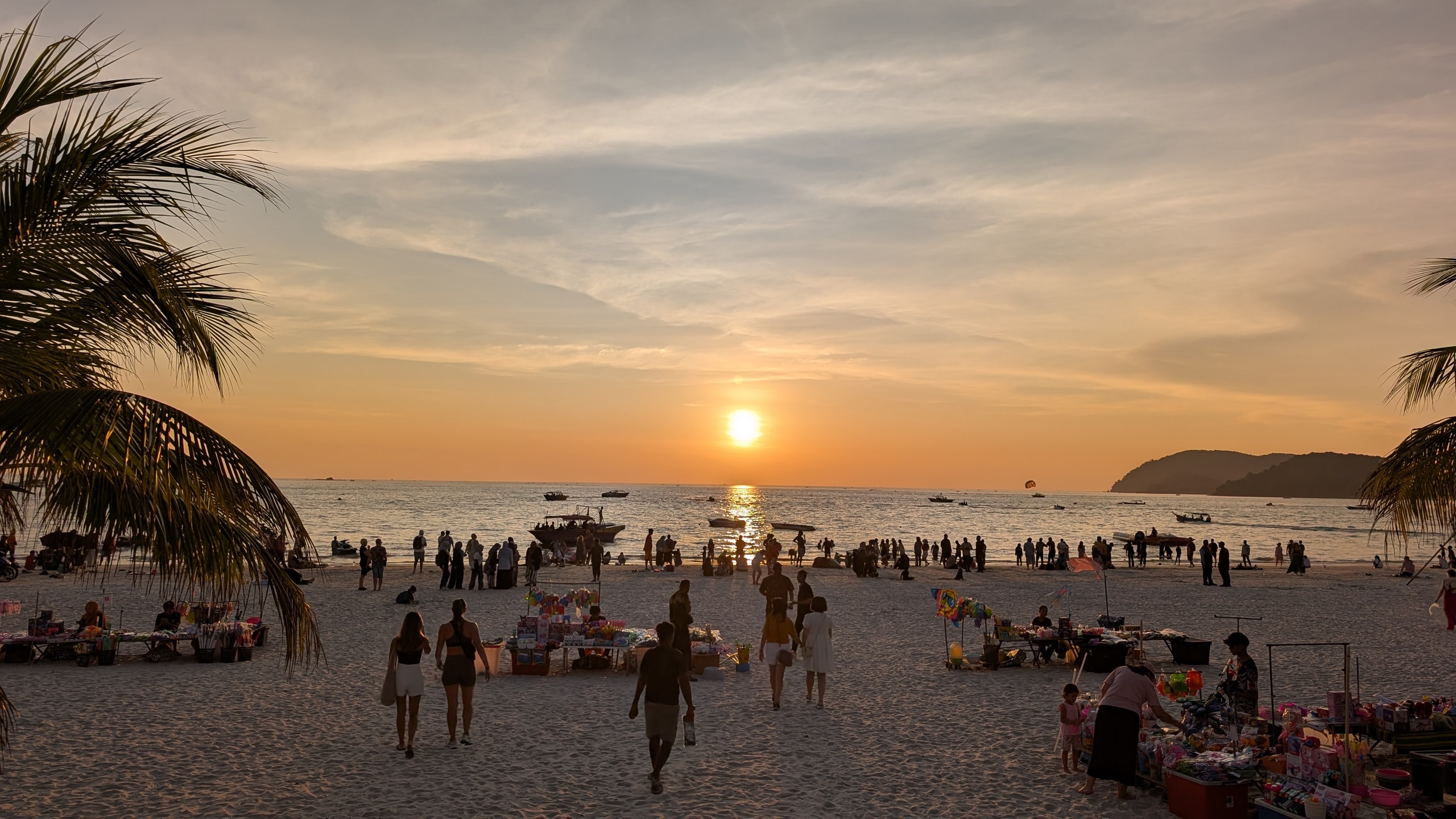
The watersports operators work the middle of the beach all afternoon. Jet ski rental runs about RM150-250 ($34-56) for thirty minutes, parasailing around RM120 ($27). The rental skis stay inside a marked box within sight of the shore, which is a lot of noise for a short loop. If you want a jet ski to be worth the money, take a guided tour out to the islands instead. Either way, the north end of the beach is where you go to read.
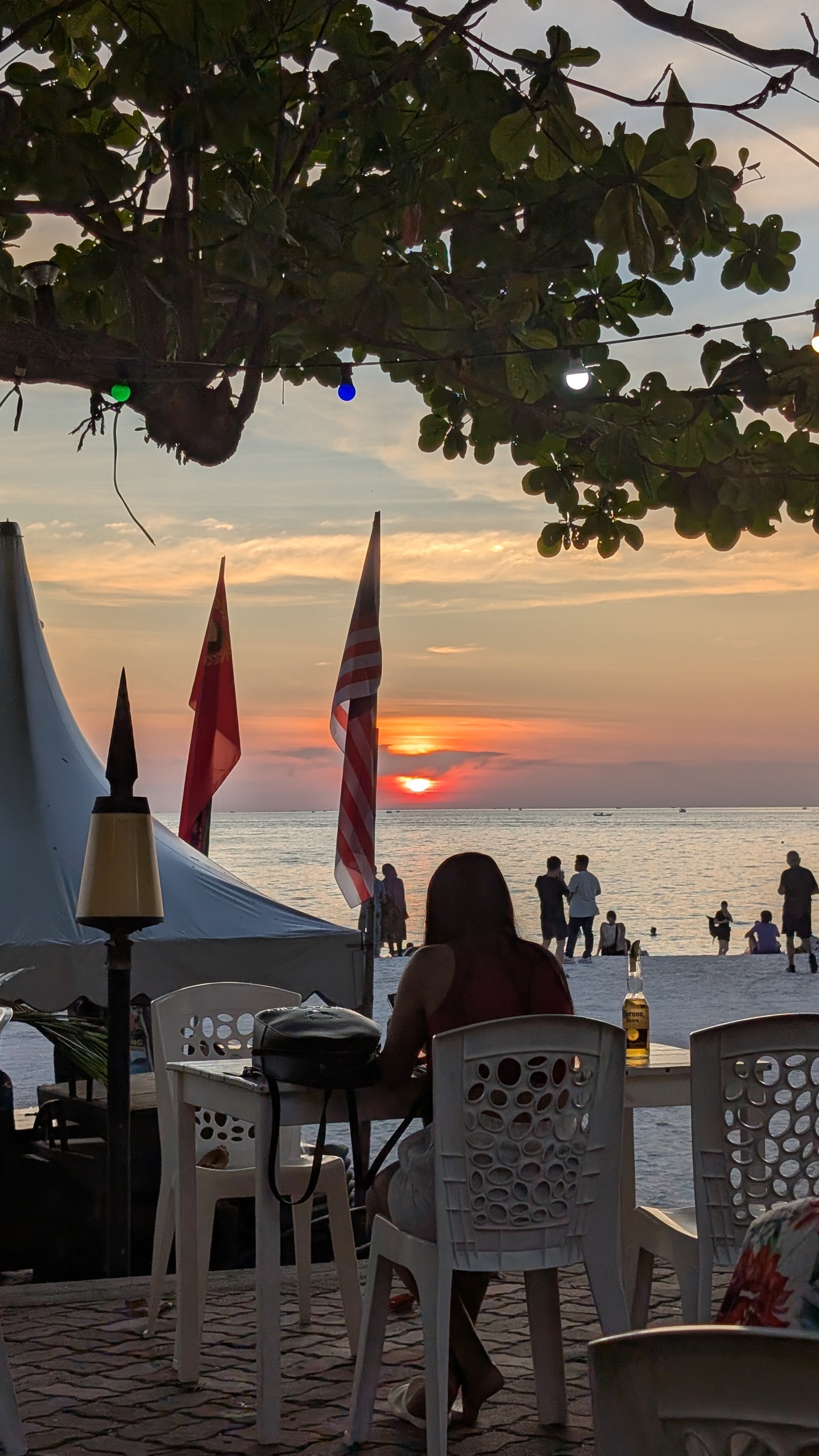
What Cenang does properly is the evening. Sunset lands between 7:10 and 7:25 p.m. from November through February. Half the beach bars are plastic chairs under a tree with a string of coloured bulbs, and they are better than the places with menus in three languages.
Duty free is not a gimmick here
This is the part that actually changes what a few days cost. Langkawi's duty-free status means a can of beer costs about RM4-7 ($1-1.60) in a shop, against RM10-14 on the mainland, and a bar on the sand will charge RM12-20 ($3-4.50) for a bottle. Chocolate, spirits and cigarettes are all sold by the box in Kuah town.
Set against a bar bill in Kuala Lumpur, the gap is obvious. It also means a modest hotel plus a bar tab here costs less than the same evening almost anywhere else in Malaysia. One caveat: Kedah is a conservative state outside the tourist strip, so drink where people are drinking.
Ten minutes inland the island goes quiet
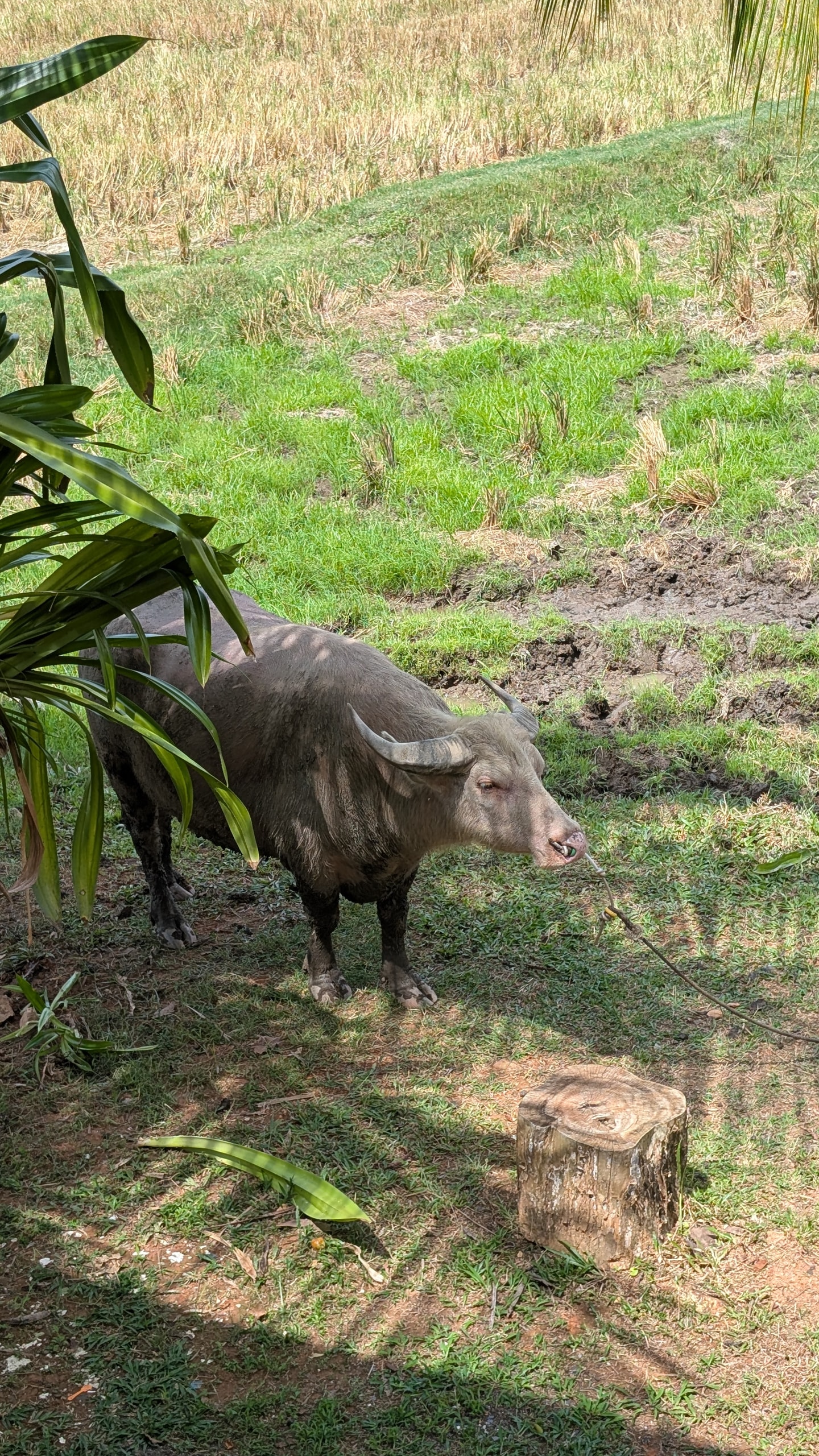
Behind the Cenang strip, past the second roundabout, is Laman Padi - a working rice garden with a small museum, free to walk into, and almost empty at midday. Plots sit at different stages: one flooded and stubbled with new seedlings, the next dry and cut to yellow stubble, water buffalo tethered on the bunds between them. There are thatched shelters, a red-roofed museum building, and a stand of coconut palms.
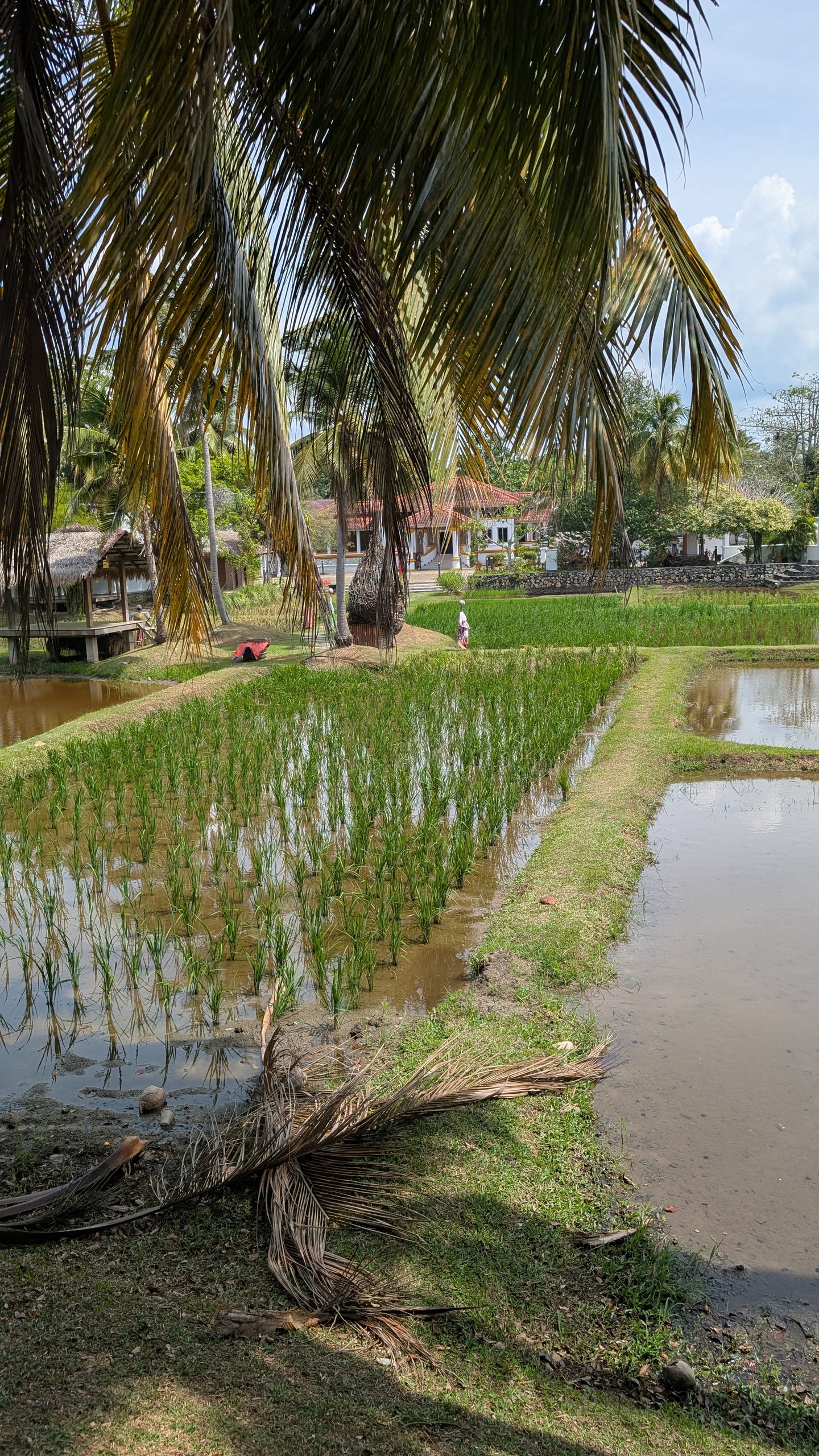
A yellow sign nailed to one of the palms reads BEWARE FALLING COCONUT, with a stick figure and a coconut drawn mid-drop. It is not a joke. Stand somewhere else.
Give it forty minutes. It is the clearest picture of what the island did before the resorts, and it is free. If you want more of that, the Telaga Tujuh waterfall near the Oriental Village is a 600-step climb to a series of natural rock pools, best after rain and often down to a trickle by February.
The one indoor thing that works in the rain
Underwater World Langkawi, at the south end of Cenang, costs around RM50-60 ($11-14) for a foreign adult. Parts of it are dated and the fish tanks are ordinary. The penguin room is not. African and rockhopper penguins live in a chilled, blue-lit enclosure of real rock and water, and the room is cold enough that you will want a shirt with sleeves.
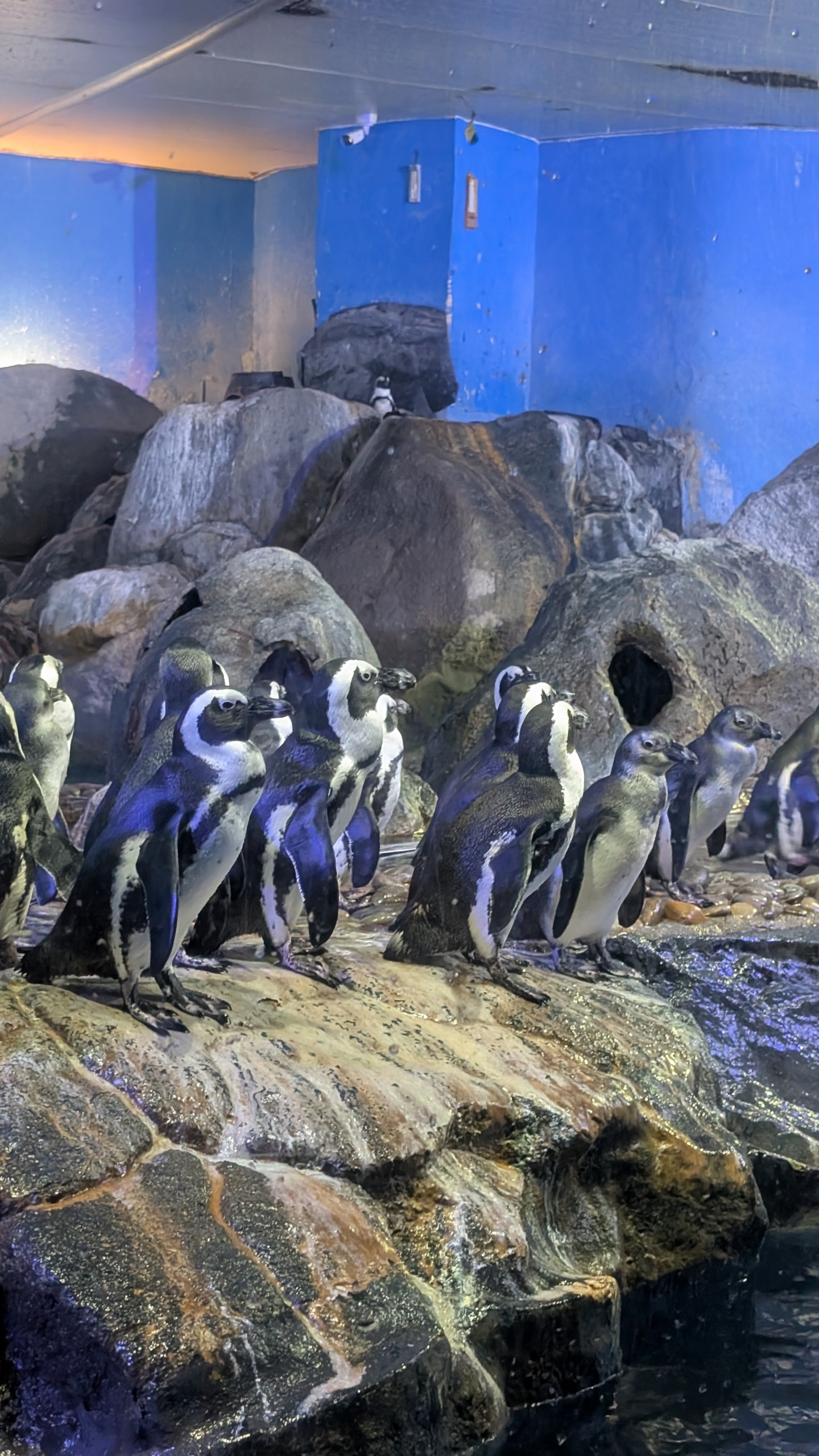
Go when it rains, which between April and October it will, usually in the afternoon.
Boats, jet skis and the eagle feeding
Two boat trips are sold everywhere. Island hopping is the cheap one, about RM40-60 ($9-14) a person for a shared half day out to Dayang Bunting, where you walk ten minutes to a freshwater lake in a limestone bowl, then on to a swimming beach at Beras Basah. Kilim Karst Geoforest Park is the better one: a mangrove boat through limestone channels, bat caves and fish farms, from roughly RM250-350 ($56-80) for a private boat for three to four hours, less per head if you share.
The third option costs more and is the one people talk about afterwards. Guided jet ski tours run the same island circuit in a convoy behind a lead guide, with stops to raft up in a bay, swim, and eat on a beach. Budget roughly RM750-950 ($170-215) per machine for a half day of three to four hours, or RM450-600 ($100-135) for a two-hour run, with two people allowed on one ski. Bring a dry bag and a strap for your phone, and take more sunscreen than you think you need - there is no shade for four hours.
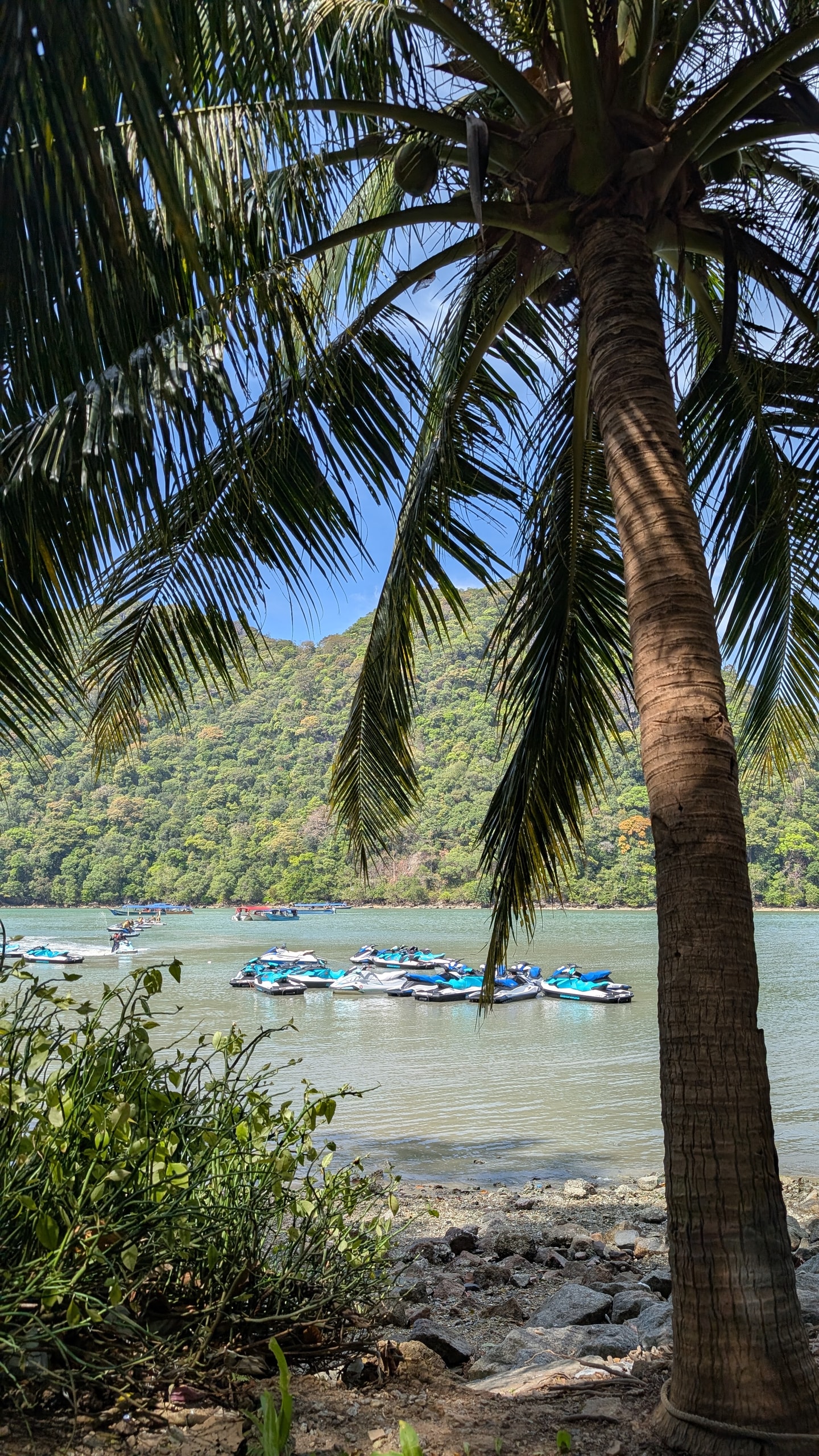
It is a loud way to see a geopark, and that is a fair thing to hold against it. If the budget only stretches to one water activity, spend it here rather than on thirty minutes in a box off Cenang.
Most of these trips include an eagle-feeding stop, where the guide throws chicken scraps in the water so brahminy kites dive for the camera. Skip it. It trains wild raptors onto boat engines, and the birds circling the mangroves on their own are a better sight anyway. Say no when you book; several operators have dropped it already.
Costs, seasons and how to move
Flights land from Kuala Lumpur in an hour. Ferries run from Kuala Perlis in about 1 hour 15 for roughly RM23 ($5), and from Kuala Kedah. The Penang ferry has been on and off in recent years, so check it before you build a plan around it.
Once here, rent something. Car hire runs RM60-120 ($14-27) a day, scooters RM30-50 ($7-11), and petrol is cheap. Grab works but thins out once you leave Cenang, and the island is too spread out to walk. A guesthouse runs $20-35 a night, a mid-range hotel $50-90, and the resorts at Datai Bay start around $250. Eat at a roadside warung for RM8-15 ($2-3.50) or a beach restaurant for RM40-70 ($9-16) a head.
November to March is the dry season and February is about as good as it gets. April to October brings afternoon storms, with August and September the wettest. Avoid Chinese New Year and Malaysian school holidays: the island fills with domestic and Singaporean visitors and room rates double. If your dates are locked to that week anyway, Singapore over Chinese New Year has its own set of closures worth knowing about.
Kuah: the ferry town and the eagle
Kuah, on the southeast coast, is where the ferries dock and where the duty-free shops are stacked three to a block. On the waterfront stands Dataran Lang, a 12-metre reddish-brown eagle with its wings up over a tiled fountain. The name is usually explained as helang, eagle, plus kawi, a reddish-brown stone.
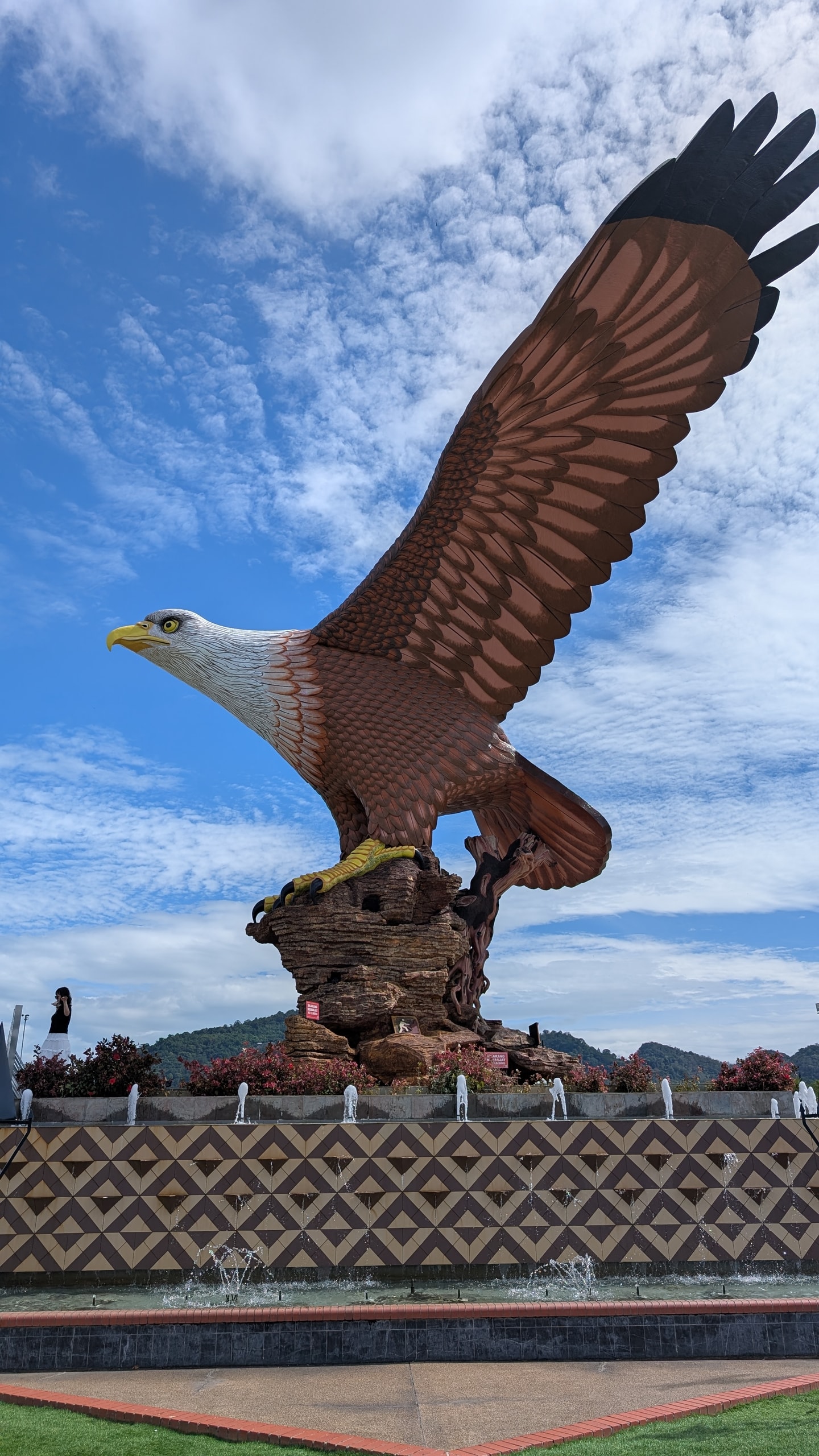
It is free and you will be done in fifteen minutes. Buy your chocolate two streets back, eat at one of the Malay places along the main road where a plate costs a third of what it does in Cenang, and drive back across the island in the dark past unlit paddy fields.
That is the shape of a good Langkawi trip: one morning up the mountain, one boat, one sunset on the sand, and the rest of it on the roads in between. More of Southeast Asia is in the destinations archive.