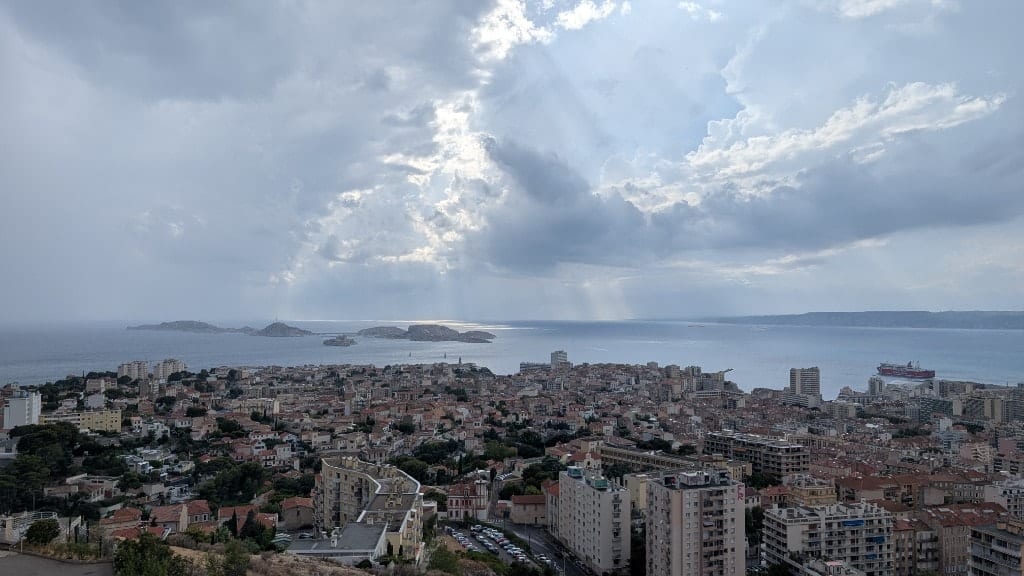
A gilded Virgin stands on the highest hill in the city, arm out over the rooftops, holding the light long after the streets below have gone into shadow. That is your first fixed point in Marseille. Wherever you get lost - and you will - look up, find the golden Madonna on Notre-Dame de la Garde, and you know which way the sea is.
Marseille is a working port of about 870,000 people - container cranes at one end, fishing boats at the other - pushed up into limestone hills around a harbour. Founded by Greek sailors around 600 BC as Massalia, it is France’s oldest city and its second-biggest after Paris. There is no palm promenade and no Cannes gloss. Loud and sun-bleached, beautiful and broke-down on the same block: that mix is why people who like real cities keep coming back. Other ports and coasts that work the same way sit in the destinations archive.
The climb to La Bonne Mère
Everything orients around Notre-Dame de la Garde, the basilica locals call La Bonne Mère - the Good Mother - on a limestone outcrop about 150 metres above the water. You can walk up through the residential streets on the hill's flanks: switchbacks, stairs, a steady grade that will have you stopping to breathe. Or take RTM bus 60 from the Vieux-Port, which runs every 20 minutes or so and does the hard part for you.
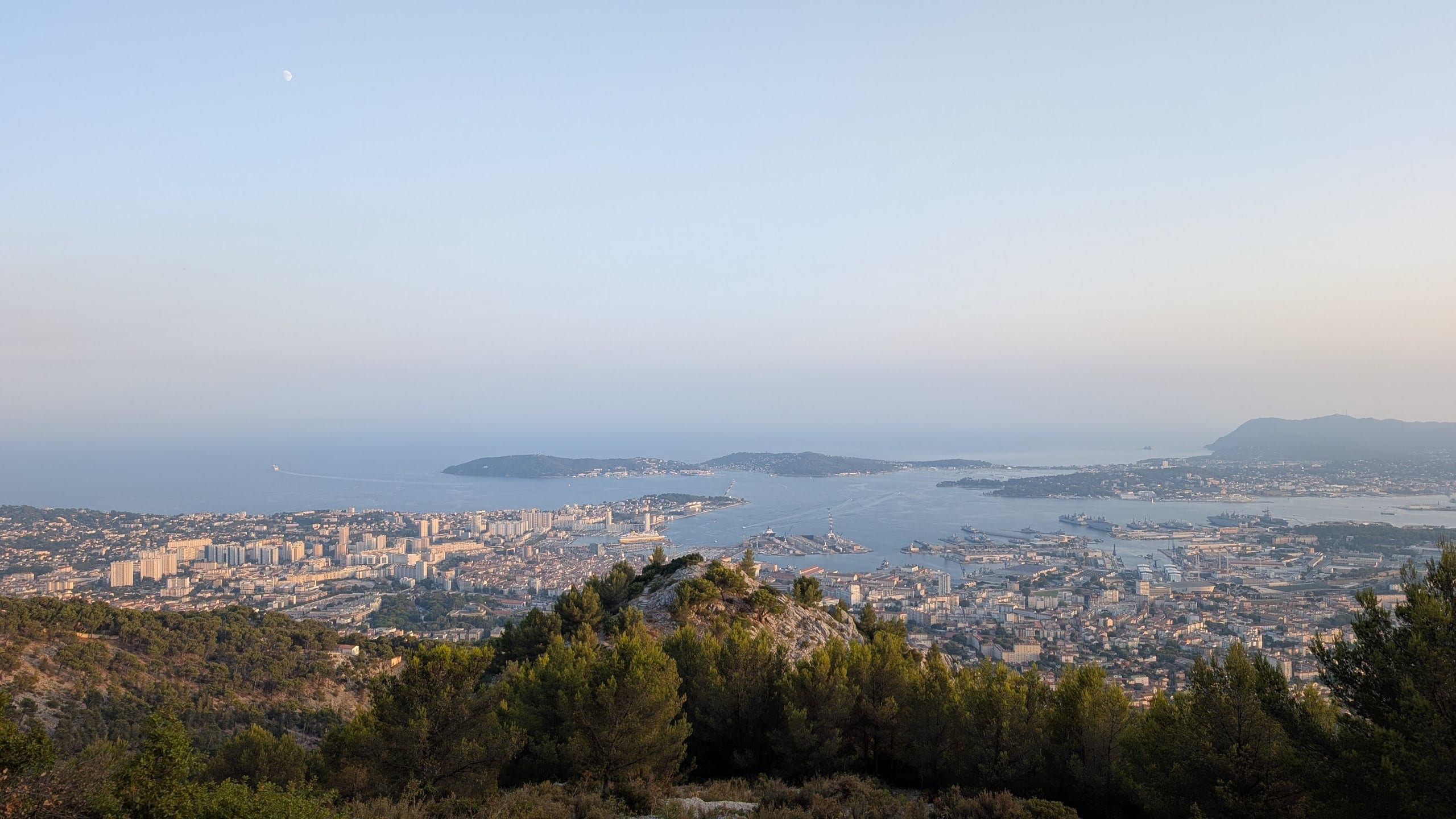
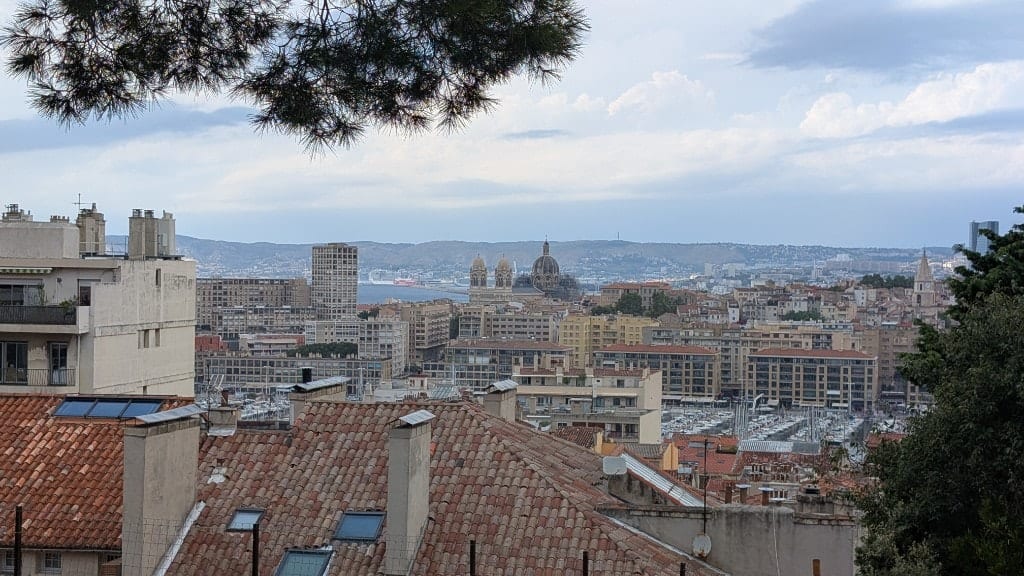
The sanctuary is open daily, 07:00-18:00, and entry is free; a small museum on site runs about $3.50. From the terrace the whole city spreads out below - the port, the islands, the container ships - the one spot where Marseille's sprawl finally looks like a single place.
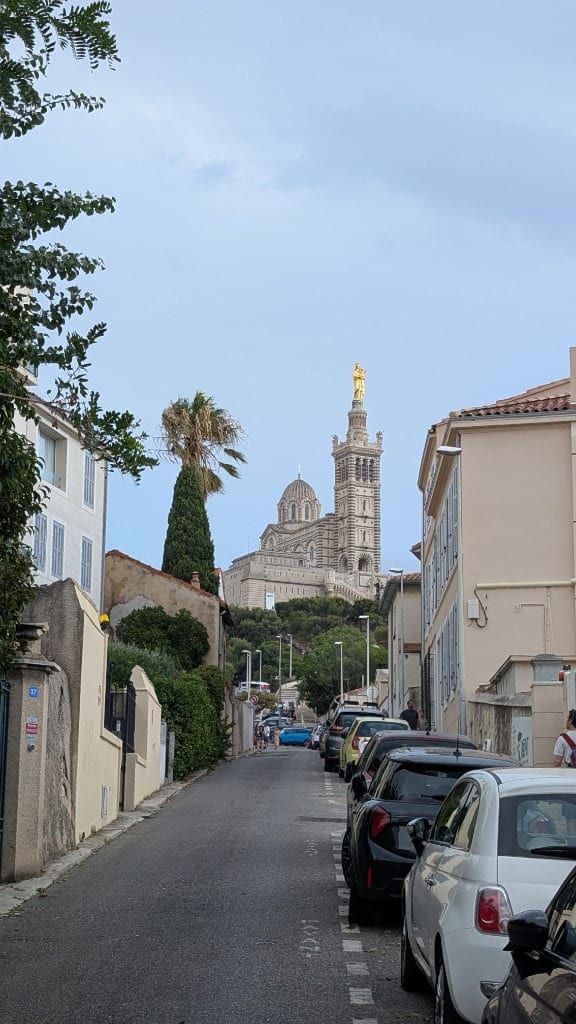
The approach on foot is half the point: ordinary streets - parked Fiats, a cypress, someone's laundry - climbing toward a basilica that keeps vanishing behind the next building and reappearing higher, until the Madonna is over your shoulder instead of the town.
Inside, the basilica turns strange and rich - banded red-and-white stone, an apse heavy with gold mosaic.
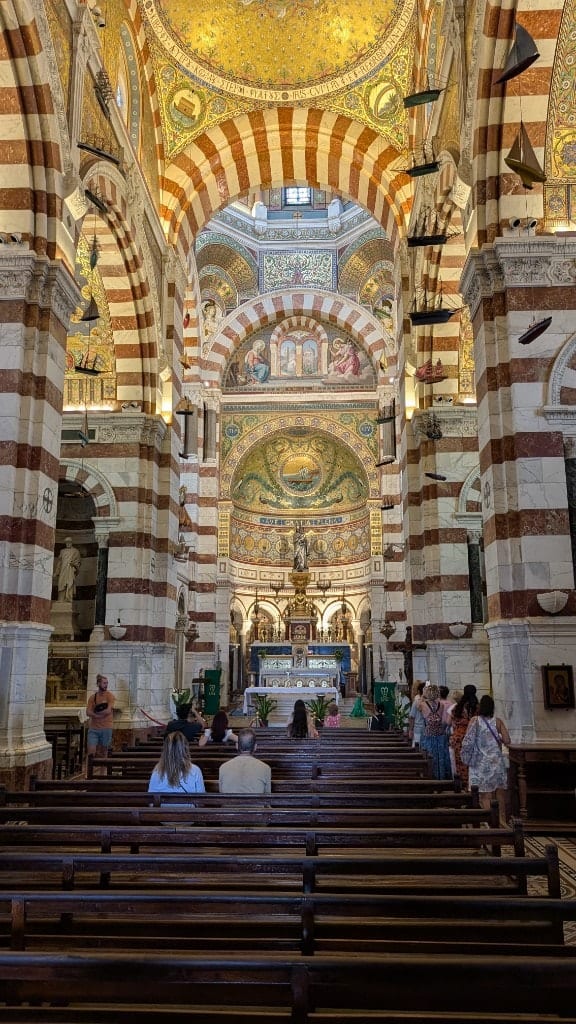
Look up before the altar. Striped arches march toward a gold half-dome, and small painted and metal ships dangle between the columns - a hundred years of "please bring them home."
The Vieux-Port and Le Panier
Down at sea level, the Vieux-Port is where the city started and still gathers. A small fish market sets up most mornings, selling that night's catch off the boats; the two forts at the harbour mouth frame the photograph.
Behind the north quay climbs Le Panier, the oldest quarter - a knot of stairs, narrow lanes, faded shutters, spray-paint, the odd square with a café and a view back down. It rewards wandering - a lived-in neighbourhood, not an open-air museum.
Mucem, Fort Saint-Jean, and the part that's free
At the harbour mouth, the Mucem - the museum of European and Mediterranean civilisations - sits in a black concrete lattice box linked by a footbridge to the old Fort Saint-Jean. The full ticket runs about $12 ($7.50 reduced); it is open daily except Tuesday, later in summer.
Here is the thing worth knowing: the fort's ramparts, gardens, and the terraces with the best sightline back to the port are free. You can spend an hour up there over the water, then decide whether the exhibitions are your kind of afternoon.
Climb to La Bonne Mère once. From up there the city looks like one place - sprawl, cranes, islands, and all.
The Calanques, and the catch
South of the city the coast breaks into the Calanques - white limestone fjords dropping into water so clear it looks fake. The best of them take a hot hike, not a car park. For another Mediterranean trip that rewards leaving the resort strip, see northwest Mallorca.
Two things will ruin the day if you don't plan for them. On peak-summer days - roughly late June through August, plus scattered dates either side - the popular Sugiton trailhead requires a free but mandatory online reservation, bookable three days ahead and gone fast. On red fire-risk days the whole massif closes to land access with no warning beyond the forecast. Check the park's app or the prefecture the night before and that morning. A closed Calanques on your one free day is the classic Marseille mistake.
The rough edges, told straight
Marseille has a reputation, and pretending otherwise is useless. Around the Noailles market and the streets near Gare Saint-Charles, you'll see peeling plaster, tagged walls, shuttered shopfronts, unswept pavements. It can feel worn and, after dark in spots, bleak.
What it mostly is, though, is a big port city with real poverty and no interest in hiding it. Keep your bag zipped and your phone in a front pocket in the market crowds. The pickpocket risk is real; the danger is mostly a story from people who never got past the train station.
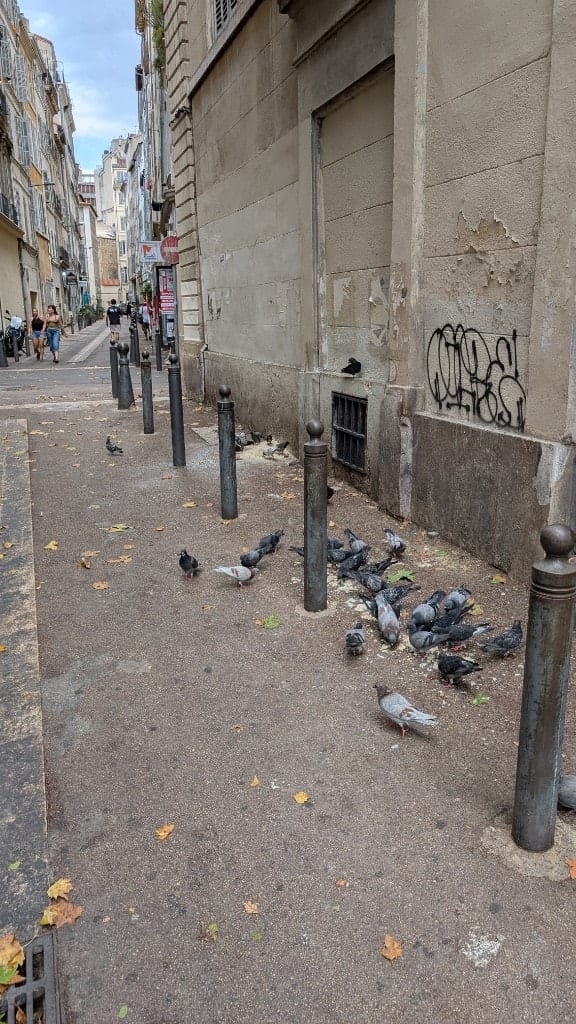
This is the frame the tourist boards leave out and the doom-scrollers exaggerate. A downhill lane, a tagged wall, birds on dropped seed, people getting on with their day. Treat it as ordinary city life, not a threat. Two hundred metres on, the same street opens to a square with a fountain.
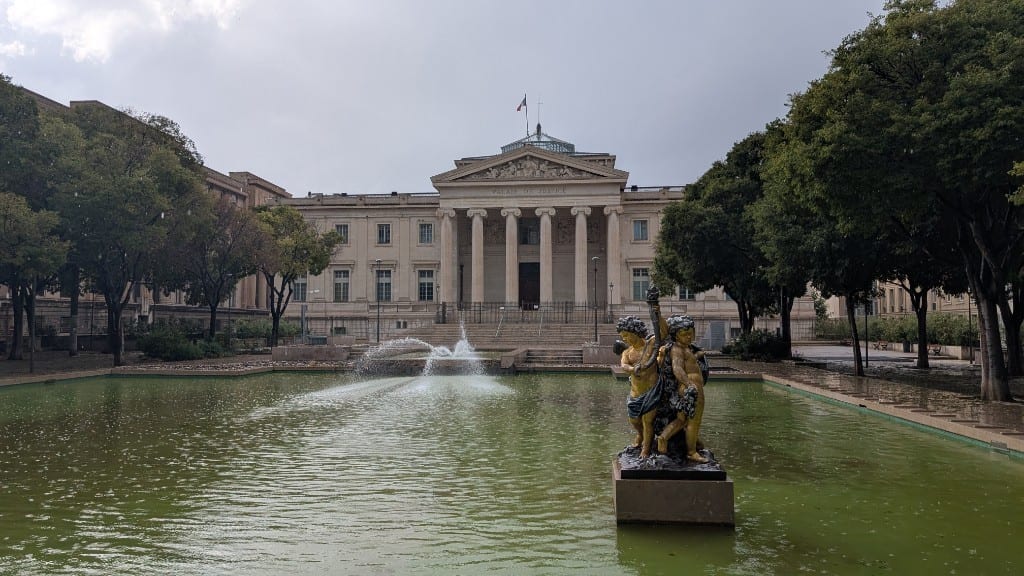
The same city keeps a grander register a few streets over. Walk up into the 6th around the Palais de Justice and Marseille turns to Haussmann-era stone: an Ionic-columned courthouse, plane-tree squares, a reflecting pool going green in the heat. The grit and the grandeur sit ten minutes apart, and both are the real place.
What it costs
- Budget hotel double: $60-110 a night; mid-range $95-165, higher in July and August
- Plat du jour lunch: $14-20. Mid-range dinner around $30-45 a head
- Panisse and socca (fried chickpea snacks): a few dollars, and the right cheap lunch
- Bouillabaisse done properly: a $50-70-per-person sit-down affair, ordered a day ahead; anything cheaper on a tourist quay isn't the real thing
- Notre-Dame de la Garde: free; the small museum about $3.50
- Mucem: about $12, but the fort terraces are free
- Train from Toulon: under an hour, around $12; Paris is about 3h10 by TGV
Getting around, and when to go
The RTM network makes the city easy: a single ticket runs about $1.90 and a 24-hour pass about $7.50, and metro lines 1 and 2 both hit the Vieux-Port. An airport shuttle runs to Gare Saint-Charles every 10-20 minutes, so you never need a taxi from the plane. The centre is walkable, as long as you accept that walking here means hills.
Come in May, June, September, or early October: the sea is swimmable, the light is long, and you skip both the August furnace and the peak Calanques crush. July and August are hot, busy, and when fire closures bite hardest. Winter is quiet, with a mistral that empties the terraces.
Who should skip it, and who shouldn't
Skip Marseille if you want a tidy resort, a spotless old town, and a beach you don't have to earn; the coast east does that better. Come if you like a city that still works for a living, food worth the trip, a climb that pays off, and honesty over gloss.