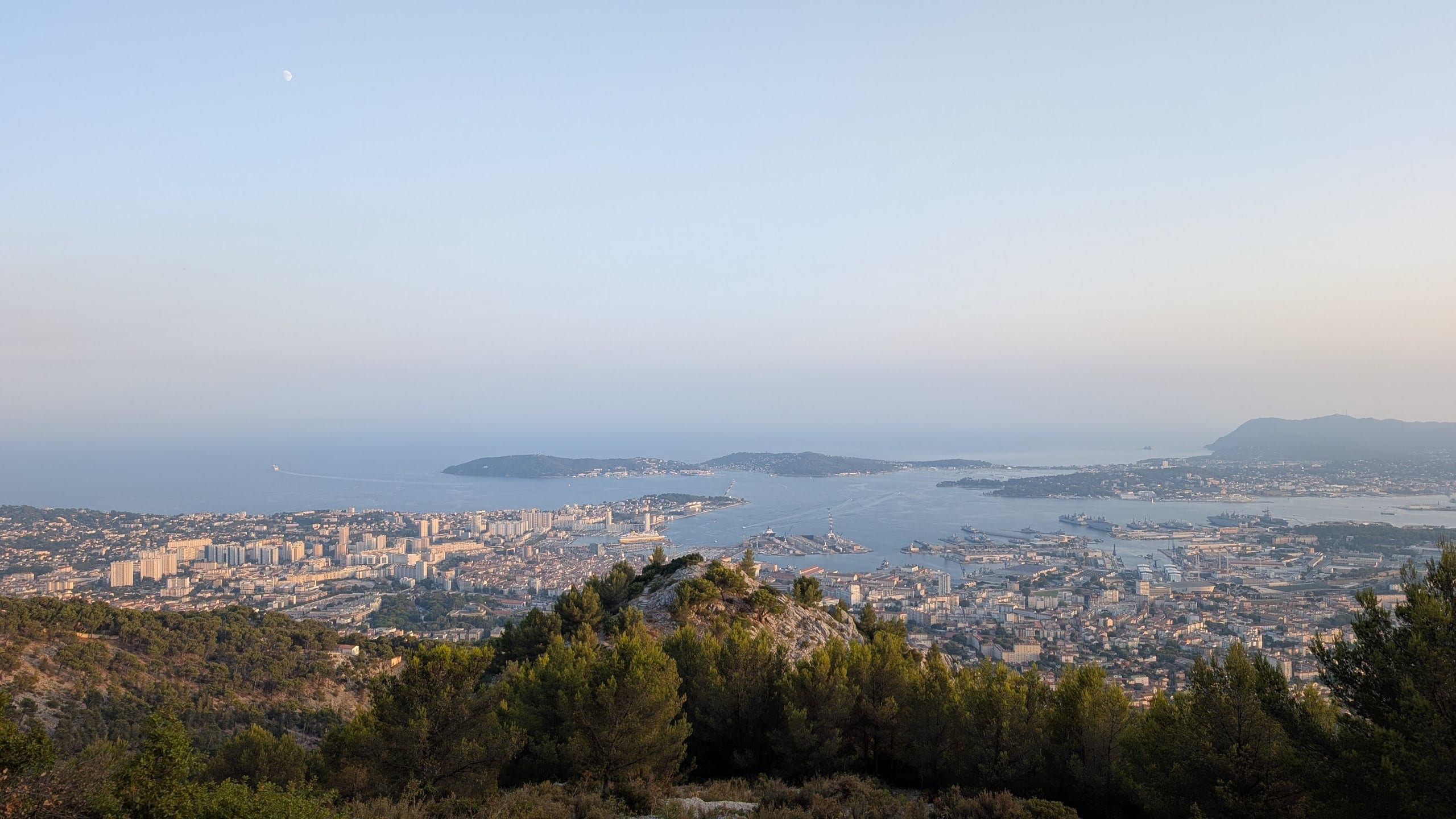
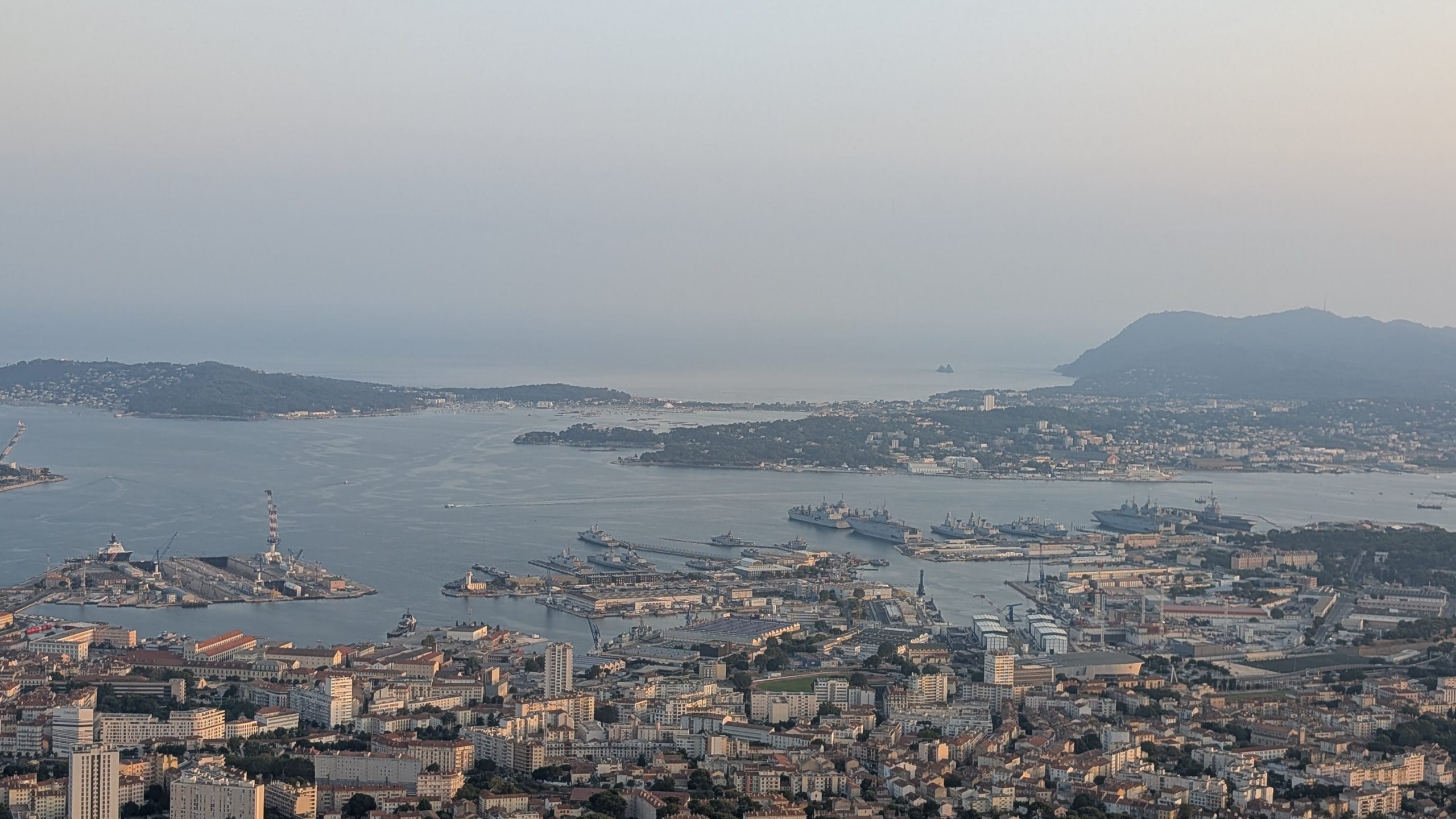
Grey hulls. That is the first thing the view from Mont Faron gives you - not the sea, not the roofs, but warships parked in rows along the arsenal quays, nearly 600 metres below and close enough to count.
Toulon is the home port of the French Mediterranean fleet, aircraft carrier included, and a city of about 170,000 people wrapped around one of the largest natural harbours in Europe. The rade is almost a closed lake: hills on three sides, the Saint-Mandrier peninsula and a breakwater sealing the fourth. It is also a city that skips the Riviera polish. An hour up the coast, Marseille is worth the climb at a bigger scale; Toulon keeps the working-port grit and drops the price. The French fleet scuttled itself here in November 1942, Allied bombs finished the waterfront, and the port came back in cheap post-war concrete. That history is why coaches drive straight past toward Saint-Tropez, and why a room here costs roughly half what it does in Nice.
Mont Faron, and the days it's shut
The mountain behind the city tops out at 584 metres, and the cable car from Boulevard Amiral Vence costs €9 ($10) return, €6.50 ($7) one way. It runs daily from 7 February to 28 November, non-stop 10:00-19:45 in July and August, with a lunch break in the shoulder months.
Two things close it. Strong wind, which on this coast means the mistral. And fire risk: when the Var prefecture rates the massif red-severe or extreme, common on hot dry days in high summer, the cable car, the summit road, and the restaurants up there all shut, and cars already at the top are sent back down. The Faron cable car site posts the day's status by 10:00. Check it before you build an afternoon around the view.
Go late if you can. Middle of the day the rade turns into white haze; by seven the light comes in sideways and the ships and the peninsula separate out.
The memorial most visitors have never heard of
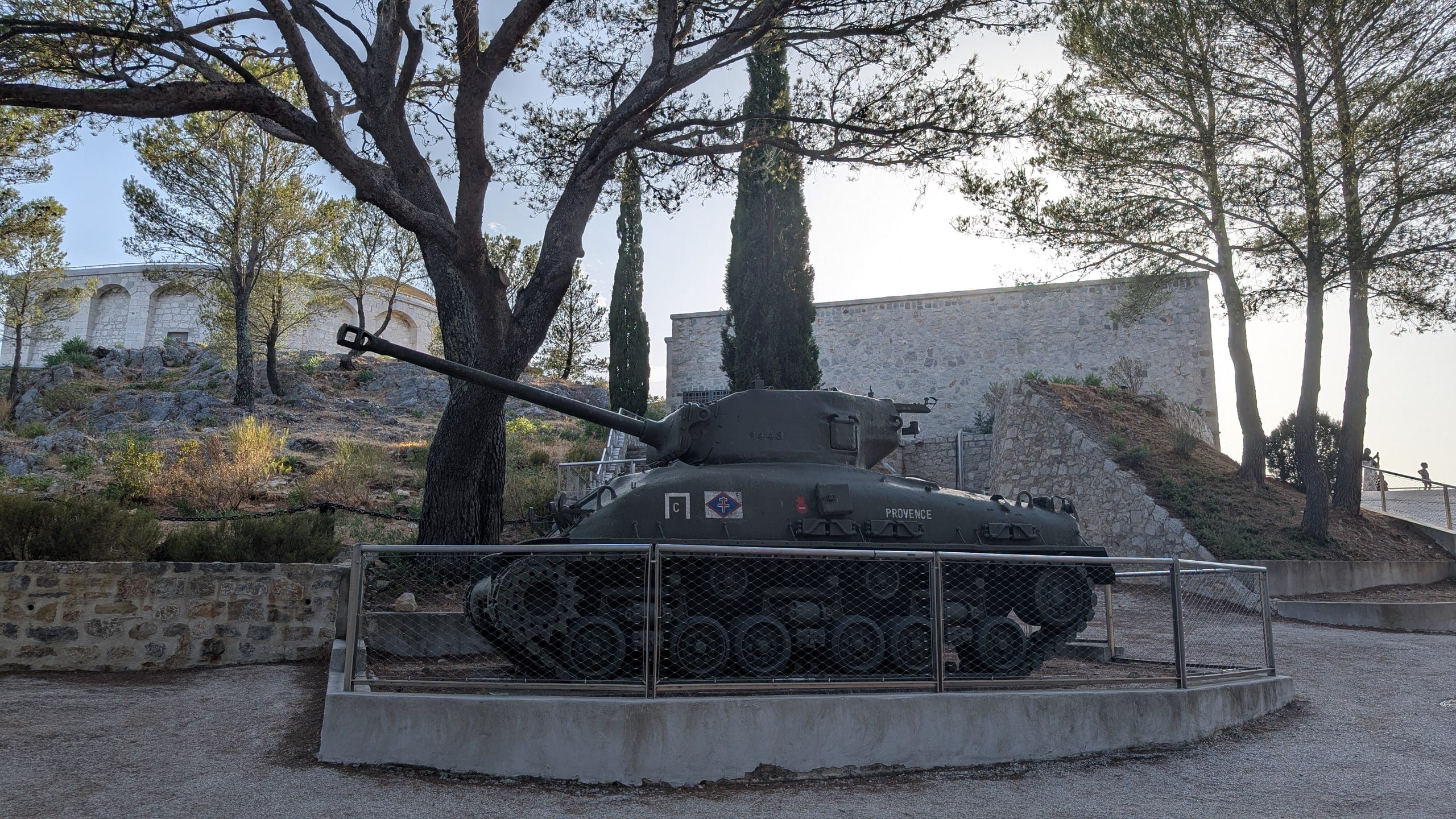
At the top, inside the old Tour Beaumont fort, the Mémorial du Débarquement en Provence covers Operation Dragoon: the 15 August 1944 landings along this coast, the ones nobody outside France remembers next to Normandy. Film, maps, first-hand accounts, and a Sherman named Provence sitting under the pines outside. A combined cable-car-and-memorial ticket runs €14 ($15), and an hour is enough.
The €2 boat that does most of what the €17 tour does
Toulon's best value is a commuter ferry. The Réseau Mistral bateau-bus leaves the Station maritime on quai Cronstadt for La Seyne-sur-Mer (20 minutes), Les Sablettes and Saint-Mandrier (30 minutes), seven days a week, all year, on a flat €2 ($2.20) maritime ticket - the same ticket works on the buses, with an hour of free transfers.
You get the rade at deck level: the naval basin, the forts, mussel frames in the Lazaret bay, and Toulon shrinking behind you against the mountain. The alternative is Les Bateliers de la Rade from quai de la Sinse, €17 ($19) for an hour with commentary, which gets closer to the arsenal and tells you which ship is which. Worth it if the Charles de Gaulle is alongside. Not worth it as your only trip across the water.
The best hour in Toulon costs two euros and leaves every twenty minutes.
Cours Lafayette is a morning market
The market runs a kilometre under plane trees, Tuesday to Sunday, 07:30-12:30, closed Monday, with a separate non-food market in the afternoons. Come before eleven or you are buying leftovers. Look for cade - a thin chickpea-flour pancake baked in wide pans and sold in wedges, Toulon's version of what Nice calls socca, and about $3 a piece.
Around it, the old town has been pedestrianised and scrubbed up: Place Puget with its dolphin fountain under a beard of moss, narrow streets of ochre plaster, small bars that fill at seven. Be honest with yourself about the rest of it. There are still shuttered shopfronts, tagged walls, and blocks north of the market that feel bleak after dark. This is a port city with an unfinished renovation, not a Provençal hill village.
Where to actually swim
Le Mourillon, twenty minutes on foot east of the port, is where the city swims: four man-made beaches with imported sand, free, shallow, and loud with families in August, with Fort Saint-Louis on the point.
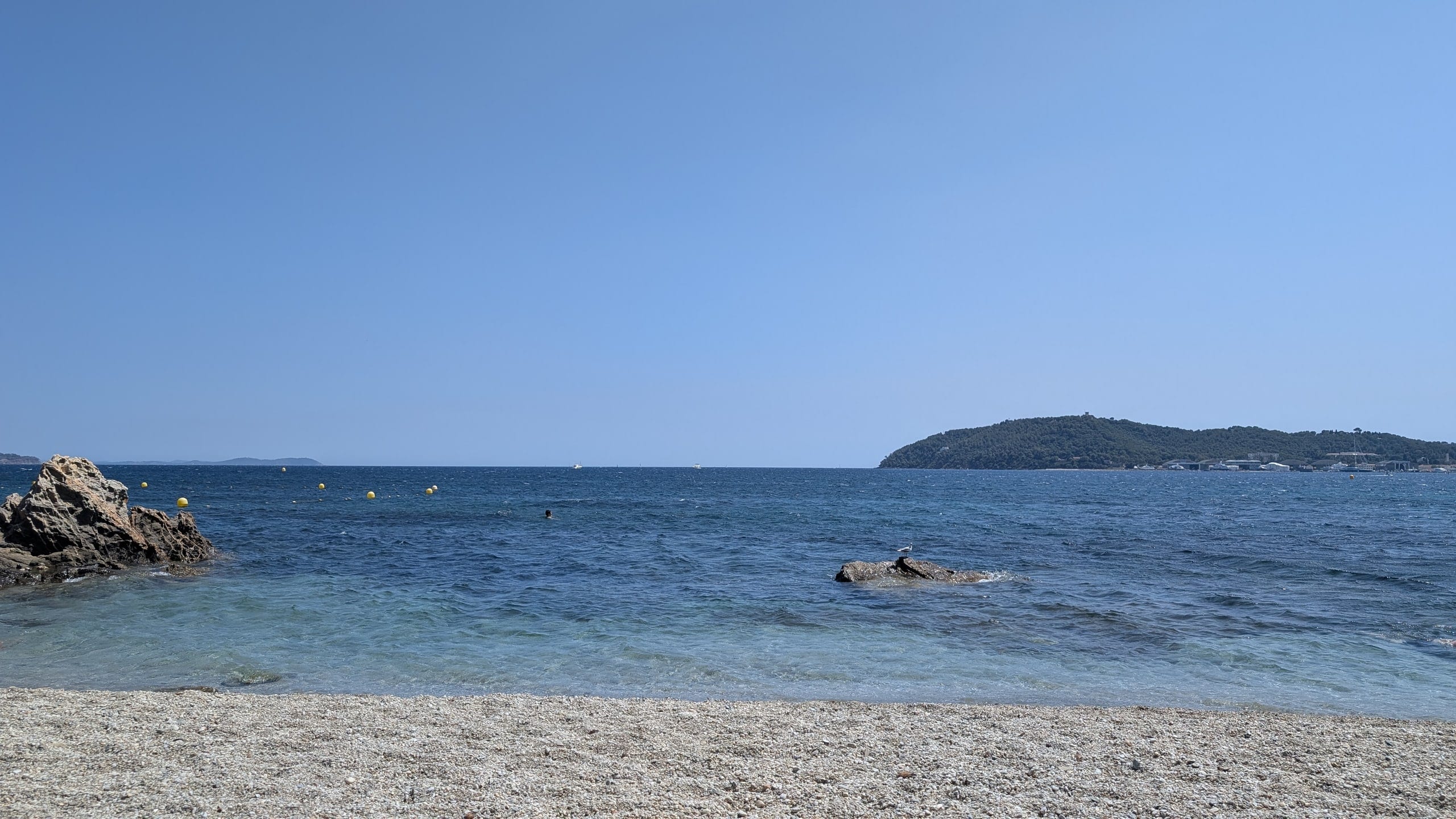
Better water sits just past them. Steep steps drop from the Cap Brun clifftops into Anse Méjean and Anse Magaud, small shingle coves with no facilities and nothing to do but get in. The coastal path between them makes an easy hour. When the mistral is up the sea turns cold and choppy, so check the wind the night before. For Mediterranean coves away from the loud resorts, northwest Mallorca is a different kind of trip.
What it costs
- Double room near the port: $90-150 in July, $70-110 in the shoulder months
- Lunch plate: $18-28. Dinner with wine, $35-50 a head
- Cable car return: $10. Memorial combined ticket, $15
- Bateau-bus single: $2.20. Rade tour, $19
- Train to Marseille: about $12, under an hour; Paris is four hours by TGV
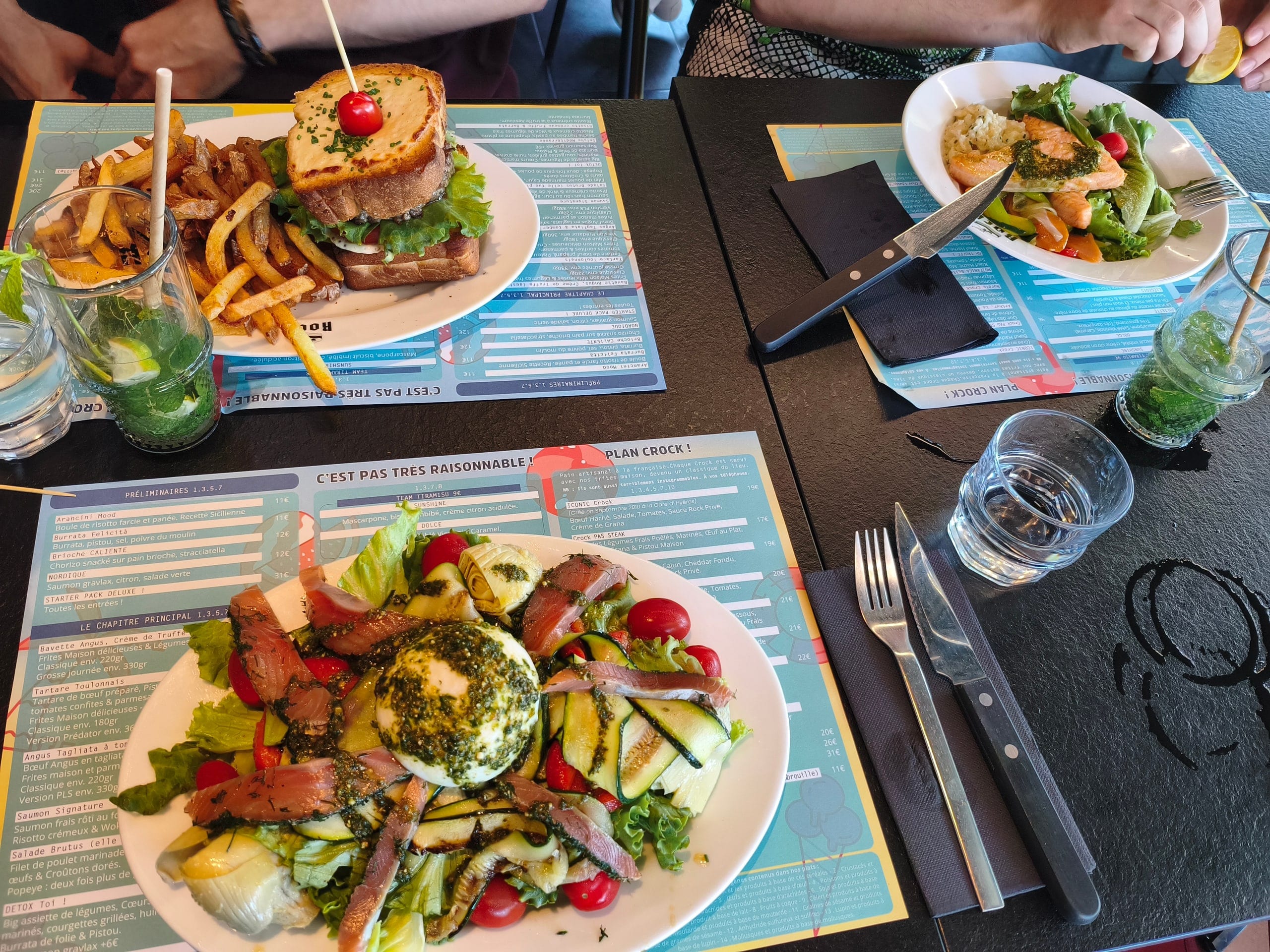
Food is the weak link. The quai Cronstadt terraces are priced for people who will not come back, and a lot of what looks Provençal arrives from a freezer. Eat where the market is, or east in Le Mourillon.
How long, and who should skip it
Three days is the right number. One for the mountain, the memorial, and the market. One for the water: Mourillon, the coves under Cap Brun, a crossing of the rade in the evening. One to leave town, either on the boat to Porquerolles and its bike tracks or up the coast to Sanary and Bandol. If a home game lands on your weekend, spend that third day at Stade Mayol instead, where the rugby club owns the city's mood.
Skip Toulon if you want lavender, hill towns, and a pretty old quarter - Provence has those an hour inland. Come if you like ports that still work for a living, prices that have not been inflated for tourists, and a view that includes a navy. For a northern harbour that also earns nights beyond the postcard strip, see Bergen.