Berghain opens around midnight on Saturday and stops letting people in sometime on Monday. People walk out into Sunday afternoon daylight, buy a coffee, and go home to bed. Berlin runs a weekend as one long event, and that changes how you plan the rest of the trip.
The city is flat, low, and far bigger than a metro map suggests: 891 square kilometres for 3.9 million people, roughly eight times the size of central Paris. Whole blocks are still gaps where buildings were bombed, divided, then never replaced. That empty space is why the clubs exist. Berlin does not tidy itself up for visitors, and Marseille has the same habit.
Berlin is huge, so learn the S-Bahn first
Distances defeat people who planned a walking trip: Mitte to Friedrichshain is 5 km. The U-Bahn and S-Bahn cover almost everything and run all night on Friday and Saturday. A single AB ticket costs about $4.35, a day pass about $12.20. App tickets are valid the moment you buy them; a paper one has to be stamped on the platform before you board. Inspectors are frequent and in plain clothes, and the penalty is a flat $65.
The Wall: East Side Gallery first, Bernauer Strasse for the rest
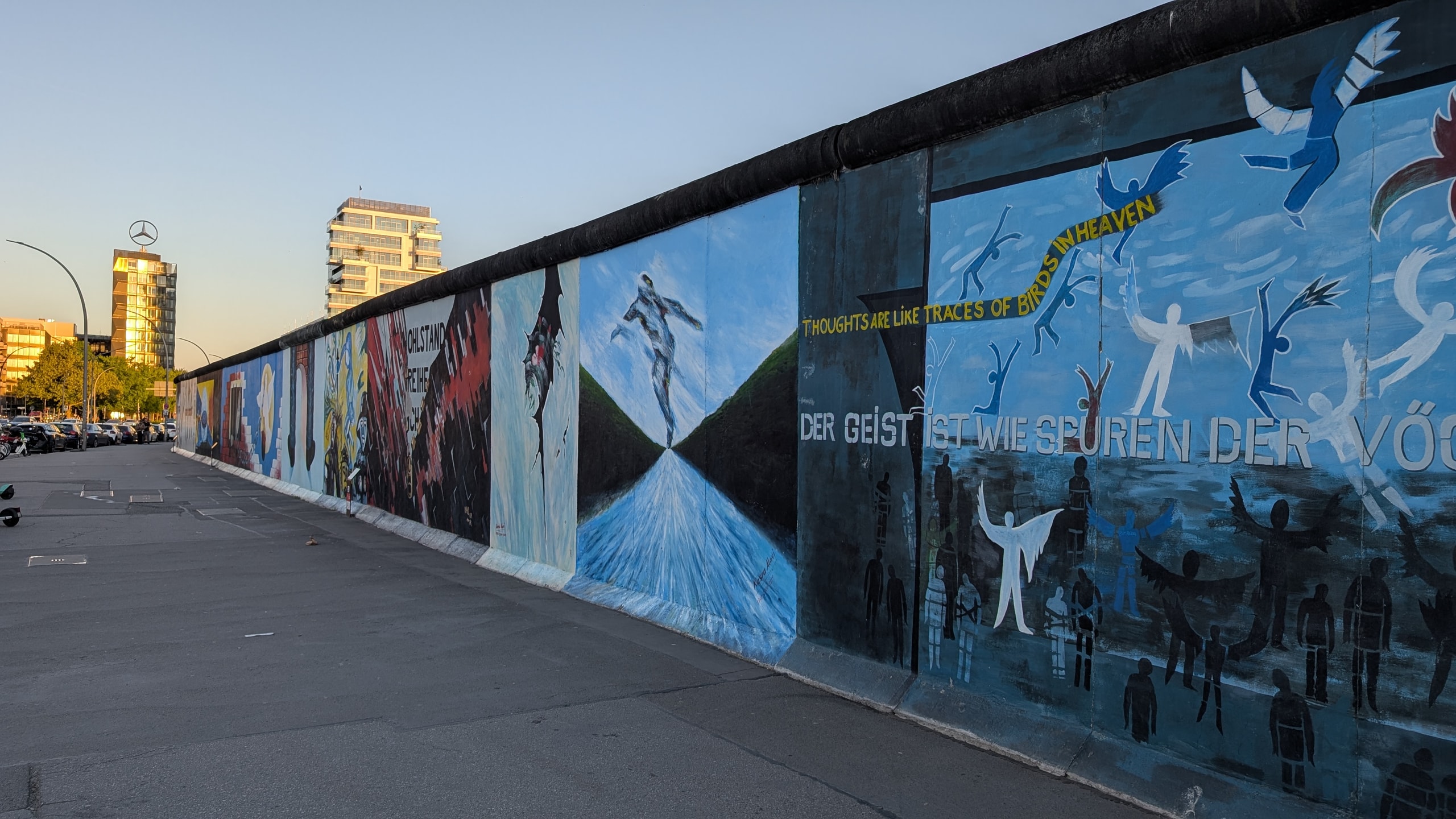
The East Side Gallery is 1.3 km of original wall on Mühlenstrasse, beside the Spree in Friedrichshain, painted by 118 artists in the spring of 1990. Free, always open, packed from mid-morning until sunset. Come at eight in the morning or in the last hour of light, when the concrete goes warm and the murals stop competing with the backs of people's heads.
What it cannot show you is how the border actually worked. For that, take the S-Bahn 20 minutes north to the Berlin Wall Memorial on Bernauer Strasse, where a full stretch survives: the outer wall, the inner wall, and the sand strip between them that guards raked flat so footprints would show. Climb the tower at the documentation centre and you look down into it. The grounds are free and open 8am to 10pm; the indoor centres shut on Mondays. Give it 90 minutes.
Do those two and skip the wall fragments dotted around the city; they add nothing after Bernauer Strasse.
One walk through Mitte, in the order that works
Almost every famous building in Berlin sits along a 4 km line, so walking them in one go beats four separate trips. The route is flat. In Lisbon the same list would cost you four staircases.
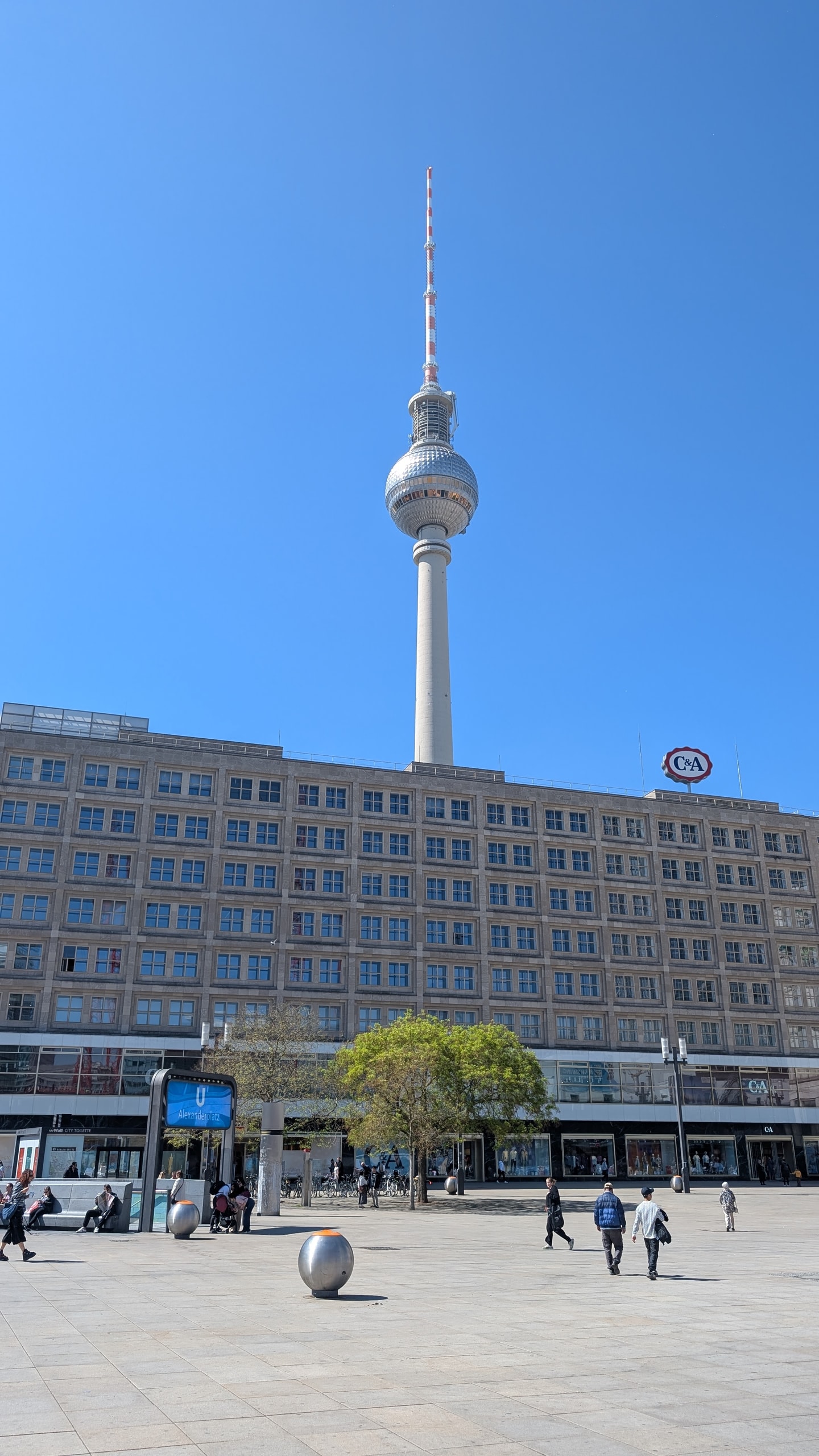
Start at Alexanderplatz under the Fernsehturm and cross onto Museum Island. Worth knowing first: the Pergamon, the museum most people come for, has been shut since October 2023. The north wing is due back in 2027, the south wing not until 2037.
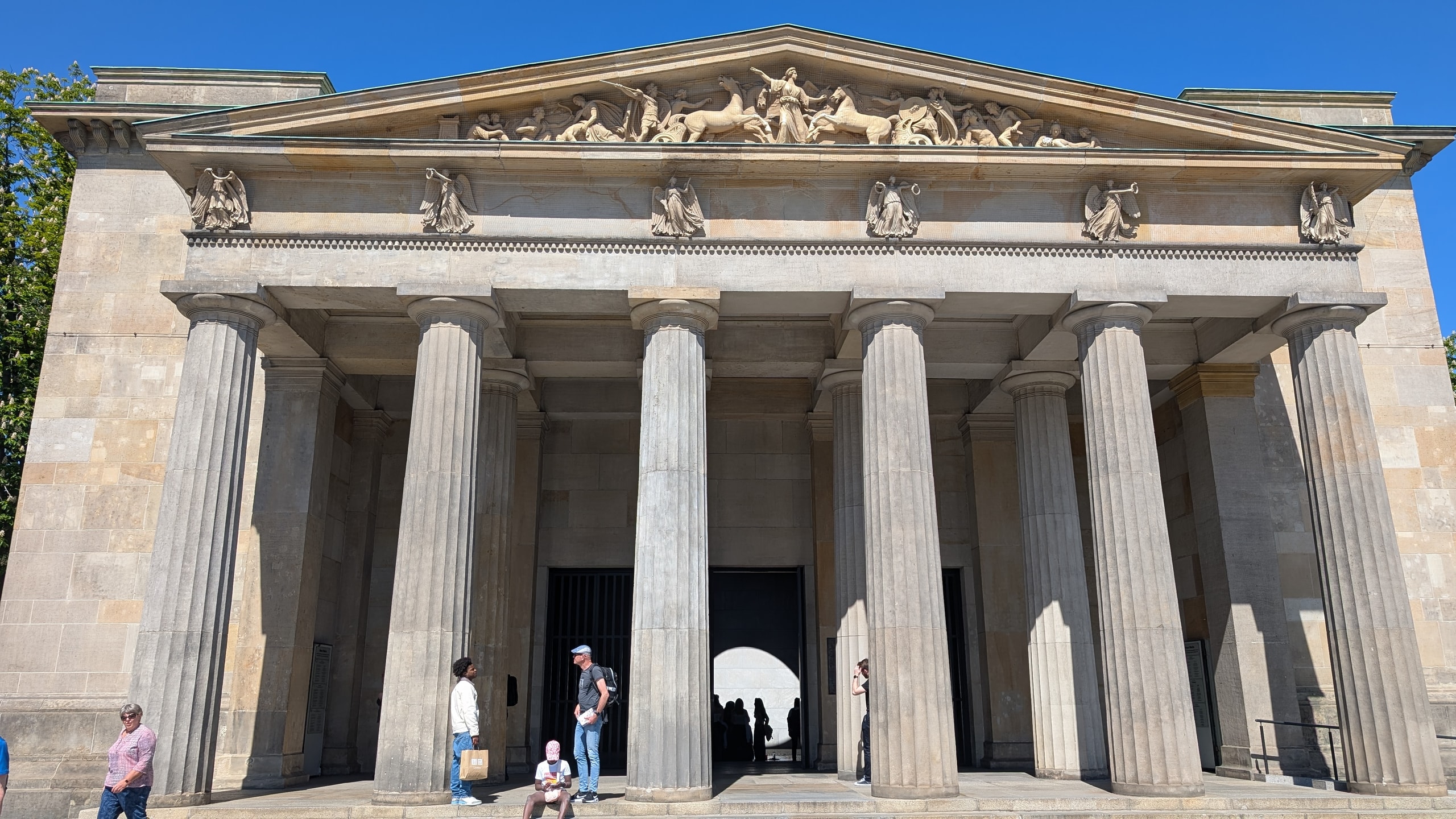
Pick up Unter den Linden. Just past the university is the Neue Wache, Schinkel's squat columned guardhouse from 1816, now Germany's central memorial to the victims of war and tyranny. Inside there is one room and one sculpture, Käthe Kollwitz's mother holding her dead son, under a round hole in the roof that leaves it open to the rain and the snow. Free, two minutes, and the quietest room in the city centre.
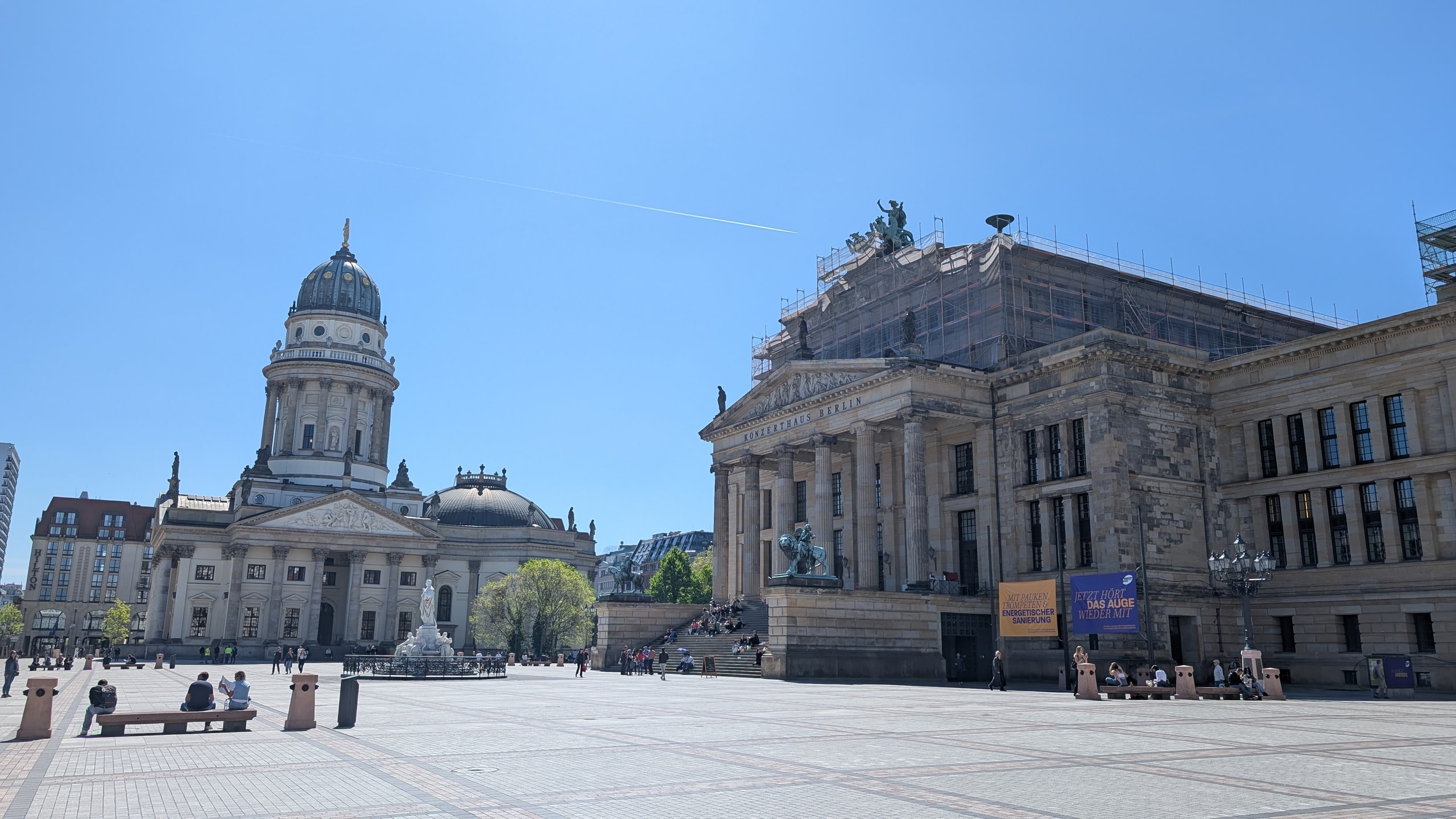
Turn south for Gendarmenmarkt, a square with a domed cathedral at each end and the Konzerthaus between them. The handsomest square in central Berlin, and something on it is always under scaffolding.
Checkpoint Charlie is the stop to skip
Checkpoint Charlie is the worst 200 metres in Berlin. The guard hut is a replica, the sandbags are decoration, the real crossing was cleared decades ago, and the block around it has been a building site for years. The private museum next door charges $19 for a cluttered walk through escape stories.
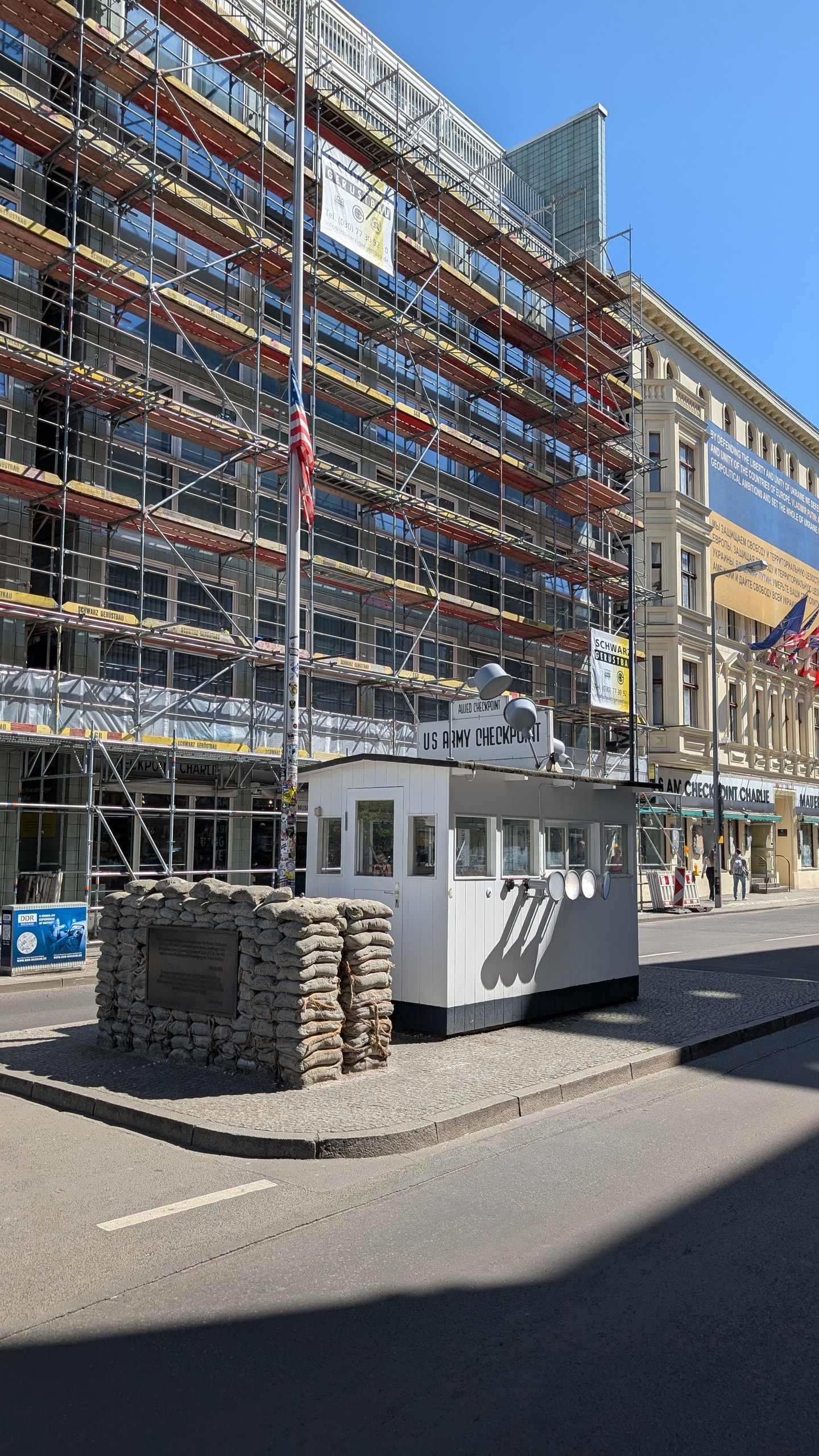
Look for five minutes since it is on the way, then walk eight minutes west to the Topography of Terror, built over the dug-out cellars of the Gestapo headquarters. Free.
The memorial with 2,710 slabs
The Memorial to the Murdered Jews of Europe covers a sloping city block just south of the Brandenburg Gate, opened in 2005 to Peter Eisenman's design. From the pavement it looks like a low grid you could step over. Walk in and the ground drops, the slabs climb past your shoulders, and within half a minute you cannot see anyone or hear a car.
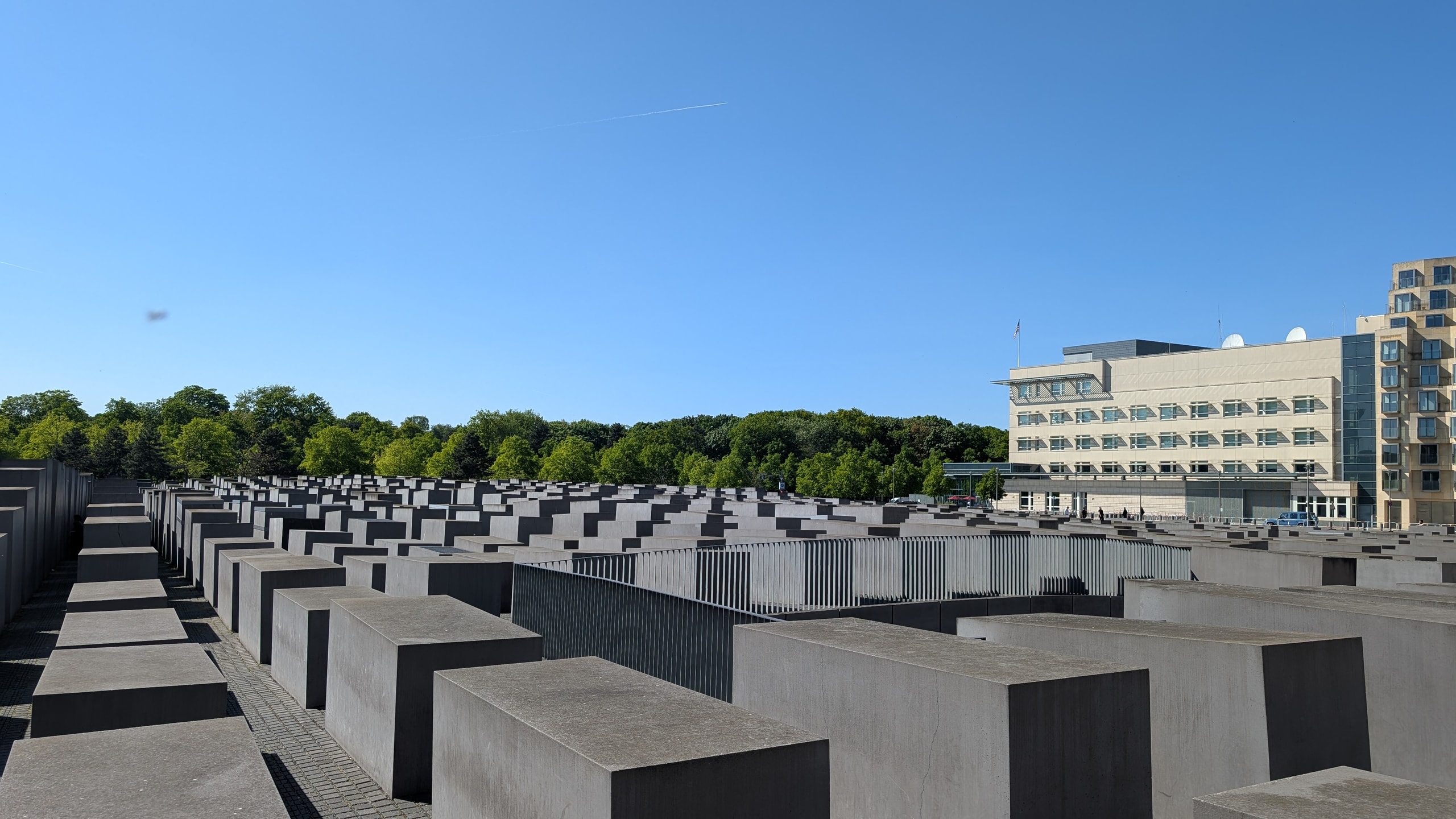
No names, no signs in the field: that is deliberate. The information centre underneath carries the history, is free, and closes on Mondays. People eat lunch on the outer slabs and children run the corridors. Mornings are quieter.
From the north edge the Brandenburg Gate is 300 metres away and the Reichstag a few hundred past that. The glass dome on the roof is free, but you must register online in advance and bring the exact passport or ID you booked with. Slots open three months out and summer dates go fast.
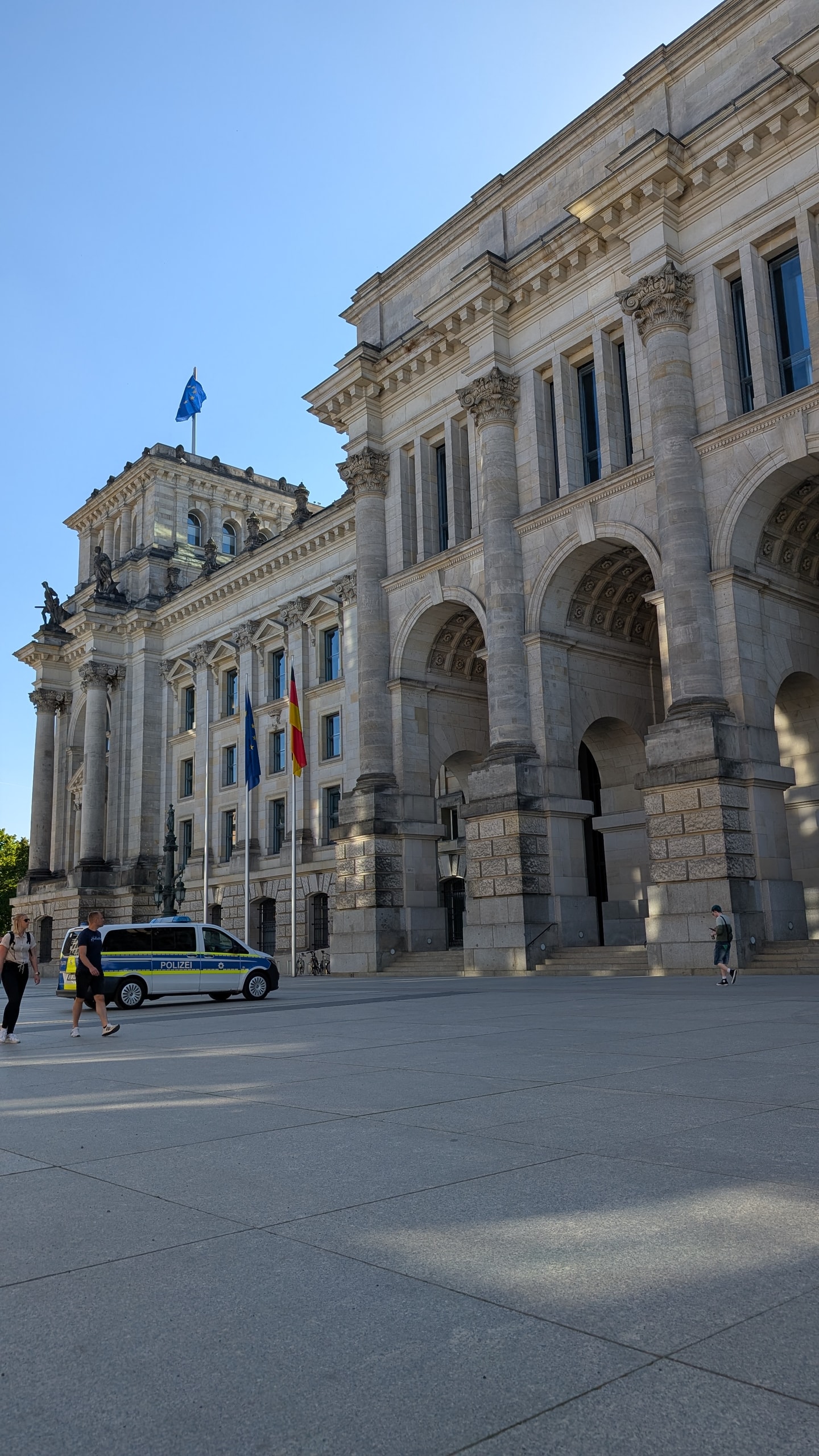
Forgot? The visitors' centre beside the building sometimes has same-day places, but ask at least two hours ahead.
Döner, and the rest of dinner
Berlin's döner is cheap and good: $7-8 for a loaded one, from a decent shop on nearly every block. Mustafa's Gemüse Kebap near Mehringdamm has an hour-long queue and is not an hour better than the shop beside your hotel. Currywurst is a snack rather than a meal, and $4-5 buys the whole experience.
The better eating is Turkish and Vietnamese, and Kreuzberg and Neukölln have both in volume. The Maybachufer market on the canal runs Tuesday and Friday for bread, cheese, and produce at market prices. Book nothing: Berlin is a walk-in city.
The clubs, and how the door actually works
There are no club photographs in this article because there are almost none anywhere. At Berghain a doorman seals both camera lenses on your phone before you climb the stairs, and peeling it off gets you removed. That one rule is why the rooms feel the way they do: nobody inside is performing for anyone.
Berlin techno went onto Germany's register of intangible cultural heritage in March 2024, credited to the empty buildings reunification left behind. The scene keeps losing rooms to rent and redevelopment; Watergate closed at the end of 2024 after 22 years.
Where to go, from the easiest door to the hardest:
- Tresor, Mitte. Berlin's first techno club, running since 1991 and in a disused power station since 2007. Take the long tunnel down to the basement floor.
- OST, Friedrichshain. A converted industrial building on the Stralau waterfront by Ostkreuz, all narrow corridors and stairwells. Queer-friendly, and rarely a fight to get in.
- KitKatClub, Mitte. A few doors from Tresor, and as much fetish club as techno club since 1994. The dress code is the door: latex, leather, or very little. Jeans and trainers get turned away.
- Berghain, Friedrichshain. The one people fly in for, in a Cold War power plant, with the hardest door in Europe.
The door is not about money or the right shoes. It is one person deciding whether you will spoil the room for everyone already inside.
Come in twos or threes rather than a group of eight, do not be visibly drunk, and do not film in the queue. English is fine, and outside KitKat nobody cares what you wear as long as your group is not in matching shirts. Bring cash; entry runs $20-30. Then pick an odd hour: four on Sunday morning gets you in far more easily than one on Saturday, and the music is better by then anyway.
Where to drink when you are not queueing
Most nights out here never involve a club door. The cheap version is a Späti, a corner shop selling cold beer at about $2 a bottle until late, with crates outside to sit on. Drinking on the street is legal in Germany. Drinking on the train is not: open drinks are banned on board, and Deutsche Bahn now bans alcohol in its stations too, which covers the S-Bahn platforms.
The bridge at the east end of the East Side Gallery, the Oberbaumbrücke, looks straight up the Spree into the sunset and costs nothing.
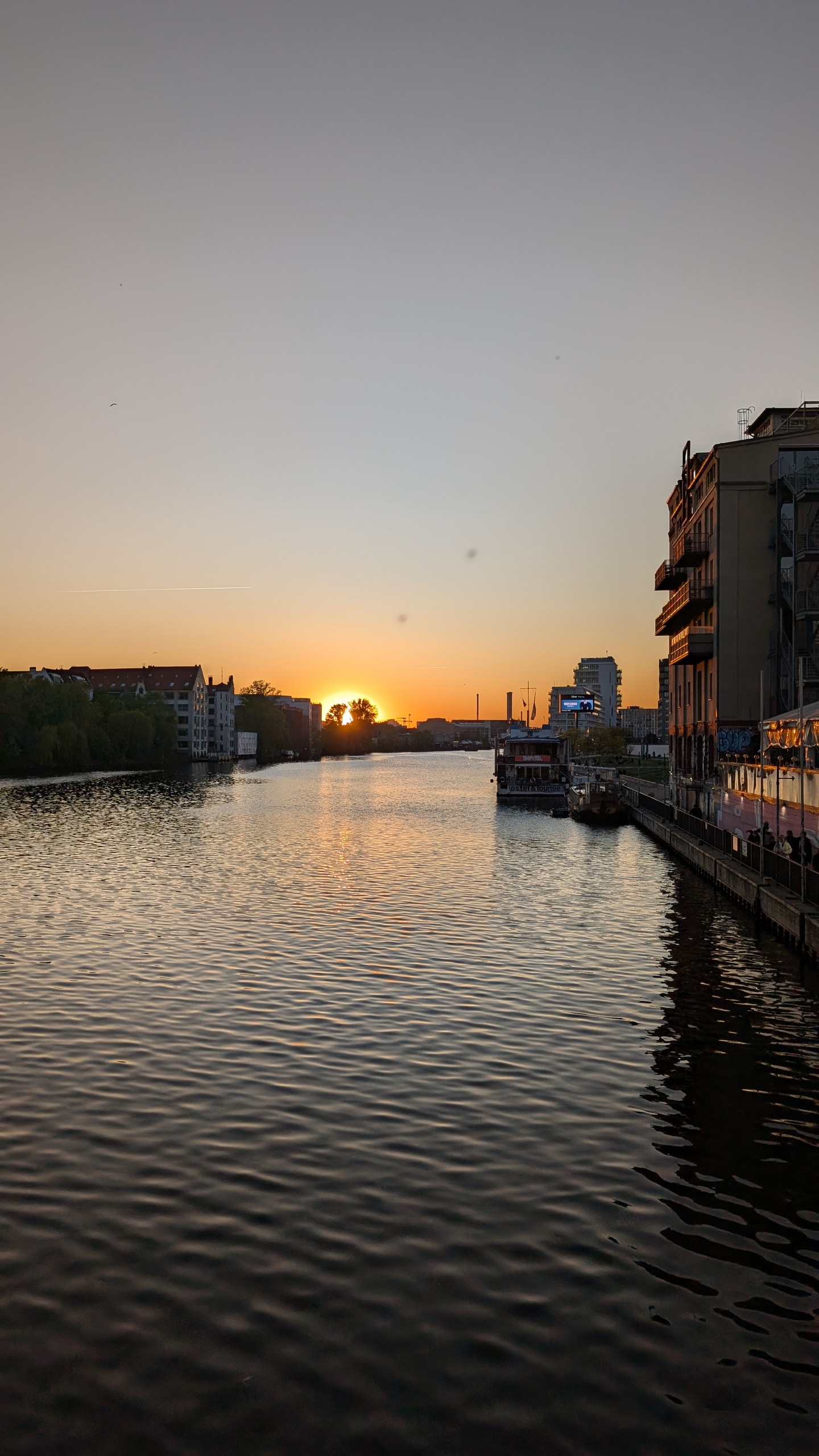
After that: the Landwehr canal in Kreuzberg for beer on the bank, Weserstrasse in Neukölln for bars that close when the staff give up, and the RAW-Gelände for graffiti and volume. Görlitzer Park is the one to avoid after dark. The dealing there is open and pushy, and the city fenced the whole park in 2026 to try to control it.
What a weekend costs, and when to come
Berlin is cheap for a western European capital. A weekend here lands at roughly half what the same one costs in three nights in Oslo.
- Beds $28-45 a hostel dorm, $80-130 a budget double, $130-200 mid-range
- Food $7-8 for a döner, $4-5 for currywurst, $20-35 a head sitting down
- Beer $2 from a Späti, $5-7 in a bar
- Club entry $20-30, cash
- Transport about $12.20 for a day pass
- The best sights free: both Wall memorials, the Holocaust memorial, Topography of Terror, the dome
Come in May, June, or September. Winter is grey and dark by four, and Berlin looks worse in flat light than most cities. July and August work, though queues lengthen and rates climb. Check the trade-fair calendar first; those weeks can double or triple hotel prices.
Two nights is not enough. Three gives you one Mitte day, one Wall day, and one night that finishes whenever it finishes. More cities like that in the destinations archive.